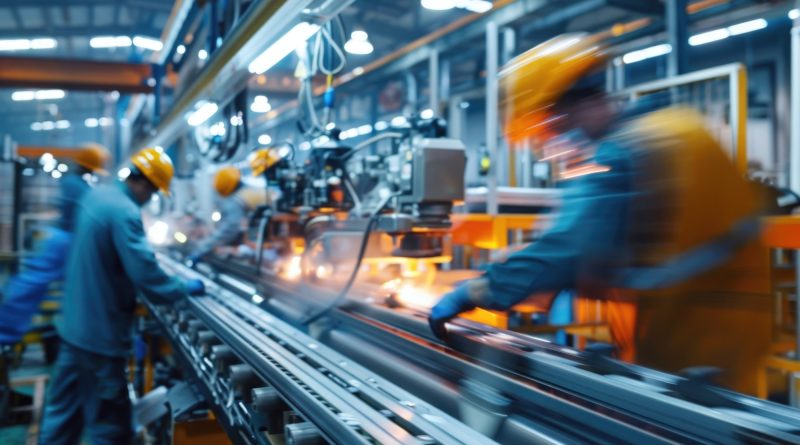
10 signs US manufacturing is in a sustained upturn

US factories have now grown for 10 months in a row. The latest ISM manufacturing report, released Nov. 2, showed the sector growing faster in October than in September. That is a clear change from the long slump that came before it.
But a few good months do not prove a lasting recovery. To judge whether this upturn can hold, it helps to look past the headline number. Here are 10 signals from the latest manufacturing PMI and other official data. Most point to real demand that should last. The final one shows the main risk to watch.
1. The ISM manufacturing PMI has grown for 10 straight months
The Institute for Supply Management (ISM) runs a monthly survey of factory buyers called the Purchasing Managers’ Index (PMI). A reading above 50 means manufacturing is growing. The PMI rose to 55.5 in October, up from 54.5 in September. Economists polled by Reuters had expected no change. October was the 10th month in a row above 50, after 10 months of decline. A run this long points to steady growth, not a one-off bounce.
2. New orders keep coming in
New orders are the best early guide to future output, because today’s orders become next month’s work. ISM’s New Orders index was 55.5 in October, up slightly from 55.3. It has now shown growth for 10 months. Export orders grew too, with that index at 51.2. Demand at home is strong as well. Reuters reports that US domestic demand grew at its fastest pace in more than 5 years in the third quarter. Steady orders give plant managers the confidence to plan shifts, buy materials, and invest in equipment.
3. Factory output is rising faster
ISM’s Production index jumped to 59.0 in October, from 56.7 in September. That is well above the 50 mark, and output has now grown for 12 months straight. ISM’s Inventories index also moved back into growth, at 51.4, as plants built up their stock of materials. Higher output is the clearest proof that orders are turning into real work on the factory floor. For suppliers, it usually means more demand for parts, materials, and services.
4. Growth is spread across most industries
A recovery is stronger when many industries share in it. In October, 12 of the 18 industries in the ISM survey reported growth. Of the 6 largest, 5 expanded, including machinery, transportation equipment, and chemical products. Only 3 industries shrank, namely printing, paper products, and nonmetallic mineral products. ISM estimates that only about 6% of the sector’s output, measured by its share of GDP, was shrinking in October. This matters because an upturn led by one sector can fade fast if that sector slows.
5. Order backlogs and low customer stock point to more work ahead
ISM also tracks 2 less-watched measures that support the outlook. The Backlog of Orders index, which tracks work not yet finished, was 54.6 and has grown for 10 months. ISM’s Customers’ Inventories index was 41.6. That means survey respondents see their customers’ stock as too low, as they have for 25 months. When customers run low, they usually need to reorder, which points to more orders ahead. Suppliers are busy too. ISM’s Supplier Deliveries index was 59.1, which signals slower deliveries, a common sign of strong demand.
6. Factories are adding jobs again
Hiring shows that companies expect demand to last. According to the US Bureau of Labor Statistics, manufacturing jobs rose by 19,000 in October. Factories have added 101,000 jobs since a low in December 2025. The biggest gains came in computer and electronic products, machinery, and primary metals. Siemens is adding 1,500 US manufacturing jobs to meet data center demand. One caution is that ISM’s Employment index slowed slightly, to 52.4 from 52.7.
7. A second survey tells the same story
ISM is not the only survey showing growth. S&P Global’s US Manufacturing PMI, which polls a different group of firms, was 54.9 in October. That was down from 55.9 in September, but still the third-highest reading since May 2022. S&P Global says factories are sustaining their best growth spell since early 2022. Hiring in its survey grew at the fastest pace since April 2021. When 2 surveys agree, the signal is more reliable.
8. Businesses are ordering more equipment
Orders for durable goods, items built to last 3 years or more, show whether companies are investing. The US Census Bureau says these orders rose 1.8% in September and have risen in 6 of the last 7 months. Core capital goods orders leave out aircraft and defense, and are a common guide to business investment. According to KPMG, they were 13.5% higher than a year earlier. That suggests firms are spending on machinery and equipment.
9. AI and data center spending is driving new demand
Much of the new demand comes from the build-out of artificial intelligence (AI). Reuters reports that strong consumer spending and business spending on AI are driving factory activity. In the ISM survey, a machinery respondent said business remains strong, driven by data centers and other vital infrastructure. Data centers need large amounts of electrical, cooling, and power equipment. Siemens is one company that sees AI and infrastructure driving a US factory revival.
10. Rising costs are the main test for the upturn
Not every signal is positive. ISM’s Prices index was 75.2 in October, down from 77.9 but still high. Input prices have now risen for 25 months in a row, a pressure that has shaped the data all year. About 66% of survey comments were negative, often citing price swings, longer lead times, tariffs, and the Iran war. Susan Spence, Chair of the ISM Manufacturing Business Survey Committee, noted that overall sentiment has weakened for 3 months running.
Taken together, these signals point to an upturn built on real demand, not a short-term bounce. Orders, output, hiring, and investment are all moving the same way. The bigger question is whether factories can keep growing while costs stay high. Economists polled by Reuters expect the Federal Reserve to raise interest rates in December, which would make borrowing more expensive. The next ISM manufacturing report, due in early December, will show whether costs are starting to weigh on new orders.