
5 reasons manufacturers choose Evocon over manual OEE tracking

Digital transformation is the focus area for many heavy industries, turning data collection into more effective decision-making. This strategy is especially prevalent in manufacturing, where operators are pushing a transition from historically manual operations to ones that leverage technology to improve productivity.
Manufacturers are generating more data than ever as factory operations expand across multiple departments and facilities. ERP platforms can also bring production, maintenance, inventory, workforce and financial data together, giving manufacturers a clearer view across the entire business. However, many are still facing challenges in turning that data into actionable insights that can help improve productivity, and ultimately, profitability.
Manual overall equipment efficiency (OEE) tracking has become a considerable roadblock to manufacturers’ ability to grow. As a result, managers and supervisors are turning to solutions like Evocon to enhance production capabilities.
What is Evocon?
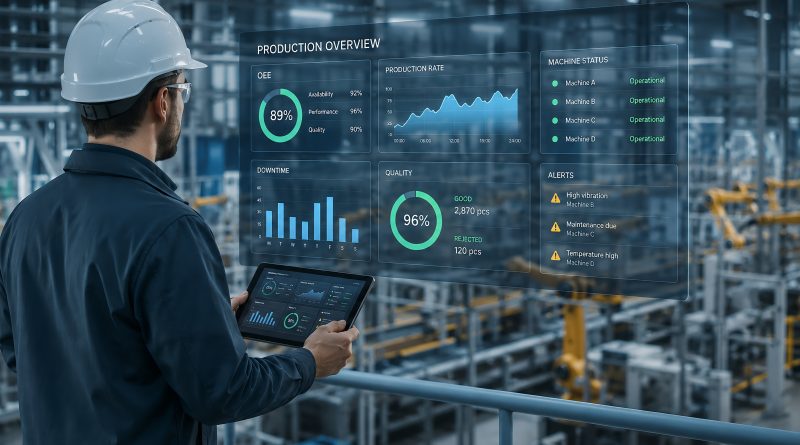
Evocon is a digital OEE platform that helps manufacturers automatically collect production data and transform performance metrics into meaningful insights. The software processes data from equipment sensors and presents it on a clear dashboard, helping improve decision-making, minimise downtime and reduce waste.
The platform aims to solve production gaps created by traditionally manual OEE tracking by automating processes and analysing significant amounts of data to support business targets. Evocon was designed to unlock business potential for manufacturers facing more globally recognised challenges, which is one reason factories in over 65 countries have implemented the software.
5 reasons why manufacturers prefer Evocon over manual OEE tracking
As manufacturing operations become increasingly complex relative to available resources, digital platforms have become a necessity to hit production quotas and growth targets. OEE tracking needs to be more proactive rather than the traditionally reactive approach using manually recorded OEE data.
Here are five reasons why manufacturers prefer Evocon over manual OEE tracking:
1. Reducing error and waste
Like any manual task, manual data processing is subject to human error. However, inaccuracies in manufacturing can have a considerable impact on business viability, with errors and waste having far-reaching effects on product quality and operating costs.
Studies have shown that replacing paper-based tracking with digital solutions can enhance OEE by 35%, reducing errors and, subsequently, waste. Evocon’s automated data collection helps eliminate memory gaps, subjective error logging and missing shift data.
2. Actionable insights through real-time data
One of the most pressing gaps in production lines is the capability to make more informed decisions based on available data. Traditionally, factory managers and supervisors have relied on historical information to drive decisions on production performance and equipment efficiency.
However, manually recorded historical data may not paint the complete picture of issues affecting OEE. Evocon offers managers and supervisors a dashboard presenting real-time data and actionable insights that deliver faster, more accurate decisions towards productivity.
3. Time and cost savings
Recent research has concluded that manual OEE tracking can significantly increase production time and costs, as it is a particularly labour-intensive task. The Industrial and Engineering Operations Management (IEOM) Society published that adopting paperless systems can save a daily average of nearly 22 minutes of downtime, over $4,000 per order and 285 papers, improving operational efficiency and environmental sustainability.
Evocon’s OEE platform is designed to address downtime, errors and their consequential costs directly. Various equipment sensors feed into a comprehensive, intuitive dashboard, giving managers the visibility they need to identify root causes faster and reduce unnecessary financial burdens.
4. Improving quality and reliability
Unplanned stoppages can impact product quality, as restarting production machines often results in “restart scrap,” compromising a batch of product while equipment temperatures and speeds restabilise. Frequent micro-stops often cause complete machine shutdowns. Many are unnoticeable to the human eye and therefore not recorded manually.
Today, equipment reliability has become a crucial part of manufacturing operations. Evocon’s real-time performance dashboard helps managers and supervisors better understand when micro-stops are occurring so they can take corrective action. Reduced downtime means fewer restarts, leading to better overall product quality.
5. Enhanced production visibility
Digital OEE platforms can provide more comprehensive visibility into factory operations than manual tracking. The speed, accuracy and logging capabilities of software such as Evocon provide broader insights into the production line, enabling greater scalability and flexibility for an ever-evolving manufacturing industry.
Being able to adapt to demand and continuously improve operations offers a significant competitive advantage for manufacturing businesses. Access to deep, real-time OEE data can help you act quickly and tweak production strategies to match market demands.
Digital OEE solutions empowering factory performance
Unplanned downtime will always be unavoidable in manufacturing operations. However, where manual OEE tracking can cause an average of 20 hours a week in maintenance, solutions that more effectively pinpoint the causes of downtime to enable preventive maintenance will be preferred.
Evocon is designed to bolster manufacturing resilience and help businesses grow in the right direction. The software can deliver the scalable digital transformation the industry needs for continuous improvement amid a volatile operating environment.

*Please note that this list includes sponsored content. Some of the companies, products, or services featured have entered into commercial agreements for placement. Sponsored placements do not necessarily reflect an endorsement and should be considered alongside other options in the marketplace.