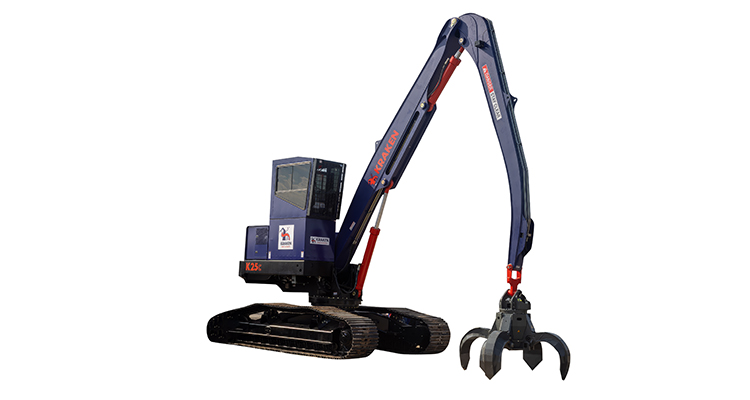
After building a name in forestry, Barko Hydraulics is entering new markets with innovative machinery

Since 1963, Barko Hydraulics (Barko) has been synonymous with rugged, reliable forestry equipment. Now, more than 60 years after developing the industry’s first hydraulically powered knuckle boom log loader, the company is channeling the same engineering DNA into an entirely new zone – demonstrating that even the most established manufacturers can still find fresh ground to break.
Starting as a family-held company, Barko’s pioneering breakthrough as the first company to develop the hydraulically powered knuckle boom log loader was achieved in Duluth, Minnesota. What began as a single innovation soon blossomed into a full product line and, as demand grew throughout the 1970s, Barko relocated to a larger manufacturing facility in Superior, Wisconsin.
“The product line grew organically as we shifted further into the forestry market,” begins Justin Rupar, President of Barko. Back-of-cab loaders gave way to merchandising loaders, and through acquisition and product development, the company expanded into harvesters, wheeled feller bunchers, and vegetation management equipment.
A pivotal moment came in 1987, when Barko was acquired by Heico Companies; a diversified Chicago-based industrial holding group. “That presented us with a fantastic opportunity to grow and expand our reach even more,” Rupar continues – and today, Barko equipment operates in forestry markets around the world, with its core expertise remaining rooted in timber harvesting and processing. “We take timber from the stump to the mill,” he explains. The current product range includes utility loaders, merchandising loaders, purpose-built grapples, self-processing harvesters, wheeled feller bunchers, and industrial wheel tractors, the majority of which are fitted with mulching attachments for land clearing and vegetation management around power lines and construction sites.
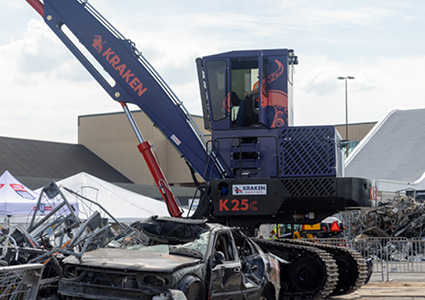
After building a comprehensive offering over several decades, Barko is certainly not resting on that legacy. The company has recently turned its engineering expertise toward an ambitious new venture – an idea that sparked four years ago, when its leadership posed the question: what other industries could Barko’s machines serve? The answer led to the creation of Kraken Machines; a new brand extending Barko’s technology beyond forestry into scrap and recycling, construction, and disaster mitigation work such as hurricane and wildfire cleanup.
“We realized that we weren’t participating in any of these more industrial industries,” reveals Rupar. While Kraken Machines’ base models share visual DNA with Barko’s merchandising and utility loaders, targeted revisions and configurations adapt them for entirely different working environments. Crucially, Barko also recognized that entering new markets meant building new relationships from the ground up. “We’re currently developing a new dealer network focused on these other industries, rather than forestry,” Rupar notes. The strategy is already proving beneficial, with the company unveiling its latest Kraken Machines model – mounted on a wheeled undercarriage – at a scrap industry expo in Louisville, Kentucky.
However, that diversification wasn’t purely a leap of faith, as Rupar elaborates: “We have a very methodical strategic plan process that we work through. We continuously strive to keep Barko stabilized, and ensure the company is still around to serve future generations within these industries.” Extensive market and competitive research revealed an underserved niche: smaller scrap yards priced out of the oversized machines dominating the market. “We saw an opportunity to introduce a smaller machine into the markets,” he tells us – a machine that smaller operators could put to work immediately.
Whether refining its own forestry line or developing Kraken Machines, customer feedback drives every business decision. Engineers, sales teams, and product managers are sent directly into the field to interview operators and dealers. “We receive direct feedback from the people that are participating in these markets – people that use them every day,” highlights Rupar. This feedback shapes everything from boom configurations to operator comfort; an increasingly important consideration given that operators can spend between eight and 12 hours in the cab daily.
Looking toward 2027, Barko has two fundamental priorities: expanding the Kraken Machines product range to meet varied capacity needs, and pursuing nonstop manufacturing improvement to boost reliability, quality and affordability. “If customers are able to use our machines, the machines stay up and running and the clients can make a good living, then that’s going to be better for everybody in the value chain,” Rupar states.
Longer term, dealer network development remains central to Kraken Machines’ five-year vision. As Rupar puts it, selling the machine is “the easy part.” The real challenge – and value – lies in sustained service and parts support that keeps equipment running in punishing conditions – whether that’s a swampy forest floor or a scrap yard strewn with sharp metal. For all its expansion into new markets, Barko’s identity remains anchored in the values that built the business. “We’re a customer-focused and network-focused company,” Rupar reflects conclusively. “We’re here to serve the market, and we never lose sight of that.” Six decades on, the same principle – paired with a willingness to establish new ground – looks set to define Barko’s next chapter as much as its first.