
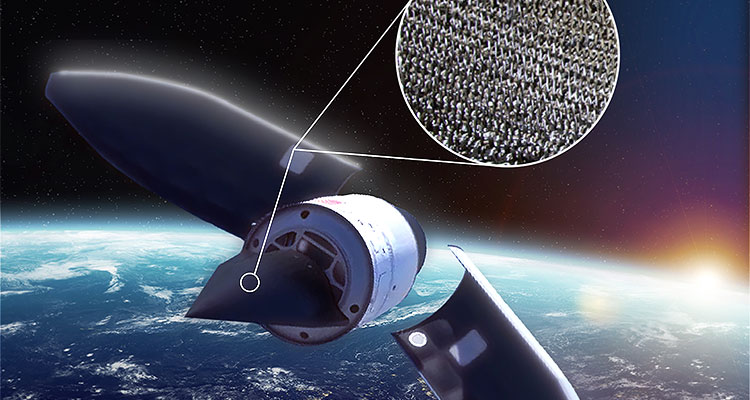
Albany Engineered Composites is combining advanced technologies, manufacturing expertise, and customer partnerships to drive composite innovation forward
Albany Engineering Composites is one of two segments within Albany International Corp; a business founded in 1895 and headquartered in Portsmouth, New Hampshire, with revenues of approximately $1.2 billion in 2025. The other segment, Machine Clothing, specializes in engineered fabrics and process belts for the paper industry and provided the foundation for key technology that defines the composites business today.

“With approximately $475 million in 2025 revenue, Albany is a leading Tier-2 aerospace supplier serving primarily the commercial and defense markets, alongside a smaller industrial presence,” begins Jared Armstrong, Vice President of Global Customers & Marketing. “We specialize exclusively in composite aerostructures and components, with our proprietary 3D-weaving technology and industry-leading Resin Transfer Molding (RTM) experience helping to differentiate us within the market. We also have extensive expertise in traditional hand lay-up, automated lay-up, over braiding, filament winding thermoplastics, autoclave cure, and out-of-autoclave cure methods giving us a broad range of technologies for developing advanced composite solutions.”
Indeed, Albany prides itself on being a solutions provider to its customers, which can take several forms. On build-to-print programs, the team draws heavily on its manufacturing expertise to manage non-recurring engineering, from shop-floor documentation through to tool design and development, ensuring the program is set up for successful production.
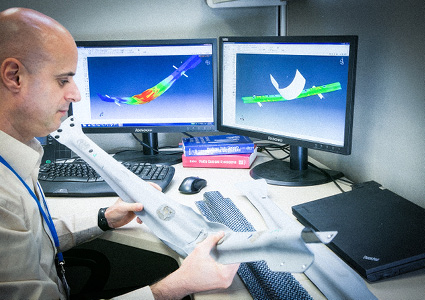
“Where we really add value, however, is when customers are working through challenging composite designs for new products or redesigns,” Jared elaborates. “We use our design-for-manufacturability expertise to help turn those concepts into production-ready designs, working closely with customers through the final design iterations and prototyping stages to ensure everything is properly optimized before entering production.
“We often see customers develop perfectly viable designs with smaller prototype shops, but those designs are not necessarily suited to high-rate manufacturing. That is where we can step in, working alongside the customer to make the necessary changes and ensure the final part is ready for efficient, repeatable production.”
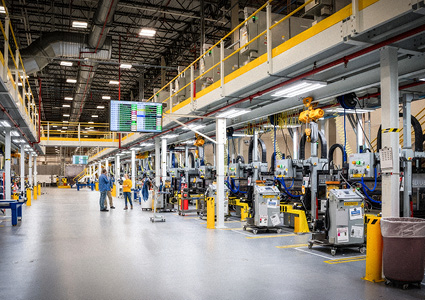
Albany employs approximately 2300 people across 11 facilities in four countries, with a combined footprint of around 1.5 million square feet. Its headquarters are in Rochester, New Hampshire, alongside its Research and Technology Center, which focuses on technology development, and its primary joint-venture facility with its partner Safran. The company also has two sites in Salt Lake City, Utah, and a site in Boerne, Texas.
Beyond the US, Albany operates facilities across Mexico, Germany, and France. In Germany, Albany has two facilities within its campus, including a production site and a second Research and Technology Center. Its joint venture also has facilities in Commercy, France, and Querétaro, Mexico. Albany also operates another stand-alone facility in Querétaro, Mexico, completing its international footprint.
“I think what really sets Albany apart is our approach to working with customers to find solutions to their composite challenges,” Jared shares. “We have deep expertise in state-of-the-art and next-generation technologies, which gives us the capabilities to tackle some of the industry’s most demanding applications.
“A good example is our joint venture with Safran, through which we are the sole-source provider of fan cases, fan blades, and spacers for the LEAP engine. It is the highest production engine in the world, and we produce around 80,000 parts a year using our proprietary 3D-woven and out-of-autoclave technologies. That experience gives us a strong foundation for helping other customers develop innovative solutions.
“We are also a very values-driven company, and those values shape how we work with our customers and with one another. We focus on building long-term partnerships rather than simply supplying components. We may not have hundreds of customers, but we have a relatively small number of strategic customers with significant books of business, and those relationships continue to grow because of the strength of the partnerships we have built.”
Indeed, Albany invests heavily in research and development, which is a key pillar of the organization. R&D activity is centered across three locations: Rochester, New Hampshire; Kaiserslautern, Germany; and the facility in Salt Lake City, forming part of its Emerging Markets and Technology segment.
“That segment has a specific role within Albany,” Jared explains. “Alongside our commercial aerospace and US defense businesses, it focuses on developing and advancing technologies to Technology Readiness Level 7 and beyond.
“Importantly, our approach goes beyond simply developing new technologies. We also help carry them through the challenging transition from research and development into sustainable production; what our industry often calls the ‘valley of death’. Rather than introducing immature technologies directly into high-rate manufacturing environments, we can develop and prove them separately before transferring them into our commercial or defense businesses when they are ready for production. That gives our customers a more complete pathway from technology development to manufacturing and is an important part of the solutions we provide.”
The company is actively investing in both its footprint and technology capabilities as it continues to grow. With facilities approaching full utilization, the team is looking at where additional capacity and infrastructure will be needed to support that growth, while also partnering and investing in ways to expand the application of technologies across the aerospace and defense markets.
“A recent example is our selection by Lockheed Martin to partner on its next generation hypersonic glide vehicle, along with our just announced US Industrial Base Analysis and Sustainment (IBAS) award to support advanced hypersonics and solid rocket motor manufacturing,” Jared adds. “We are making investments to support that partnership while also utilizing the IBAS award to help advance the use of our 3D-woven and high-temperature composite capabilities to support US defense applications. We are also partnering with A&P Technology to advance braiding and over braiding, utilizing out-of-autoclave cure methods that will allow us to introduce these technologies in new ways and support future programs.
“From the outside, it is easy to overlook how much the aerospace industry is changing,” he continues. “If you are on an aircraft, you do not notice whether a component is composite or metallic, but behind the scenes there is a significant shift towards composites across next-generation engines and airframes.
“A major driver is weight. Composites can deliver lighter aircraft, thereby improving fuel efficiency and increasing cargo capacity, but there is also a growing focus on reducing reliance on titanium, which has become a significant supply chain constraint. Our technology can replace traditionally forged and machined titanium components with composite alternatives, such as aircraft tail fittings. That provides the benefits of lightweighting while also helping to address supply chain challenges.
“The capabilities available today are far beyond what many would have considered possible ten or 15 years ago. We are applying that technology through programs such as Airbus’ Wing of Tomorrow and the UK Aerospace Technology Institute’s Advanced Wings Enabling Ultra Efficient Propulsion 2 (AVIATION_2) Project, helping to explore new ways of using composites in the next generation of aircraft.”
Additionally, Albany recently completed a strategic review of its Salt Lake City facility on Amelia Earhart Drive and has decided to keep it operational. The priority now is to continue to drive operational excellence and expand the site’s program portfolio. The company has secured new US defense contracts for the facility and renewed its agreement with Boeing for the 787 one-piece frames, providing further opportunities for growth.
More broadly, the company is also working with customers on titanium replacement solutions, using its composite expertise to address supply chain challenges. It is also supporting the rapid development of solid rocket motor nozzles and cases; an area where its technologies could offer new solutions for US customers.
“We believe that the programs we have, and the customers we are partnering with, will drive significant growth in the coming years. As we grow, we’re looking at programs where our technology can play a very important role in helping solve a challenge for a customer, and those types of programs are really what we’re hyper-focused on pursuing,” Jared concludes.
albint.com/engineered-composites
This interview contains forward-looking statements. Information regarding forward-looking statements, non-GAAP financial measures, and reconciliations to GAAP can be found in the Investor Relations sections of albint.com