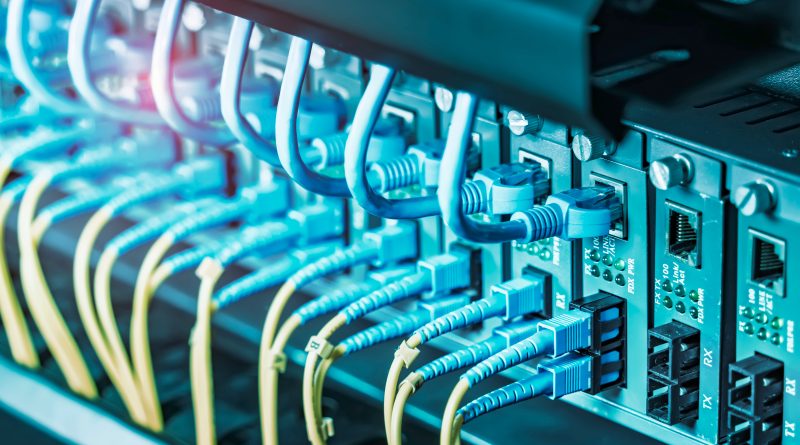
Amazon is spending billions on fiber optics

Subscribe to our free newsletter today to keep up to date with the latest manufacturing news.
Artificial intelligence has become synonymous with advanced chips, sprawling data centers and eye-catching investment figures. Less visible, but equally important, is the network infrastructure that allows these systems to operate at scale. That reality was underscored by Amazon’s newly announced multibillion-dollar agreement with Corning, a deal that highlights how fiber optics have become a critical component of the AI economy.
The partnership will see Corning provide optical fiber, cable and connectivity solutions to support Amazon’s expanding network of data centers across the US. Alongside the supply agreement, Corning plans to expand its manufacturing footprint in North Carolina, creating 1,000 advanced manufacturing jobs and hundreds of construction roles.
The announcement comes as hyperscale cloud providers race to build the infrastructure required to support increasingly sophisticated AI models. While processors from companies such as Nvidia attract much of the attention, the networks connecting those processors are becoming equally important. Without high-performance optical connections, even the most powerful AI systems can struggle to operate efficiently.
Why AI is creating unprecedented demand for fiber optic infrastructure
The latest generation of AI models requires vast amounts of computing power. Training and operating these systems involves thousands, and in some cases tens of thousands, of processors working together across large-scale computing environments. The speed at which those processors communicate directly affects performance, efficiency and operating costs.
Fiber optics have emerged as one of the most effective ways to meet these requirements. Optical networks can move enormous volumes of data with minimal latency, making them well suited to AI clusters that continuously exchange information during training and inference.
As cloud providers expand their AI capabilities, networking infrastructure has become a strategic priority rather than a supporting component. Amazon Web Services has invested heavily in designing data center architectures that can scale efficiently as AI workloads grow. That effort includes networking technologies intended to improve communication between computing resources while maintaining reliability across increasingly complex systems.
The Corning agreement reflects this shift. Fiber optics are no longer viewed as a utility within a data center. They are becoming a competitive asset that can influence the performance and economics of AI deployments.
The trend extends well beyond Amazon. Major technology companies are investing aggressively in optical networking to support next-generation AI infrastructure. Demand for advanced fiber solutions has accelerated across the sector as operators seek to eliminate bottlenecks from their computing environments.
How Amazon’s investment strengthens domestic manufacturing
While the agreement is rooted in technology infrastructure, its economic significance extends into manufacturing and workforce development.
Corning’s expansion in North Carolina represents one of the clearest examples of how AI-related investment is beginning to reshape industrial activity across the US. The company plans to add 1,000 advanced manufacturing positions while supporting additional construction employment tied to facility growth.
The investment also reinforces a broader movement toward strengthening domestic supply chains. Technology companies increasingly want reliable access to critical infrastructure components as demand for data center capacity rises. Expanding production within the US can reduce logistical risks while supporting regional economic development.
Workforce development forms another important element of the partnership. Amazon and Corning will expand collaboration with Catawba Valley Community College through the Fiber Optic Technician Training Program. The initiative is intended to develop skilled workers capable of supporting an industry that requires increasingly specialized expertise.
For North Carolina, the announcement builds on a long period of investment from Amazon. The company says it has invested more than $20 billion in the state since 2010, supporting more than 26,000 jobs across multiple sectors. The latest project strengthens the state’s position as a growing center for advanced manufacturing and digital infrastructure.
The broader race to build AI infrastructure
The Amazon-Corning partnership illustrates how competition in artificial intelligence is expanding beyond software and semiconductors. Companies across the technology sector are investing in every layer of the infrastructure stack required to support AI growth.
Corning has become an increasingly important participant in this environment. The company has benefited from rising demand for optical communications products, reporting strong growth in its optical communications business as AI-related projects accelerate. Similar agreements involving major technology firms highlight the extent to which fiber infrastructure has become a strategic asset.
The race to develop larger and more capable AI systems is expected to continue driving investment across data centers, networking equipment, energy infrastructure and manufacturing capacity. Industry leaders increasingly recognize that competitive advantage will depend on the ability to build complete ecosystems capable of supporting AI workloads at scale.
For Amazon, the agreement provides greater certainty around access to a critical component of its future infrastructure. For Corning, it offers long-term demand visibility and supports continued expansion of its manufacturing operations.
The deal is a reminder that the AI economy is not being built through software alone. Factories, supply chains and physical networks are becoming just as important as algorithms and processors. As investment in artificial intelligence accelerates, those foundational technologies may prove to be among the sector’s most valuable assets.
Source