Amazon moves further into robotics manufacturing with Indiana expansion

Subscribe to our free newsletter today to keep up to date with the latest manufacturing news.
Amazon is preparing to invest more than $100 million in an advanced manufacturing facility in Greenwood, Indiana, adding a large production operation to a state where its physical footprint has traditionally been associated more closely with fulfillment and logistics.
The planned 585,000-square-foot facility is expected to open by 2028 and create 300 manufacturing and engineering positions, according to Amazon and the Indiana Economic Development Corp. Rather than serving as another fulfillment center, the Greenwood operation will manufacture products used across Amazon’s North American fulfillment and robotics network.
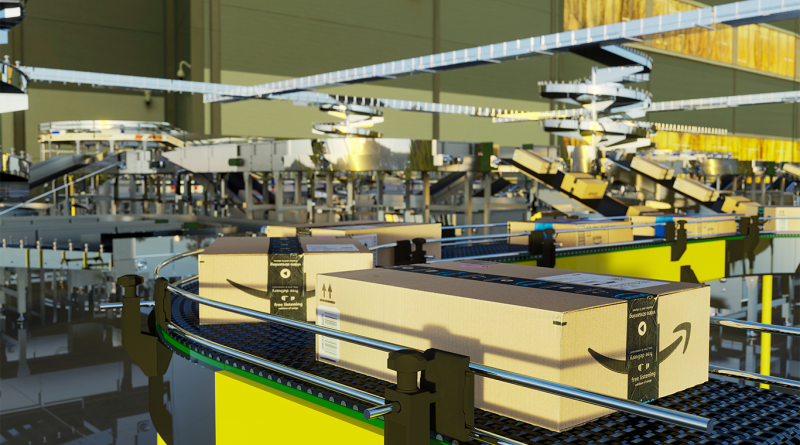
That distinction gives the investment broader significance for manufacturers watching how large industrial users are approaching automation. Amazon has spent more than a decade deploying robotics throughout its fulfillment network, but Greenwood represents part of a growing effort to build the equipment and supporting systems that underpin those operations within its own manufacturing organization.
Amazon says the Indiana facility will combine advanced fabrication, robotic welding, automated powder coating and assembly with robotics and smart manufacturing systems powered by AWS and artificial intelligence. The result will bring processes associated with a conventional metalworking plant into the same production environment as cloud infrastructure, software and industrial automation.
Amazon is bringing more automation manufacturing under one roof
The planned production mix provides a useful indication of how Amazon expects the Greenwood plant to operate. The company is recruiting for roles including computer numerical control operators, welders, powder coating technicians, assemblers, manufacturing engineers, controls engineers, quality assurance specialists and program managers.
Amazon says the positions will pay an average of nearly $100,000 annually. The company has not disclosed the salary distribution across individual occupations, so that figure should not be interpreted as the expected salary for every worker at the site.
The employment profile is significant because it places conventional manufacturing skills alongside disciplines associated with highly automated production. CNC machining, welding and coating remain physical production processes, but operating them in a plant built around robotics and connected manufacturing systems requires engineering, controls, maintenance and quality expertise alongside production labor.
Greenwood will not be Amazon’s first large robotics manufacturing operation. The company has developed what it describes as one of the world’s largest industrial robotics manufacturing operations at its Massachusetts facilities, where it produces systems for its fulfillment network.
A second expansion was announced in August, when Amazon disclosed plans for a new manufacturing facility in Austin, Texas. That project is expected to create between 300 and 500 manufacturing and engineering jobs and produce robotics systems designed to work alongside employees performing fulfillment operations.
Taken together, Massachusetts, Texas and Indiana point to a manufacturing network that is becoming more closely connected to Amazon’s logistics infrastructure. Rather than relying solely on outside equipment suppliers, the company is developing internal capacity to design, manufacture, deploy and operate some of the automation technology used throughout its facilities.
A million robots change the scale of the manufacturing equation
The industrial logic behind that investment becomes clearer when measured against the size of Amazon’s robotics fleet. The company announced in June 2025 that it had deployed its 1 millionth robot, with robotic systems operating across more than 300 facilities worldwide.
Amazon said in September 2026 that those systems now assist employees with 75% of the customer orders it delivers globally. At that scale, even relatively small improvements in equipment performance, production cost, deployment speed or maintenance requirements can affect a substantial portion of the company’s fulfillment operation.
Artificial intelligence is becoming part of that equation. Amazon introduced DeepFleet in 2025, a generative AI foundation model designed to coordinate movement across its robotic fleet. The company says the technology can improve robot travel efficiency by 10% by reducing congestion and identifying more efficient routes through fulfillment facilities.
That figure is an Amazon estimate rather than an independently verified measure of operational performance, but it illustrates how the company is connecting physical automation with software optimization. Manufacturing a robot is only one part of the system when its productivity can be altered by the software coordinating thousands of machines across a facility.
The Greenwood project pushes that integration further upstream. Amazon says AWS and AI-powered manufacturing systems will support production at the Indiana plant, meaning the technologies used to optimize its logistics network will increasingly sit alongside the fabrication and assembly processes used to make equipment for that network.
This approach gives Amazon a tighter connection between manufacturing and deployment. A company operating more than 1 million robots has access to extensive operational data about equipment performance, movement, maintenance and workflow. Bringing additional manufacturing capability in-house could shorten the distance between what engineers observe inside fulfillment centers and what manufacturing teams change in future equipment, although Amazon has not publicly quantified such a development cycle for the Greenwood operation.
The investment also forms part of a much larger US manufacturing expenditure. Amazon says it has spent more than $230 billion on US-manufactured goods and equipment since 2010 and estimates that this activity supports more than 100,000 manufacturing-related jobs in 2026. Those figures come from Amazon and provide a measure of the scale the company attributes to its domestic purchasing and manufacturing activity rather than an independent assessment of its wider economic impact.
The workforce question is becoming more technical
Automation projects are often discussed through the number of tasks that machines can perform, but the Greenwood hiring plan highlights another part of the equation: automated plants still require people who can build, program, inspect and maintain increasingly complex equipment.
Amazon’s planned Indiana workforce ranges from welders and assemblers to controls engineers and manufacturing engineers. The mix suggests that the boundary between production work and technical work is becoming less distinct as robotics, software and conventional manufacturing processes converge on the factory floor.
Amazon has reported a similar pattern elsewhere in its operations. At its next-generation fulfillment center in Shreveport, Louisiana, the company says advanced robotics require 30% more employees in reliability, maintenance and engineering roles than its traditional facilities. That company-reported figure does not establish what employment patterns will look like across manufacturing as a whole, but it provides an example of how greater automation can change the composition of labor demand inside a heavily automated operation.
The same qualification applies to Amazon’s workplace safety claims. In announcing its Austin manufacturing investment, the company said robotics systems deployed over the previous six years had coincided with a reduction of more than 43% in its global recordable injury rate and more than 70% in its global lost-time injury rate. The figures are reported by Amazon and should not be interpreted as proof that robotics alone produced those changes, since workplace safety can be affected by multiple operational factors.
For Indiana, the employment proposition is more immediate. Amazon has operated in the state since 2008 and says it now employs more than 27,000 people there after investing more than $40 billion. The Greenwood plant introduces a different category of work into that footprint, with manufacturing and engineering positions tied directly to the equipment supporting the company’s logistics network.
Indiana already has a substantial industrial labor base. Amazon cites manufacturing employment of more than 518,000 workers in the state and says manufacturing accounts for roughly 24% of state GDP. The Indianapolis region also gives the company access to engineering and technical education institutions, including Purdue University, Rose-Hulman Institute of Technology and Ivy Tech Community College.
The significance of Greenwood, then, lies less in the 300 jobs alone than in what the plant will manufacture and how those products fit into Amazon’s wider operating model. The company is connecting fabrication, robotics, cloud computing, AI and logistics inside a manufacturing network that supplies its own fulfillment infrastructure.
When the Greenwood operation begins production, its output will move into a network containing more than 1 million robots and hundreds of automated facilities. That makes the Indiana investment one part of a much larger industrial system in which the factory, the warehouse and the software coordinating both are becoming increasingly difficult to treat as separate operations.
Source:
Thomasnet