Applied Optoelectronics lands $2.2 billion AI optics supply deal

Subscribe to our free newsletter today to keep up to date with the latest manufacturing news.
Applied Optoelectronics (AOI) has signed a multiyear supply agreement with a Tier-1 hyperscale datacenter customer. The deal commits the buyer to about $2.2 billion in minimum purchases of AI optics, and part of the supply must be made in the US.
The Texas-based company announced the deal on Nov. 24. It runs from December 2026 to December 2030 and covers 800G transceivers and laser diodes, with room to add other products. The customer, which AOI did not name, has committed to buy about $1.5 billion of 800G transceivers in 2027 and about $700 million of laser diodes across 2028 and 2029.
AOI has also committed to ship an agreed quantity of products made in the US. Those shipments are scheduled to start in the first quarter of 2027 and ramp through the year, and the company plans to expand its laser manufacturing capacity in Texas to support them.
The agreement shows where pressure is building in AI infrastructure. Chips and power equipment have dominated the conversation about supply constraints. Optical components, which move data between servers and switches at high speed, are now being locked in years ahead.
Hyperscalers are securing AI optics capacity years in advance
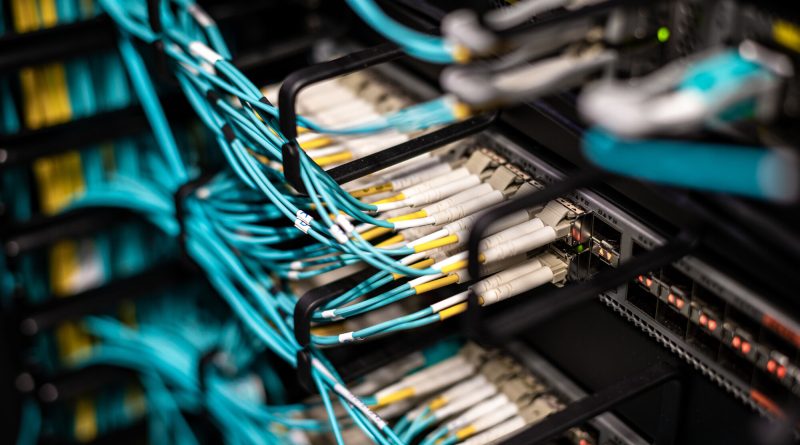
Transceivers convert electrical signals into light so data can travel over fiber between machines in a data center. As AI clusters grow, the number of these links grows with them, and so does the speed each one must handle. The 800G products in this deal carry 800 gigabits per second.
A firm, multiyear minimum commitment sends a different signal from a one-off order. It gives the supplier enough certainty to invest in capacity, and it gives the buyer a guaranteed place in the production queue.
AOI says this is its second long-term agreement with a hyperscale customer. Founder and CEO Thompson Lin said the deal gives the company long-term visibility on revenue and demand.
The structure matters too. AOI will cover a $2 million one-time expense to speed up product qualification with the customer, while the customer has made no capital commitment. The customer is paying for products, and AOI carries the cost of building the capacity to make them.
A US manufacturing commitment is written into the contract
The US-made shipment requirement may be the most significant detail for manufacturers.
The company is headquartered in Sugar Land, Texas, where it has engineering and manufacturing facilities. It also runs engineering and manufacturing sites in Taipei, Taiwan, and Ningbo, China. The agreement commits the company to supply a set quantity from US production rather than leaving the location of manufacturing open.
AOI did not disclose what share of the deal must come from US plants. Even so, the clause shows sourcing location moving into the commercial terms of AI supply contracts. Alongside price and delivery, this customer has set terms on where components are made.
That has practical consequences. A US production commitment means AOI must hire, train, and qualify domestic lines on a fixed timeline. The company points to its automated manufacturing as part of how it plans to do that.
Laser diodes point to the next phase of AI networking
The second half of the agreement looks further ahead. About $700 million of laser diodes are scheduled for 2028 and 2029, and AOI expects some of them to power co-packaged optics starting in 2028.
Co-packaged optics place the optical engine right beside the processor or switch chip, rather than in a pluggable module at the edge of the equipment. The approach aims to cut the power lost in moving signals over copper. In many of these designs, the laser sits outside the chip package as a separate light source, which is why AOI expects demand for high-power lasers to rise as the technology grows.
If that shift happens at scale, value moves toward the companies that can make lasers in volume. AOI says it develops its laser technology in-house, which places it closer to that part of the supply chain than a company that only assembles modules.
The $2.2 billion figure is a minimum. CFO and Chief Strategy Officer Stefan Murry said the customer’s forecast points to demand beyond the committed purchases, and that current demand from long-term discussions exceeds $10 billion over the 4 years. He also said this is not guaranteed. Any sales above the committed minimum depend on AOI bringing new capacity online and securing further purchase commitments.
That leaves the open question. Can AOI build and qualify US capacity fast enough to turn a $2.2 billion floor into something closer to the customer’s larger forecast? And will other hyperscalers start writing similar domestic production terms into their own contracts?
Source:
Applied Optoelectronics