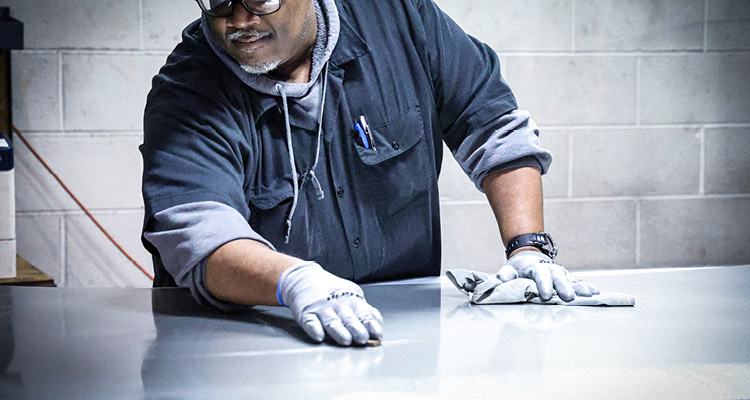
As ‘caretakers’ of customers’ aluminum, Aluminum Blanking Company protects materials, preserves value, and creates opportunity

In aluminum processing, the material’s value is also its vulnerability: prime aluminum now costs upwards of $4 a pound – and even a single deep scratch or flatness defect can send it back to the mill for remelting. For Aluminum Blanking Company (ABCO), that risk shapes everything the business does. The company was established in 1979 as ‘The Original Toll Processor’ of aluminum, stainless steel, and other surface-sensitive materials, and was founded by Marvin Hole, father of current President and CEO, Laura Anderson.
With Laura’s father being a design engineer and manufacturer’s representative for coil handling and press room equipment, he recognized that aluminum could help OEMs meet CAFE standards, introduced off the back of the 1970s oil crisis. The business grew through the 1980s on carefully sourced equipment – much of it originally sold by the founder to OEMs and built for very heavy material.

Engineering runs in the family. “I graduated from the University of Michigan with degrees in both aerospace engineering and physics,” Laura recalls. “My interest has always been in science, math and technology. My first job was in California at the Jet Propulsion Laboratory – the prime contractor to NASA for all interplanetary space exploration – and I worked in attitude and articulation control systems on Project Galileo, which went to Jupiter and explored the planet and its moons.” Afterwards, Laura moved into IT, Six Sigma, and SAP deployments across Tier One automotive suppliers before returning to lead the family firm in 2015. Her younger brother Scott Hole is ABCO’s Chief Engineer, following their father’s footsteps as pressroom equipment and tooling expert. “What makes our work exciting, and really drives the whole team, are challenges we are able to solve.”
The company’s toll-processing model still defines operations. “We don’t own the material we process,” Laura says. “We’re the caretakers.” Everything that touches the material is designed for surface-sensitive materials, and the business is organized around protecting the material, preserving its value, and creating opportunities for customers through the services and capabilities it offers.
Protection begins with handling, but preservation is where science comes in. Exposed automotive panels, such as doors and hoods, must be pristine, yet the heat-treated 6000 series aluminum used can arrive from the mill with flatness issues. For this reason, ABCO has implemented an innovative new leveler on its automotive line. “Almost every coil can be different because the alloy is ageing and hardening in ways that can vary from coil to coil,” Laura elaborates. The stakes are considerable for ABCO, as material that cannot be used as prime typically loses around $1.50 per pound of value, and returning it to the mill for remelting means five to eight weeks of lead time on top of transport and reprocessing costs. “The aim is to flatten material with minimal property changes, since if it gets too hard it cannot be stamped.”
ABCO’s six lines are highly integrated, some with automatic stacking systems. ABCO’s vacuum stacker was the first installed in North America and has since been upgraded with more efficient vacuum technology. Data systems track processing performance, and the business is automating the capture of incoming coil conditions and scrap volumes, giving customers more data to improve their own processes.
The firm’s latest capability is a blank washer, having completed its first full trial in September. This processing line cleans all types of blanks of debris and lubrication types. Proper lube application can be critical for forming because aluminum blanks can suffer ‘fretting’ in transit – a pitting-like damage caused when they rub together, often because lubricant has been applied at the wrong levels. ABCO has long been able to re-lube offline, but now it can wash blanks, and re-lube them to proper specifications, or return contaminated material to prime, with the service also being available for steel. ABCO’s next plans a strip washing line; a coil-to-coil process combining surface inspection with washing and slitting. This is likely to be a 24-month project, which has only just started.
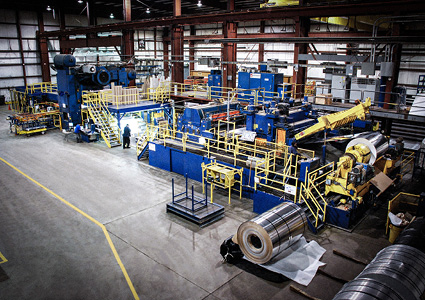
Many competitors trim coil to width on a separate line and then move it to a blanking line, but ABCO has integrated edge trimming into two automotive lines reducing scrap and handling. A further 84-inch, full-width line with a swing shear is also in progress which will produce rectangles, trapezoids for car hoods, and parallelograms, freeing up presses for more developed blanks.
ABCO’s leadership team also plans to win back non-automotive work across Michigan, Ohio, Indiana, and Illinois, in sectors such as marine, much of which has drifted to larger corporations due to mills now selling through service centers. The plan is to partner with long-standing service center partners, as well as set up the capability for direct business.
ABCO’s portfolio includes supporting construction of the Dubai International Airport. “It’s a fascinating-looking airport and you’ll notice diamond shaped patterns in all of the ceilings,” highlights Laura. “We processed those diamonds for the design firm employed. We process for any industry, and we have the largest breadth of capabilities in terms of width, gauge, length, and material types. With six lines, we can process anything that can be coiled or shipped.”
The company’s recent support for a top automotive OEM further demonstrates its capabilities. When one of the OEM’s largest material sources suffered devastating fires, ABCO supported the OEM’s stamping operations with expedited processing, which also raised its own profile as OEM’s rarely deal with processors directly. “It’s great when others learn of our capabilities and can benefit from them,” Laura says, while ultimately crediting her team. “I call them the miracle workers,” she concludes, describing the Friday-evening calls for hot weekend shipments that keep stamping plants running. “Every time this team has come through, I’m so proud of them.”