

As rising energy costs see UK ceramics manufacturers struggle, Churchill China is continuing to champion British ceramics

With a proud heritage as a British ceramics manufacturer spanning more than 230 years, Churchill China (Churchill) is a name recognized around the globe for its superior quality and innovative designs. As Britain’s leading ceramic exporter in hospitality, 60 percent of Churchill’s sales are exports, and the company has become known for its innovative and durable tableware in over 70 countries worldwide.
Churchill’s home is in Stoke-on-Trent, known in the industry as The Potteries, which has been at the heart of UK ceramics for centuries. At its peak, The Potteries hosted over 300 works and employed an estimated 79,000 people. Despite decline after the Clean Air Act in the 1950s and deindustrialization in the 1980s, the industry still employs 5000 people today, but there are new challenges at hand, primarily rising energy costs and labor inflation. Three of Churchill’s competitors – Royal Stafford, Moorcroft, and Denby – have all announced closures in the last 12 months due to energy costs and lack of government support.
However, Churchill’s founding values of entrepreneurship, innovation, infrastructure, and a dedicated workforce remain at its core as it continues to navigate these issues. To learn more about these projects, along with investments in UK manufacturing and the challenges Churchill is navigating, we speak with Sales and Marketing Director James Roper.
“Churchill manufactures a distinctive ceramic body for use in professional hospitality businesses” James begins. “The unique blend of raw materials, manufacturing processes, and firing temperatures creates an extremely strong and aesthetically designed product. Our glaze is tested to a minimum of 5000 dishwasher cycles or the equivalent of 13 years in normal use, in comparison to standard testing of 500 dishwasher cycles on domestic ceramics. Our products are also covered with an edge chip warranty. All of our UK manufactured products are tested to over 13 UK & European standards that demonstrate food safety, durability and compliance. One of our best collections, Stonecast is globally recognized as best in class and is used in some of the most demanding catering environments.
“In terms of processes and strategy, we have been extremely focused on managing our cost base in recent years, in an attempt to counter inflation driven by energy costs and UK labor cost increases,” James continues. “The global hospitality market has endured a very difficult period since 2019, so our customers are subject to the same inflationary pressures.”
Energy costs
As James explains, the substantial rise in energy costs across the UK since 2022 has placed increased pressure on ceramics businesses, and a significant portion of these costs are non-commodity costs like network charges and environmental levies. Although the UK Government’s Spending Review and the Modern Industrial Strategy promises to help energy-intensive industries, these schemes don’t apply to UK ceramics manufacturers, which are predominantly gas-intensive, as electrifying the high-temperature processes required is economically and technically challenging, making manufacturers question the viability.
Indeed, Churchill’s energy price, per piece, increased by 350 percent between 2018 and 2022. Since then, the business has managed its cost base by prioritizing investment in efficiency, automation, productivity, and skills focused on continuous improvement. When it comes to manufacturing, the business has invested over £2 million in energy efficiency projects, generating annualized savings but not enough to offset the rising costs. These investments include the installation of two electric (rather than gas) glazing pre-heaters, which has resulted in an 80 percent reduction in kilowatt hours, as well as an upgraded burner replacement and a new VDS compressor with smart link capability.
The installation of solar panels has played a key role in Churchill’s energy efficiency strategy. The company trialed solar with the installation of 232 panels in 2019, before adding a further 405 panels in 2021. In 2022, a further £1.4 million was invested to install 4500 panels, resulting in an average lifetime saving of 901 tons. Churchill applied to install an additional 5000 panels, but the application was refused until 2033 due to infastructure on the National Grid.
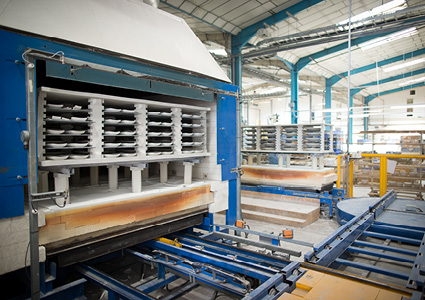
For kilns, the company has invested in its kiln car structures to increase the amount of product on each car. With kilns accounting for 84 percent of Churchill’s total gas usage, the business has engaged with several kiln manufacturers to target future solutions of tableware firing. Natural gas is still viewed as the optimal fuel, as electric tunnel kilns are unproven and running costs are too expensive. While hydrogen firing is feasible, with Churchill having test fired a 100-percent hydrogen plate and become a member of the Hydrogen Valley consortium, the lack of supply and safety concerns remain major barriers to this technology.
Aside from internal investments, James is keen to highlight that the UK Government could do more to support UK ceramics businesses. “It is essential for the industry that there is no increase in gas commodity charges ahead of support on electricity and a viable route to electrification, including network capacity,” James states. “Support could also be provided through interest free loans for UK capital projects relating to automation, productivity, and further decarbonization. This is a well-trodden route in markets like Germany, as it strengthens local industry at a very low cost to the taxpayer.
“Further renewable investment is not possible without network grid infrastructure, as the current infrastructure is unable to accommodate additional generation capacity until 2032. It would also be valuable to have access to the British Industry Competitiveness Scheme, and any further increases to minimum wage need to be in line with inflation.”
Despite the challenges facing UK ceramics businesses, Churchill’s track record of strategic investment and adaptation speaks to its resilience. The company’s commitment to innovation, from kiln efficiency schemes to solar expansion and hydrogen exploration, reflects a business that is not simply weathering market conditions but finding solutions to actively shape its future. With a globally recognized product range, a loyal international customer base, and deep roots in The Potteries and its heritage, Churchill is well positioned to grow alongside recovering hospitality markets.
“We are still dealing with challenging customer markets due to the ongoing cost pressures on the hospitality industry, particularly in the UK where the government continues to increase the cost burden on the hospitality sector with minimum wage increases above inflation, higher business rates, and energy cost inflation,” James concludes. “However, we’re continuing to see a lot of opportunities to grow our export business in regions where hospitality markets have recovered, including Europe, India, and Central and North Americas, as well as further opportunities to invest in our manufacturing operations.”
