

In conversation with James McAllister: How Atlas Copco is advancing UK manufacturing with AI-driven solutions

Firmly positioned at the forefront of the UK Government’s Advanced Manufacturing and Industrial Strategy, Atlas Copco Group (Atlas Copco) supports the country’s most advanced and strategically critical industries. From Formula One and other automotive applications to aerospace and defense, digital infrastructure, electronics, energy, off-highway, and beyond, the organization’s breadth of solutions is driven by Smart Factory technology, enabling manufacturers to improve productivity, quality, and sustainability. The company’s expansive portfolio offers a comprehensive scope of technologies to assist customers on their digital transformation journeys, including quality assurance, AI vision systems, dispensing, fastening, automation, and data-driven process control software. Across the board, these solutions are engineered with a clear goal: improving operational performance whilst ensuring factory longevity and future-focused innovation.
James McAllister, General Manager for Atlas Copco Tools & Industrial Assembly Solutions UK, has been with the company for over 30 years, working across three continents. With the UK and Ireland representing one of the Group’s most prominent markets, generating nearly £2 billion in revenue with a team of 3000 employees, James plays an integral role in driving Atlas Copco’s growth, innovation, and operational efficiency.
“I’ve had the privilege of building my career at Atlas Copco, working across Asia, Europe, and North America. My journey has taken me to the UK, Sweden, Japan, and Canada,” James recounts. “I’ve held a variety of roles in both customer centers and divisional headquarters in Sweden, culminating in my previous position as President of the General Industry Division, based in Sweden and, for the past eight years, in the UK. The company has given me extraordinary opportunities to develop, lead, and learn from teams around the world. One of the most rewarding aspects of my career has been immersing myself in those different cultures – discovering how people work, communicate, and collaborate. What I’ve learned is that our fundamental business model works everywhere, but success comes from understanding and adapting to the cultural nuances of each market.”
In his current role, James serves as a Director and General Manager of Atlas Copco’s UK Customer Center, where the company delivers sales, project execution, and service solutions to the UK’s manufacturing sector. Boasting a wealth of experience across various cultures and customer bases, his leadership style is underpinned by open-mindedness, clarity, and a deep understanding of how alignment across all teams and individuals cultivates real success. When asked about what advice he’d offer to other leaders in the manufacturing industry, James highlights four key pillars of his own approach.
“First, simplicity,” James reveals. “Keep the vision, strategy, and actions clear and simple. Complexity slows organisations down; clarity accelerates them. When people understand the ‘why’ and the ‘how’, execution becomes natural. Then, authenticity. Be yourself and let your values guide your decisions. Authentic leadership builds trust, consistency, and credibility, especially in moments of pressure.
“Next, resilience,” he continues. “Good things are never easy. Progress requires persistence, courage, and the willingness to push through challenges. Resilience is what turns ambition into achievement.
“Finally, speed and pace setting. As a leader, you set the tempo. Speed matters – not recklessness, but decisive movement. Resource accordingly, remove bottlenecks, and show the organization what good pace looks like.”
Technical transformations
That philosophy extends beyond leadership style and is equally evident in how the wider industry is approaching technological change. AI is already delivering tangible value across modern manufacturing, helping companies improve efficiency, quality, and flexibility. One of the most advanced examples is Atlas Copco’s pioneering VisionTools solution, which applies AI and virtual commissioning to fundamentally change how machine vision systems are deployed.
“VisionTools is an industry-ready system that combines AI-based analysis with virtual commissioning for optical quality control, part identification, and robot guidance,” James explains. “Traditional commissioning of a vision system is slow, labor intensive, and dependent on physical samples – golden parts, borderline pass/fail parts, and every variant in every color, size, and design. Manufacturers often need to run large production batches to understand thresholds, variation, and edge cases. In some cases, teams wait months for the right parts to appear.
“With VisionTools, none of this is required. The system can be trained directly from 3D CAD models, generating synthetic images for all variants before a single part exists. The system generates unlimited artificial reference images before series production begins.”
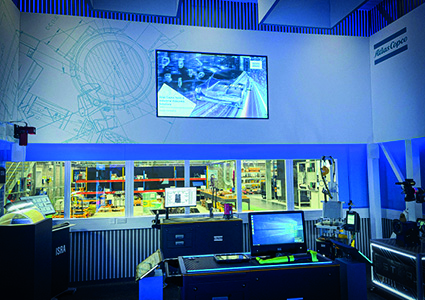
As automotive manufacturers face growing pressures from rising costs, supply chain complexity, cybersecurity risks, skills shortages, and evolving regulations, Atlas Copco has also introduced its Common Control Platform to simplify and future-proof production. The platform’s unified architecture enables multiple manufacturing technologies to operate through a single interface, improving productivity, reducing integration and training requirements, and lowering total cost of ownership. Built with cybersecurity and regulatory compliance at its core, the platform also provides a scalable foundation for data-driven manufacturing, supporting advanced analytics, AI integration, and seamless connectivity across modern automotive production environments.
“The future of advanced manufacturing is being shaped by trends in automation, vision systems, AI-driven sustainability, cybersecurity, and the shift toward Industry 5.0, where technology and human capability work together,” James affirms. “Automation continues to accelerate across every sector. Vision systems are moving from simple inspection tools to intelligent decision-making systems. With AI, they can now detect defects, guide robots, and adapt to new variants instantly, transforming quality assurance and reducing waste. Additionally, AI is becoming one of the most powerful enablers of sustainability. It delivers measurable impact in three core areas: waste reduction (fewer defects, rework, and scrapped parts), productivity improvements (smarter processes, predictive insights, and faster decision-making), and cost efficiency (optimized energy use, reduced downtime, and better resource allocation.
“AI is no longer a future concept, it’s a practical lever for operational excellence. Industry 5.0 represents the next evolution: technology and people working together. It emphasizes human-centric design, personalization, sustainability, and resilient, adaptive systems.”
As UK manufacturers navigate an increasingly complex and competitive landscape, the ability to embrace digitalization, automation, and AI will be critical to long-term success. Through innovations such as VisionTools and the Common Control Platform, Atlas Copco is helping manufacturers improve productivity, resilience, and sustainability while preparing for the next era of Industry 5.0. With strong industrial foundations, world-class engineering expertise, and continued investment in technology and skills, James is optimistic that the UK manufacturing sector is well-positioned to remain a global leader in advanced manufacturing.
“I am genuinely positive about the future of UK manufacturing. We have some of the strongest brands, deep technical expertise, and highest quality talent anywhere in the world. The foundations are solid, but to compete globally, we need to build on them with urgency and alignment,” James concludes.
“The UK must double down on strategic sectors where we already have an edge, in advanced engineering, aerospace, automotive, energy, and digital infrastructure. Every company, large or small, needs to embrace new technologies. Automation, AI, and data-driven systems are no longer optional, they are essential for productivity and global relevance. At the same time, the workforce must evolve with the technology. We need large-scale programs to upskill existing employees and attract new talent into engineering, robotics, software, and AI.”
