
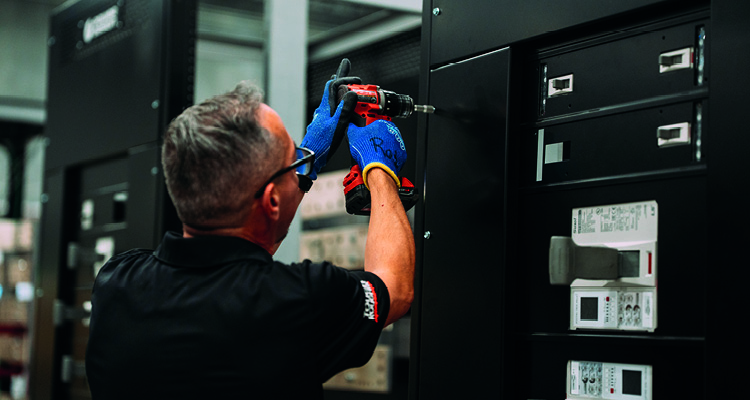
Born from disruption, LFG Manufacturing is redefining electrical manufacturing through contractor-led innovation

A subsidiary of design-build contractor Power Design, electrical equipment manufacturer LFG – which stands for ‘Let’s Fucking Go’ – overcame the challenges of the 2022-to-2023 supply chain crisis, which included overspending to keep client projects on schedule, not having distribution equipment delivered on time and seeing a strain put on relationships it had built over time.
Although it was thrown into this tough position following the pandemic, today, the Florida-based manufacturer is not only fully operational; it is one of the most intriguing new entrants in a sector long dominated by a handful of global giants.
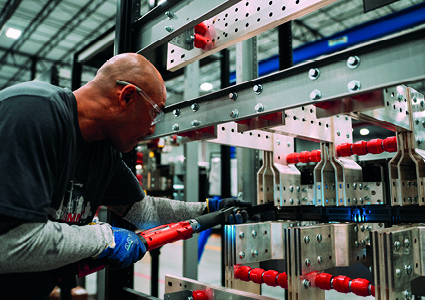
Zac Elkins, Chief Operating Officer, elaborates on LFG’s pivot towards building the equipment it could no longer reliably source. “We take a great deal of pride in meeting our commitments. We decided we would start looking at how we could continue to control our own destiny. Acquisition often involves inheriting problems and bad habits. We looked at some smaller and mid-sized shops; however, we decided it simply wasn’t worth it and opted to rely on ourselves again.”
The team spent much of 2023 learning manufacturing processes and expanding an existing 208,000-square-foot Florida facility, and by mid-2024 LFG was building earnestly. The first UL 891 low voltage switchboard was released to a Power Design project in late 2024 and LFG was formally spun off as a standalone entity in early 2025, with Zac shifting from a project management executive to leading the operations of the LFG manufacturing business, after 15 years in construction.
LFG’s product range covers the full spectrum of commercial and industrial electrical distribution equipment: UL 891 switchboards handling loads with up to 5000 amps, UL 67 panelboards for smaller power requirements, UL 508A control cabinets, and UL 1773 copper bus wireway systems, as well as enclosures, transformers, and more. “We continue to invest in R&D and roll out new products,” reveals Zac. “While 100 percent of our business is commercial and industrial, we have our sights firmly set on the data center space. We’re very close to UL approval on a power distribution unit – a distribution panel with an integrated transformer within the same cabinet, allowing two different voltages in a single enclosure. That approval is expected within the next couple of months, and it gives us the ability to go fully after the data center market.”
Yet the company’s real differentiator is the philosophy baked into how it operates. The four major US electrical distribution manufacturers run on first-in, first-out queues that can stretch a year or more from order to delivery, and hyperscale data centers could easily displace smaller contractors entirely. LFG’s answer is $20 million of inventory always held on the shelf – raw steel, copper, and critical components – meaning a bespoke piece of equipment can be turned around in weeks rather than months. “The cost of holding that capital is real,” Zac acknowledges. “However, we’ve made that commitment because we know it’s the long-term play.”
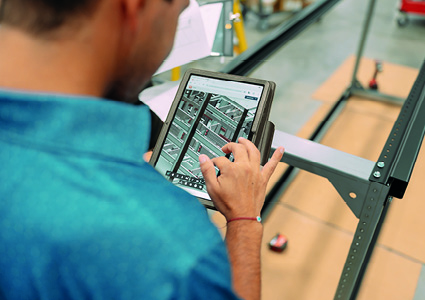
With the company slogan ‘for builders, by builders,’ Zac and his team understand job-site realities intricately – from delivery constraints in dense urban environments and the preferences of the installing electricians, to the nuances of working with thousands of different utility companies across the country to get equipment approved and power flowing. “We know what it feels like to be a contractor and miss a critical date,” states Zac. “That is our North Star.” Additionally, it has invested approximately $20 million in machinery, including two automated lasers, four press brakes and full in-house painting capability. The most significant recent addition is a $4 million laser-punch combo machine – a CNC-driven system with an integrated robotic arm and press brake that occupies 3500 square feet of the production floor. What previously took four hours to bend can now be completed in around a minute, running lights-out through automated cycles.
ERP systems
Technological investments are helping strengthen customer relationships too, in the form of an ERP system with a client-facing portal that will provide real-time visibility at every stage of the build. Every product is delivered on LFG’s own transport fleet, with drivers remaining at the destination until the client has received and is ready to offload the equipment. “Manufacturers traditionally operate behind closed doors, but that is not our approach,” notes Zac. Clients are actively encouraged to visit the facility, ask questions and get hands-on. Quality control follows an ISO 9001 framework, with full certification expected before year-end, and all equipment undergoes in-house injection testing before it leaves.
Already benefitting from a relationship with global manufacturer LS Electric, as well as OEM partnerships with Siemens and ABB, LFG is able to offer genuinely turnkey solutions, adding over a dozen product lines to its portfolio – the data center market, with its complex but highly repeatable builds, is the immediate target. By 2028, LFG expects maximize the square footage of its current facility, with land near the existing site already being evaluated and additional buildings planned for five-year projection: potentially 400,000 square feet by 2031 or 2032.
Power Design built LFG because it wanted more speed, reliability, and transparency. In three years, it has created a manufacturer with the instincts of a builder, the inventory discipline of a distributor and the ambition of a business that continues to surprise, innovate and thrive.
