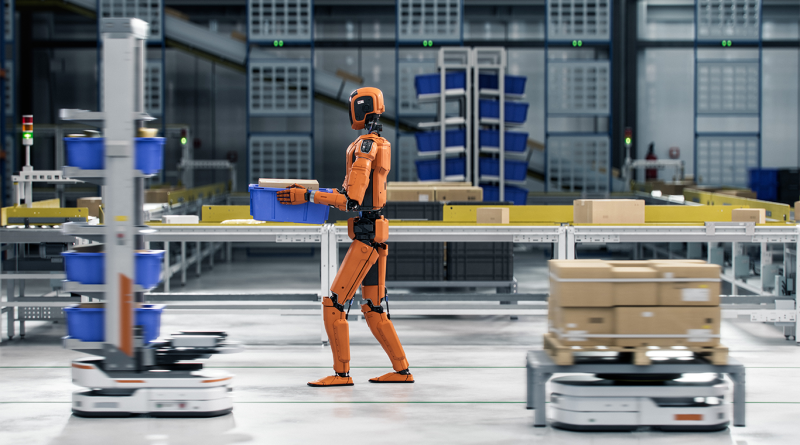
Boston Dynamics prepares Atlas robots for large-scale manufacturing

Subscribe to our free newsletter today to keep up to date with the latest manufacturing news.
Humanoid robots have spent years demonstrating that they can walk, lift objects, manipulate tools and recover from movements that would challenge many conventional machines, but manufacturing presents a more demanding test because factories reward repeatability, uptime, predictable cycle times and the ability to work within tightly coordinated production systems.
Boston Dynamics is now trying to close that gap with the opening of its Robotics Metaplant Application Center, or RMAC, at Hyundai Motor Group Metaplant America near Savannah, Georgia, where Atlas humanoid robots are being trained in manufacturing conditions that more closely resemble the environments in which they would eventually be expected to operate.
Opened in September 2026, the facility is initially focused on automotive parts logistics and sequencing, with Atlas learning how to prepare components and arrange them in the correct order for assembly. Boston Dynamics plans to expand the program into component assembly by 2030, followed by other applications involving repetitive motion, heavy lifting and physically demanding work.
The timing places the project within a manufacturing sector that is already highly automated. According to the International Federation of Robotics, factories worldwide had a record 5 million industrial robots in operation during 2025, while more than 600,000 new units were installed during the year, representing an 11% increase from 2024.
Humanoid robotics is therefore entering an industrial environment in which automation is already mature, and the challenge is no longer simply to prove that another category of robot can perform useful work. Developers now need to demonstrate where the humanoid form can offer advantages that established automation cannot provide as easily.
Atlas is moving from robotics research to manufacturing work
Atlas has spent more than a decade as one of the most recognizable platforms in humanoid robotics research, with earlier demonstrations focused heavily on mobility, balance, full-body control and the ability to navigate complex environments.
The commercial version has been developed for a different purpose, with Boston Dynamics shifting its focus toward autonomy, serviceability and repeatable industrial use rather than demonstrations designed primarily to test the limits of robotic movement.
Boston Dynamics unveiled its production-ready electric Atlas in January 2026 and began manufacturing the robot at its Boston headquarters, with the first production deployments assigned to Hyundai and Google DeepMind. The company has positioned the new Atlas as an industrial system designed to operate autonomously and transfer learned behaviors across fleets, a capability that could become increasingly valuable as deployments grow.
For Hyundai, the technical specifications are clearly geared toward physical work. Atlas can lift up to 110 pounds, or 50 kilograms, and has 56 degrees of freedom, tactile sensors in its hands and a 360-degree camera system that helps it interpret its surroundings. It can also replace its own battery autonomously when power runs low, and Hyundai has said that most tasks can be taught in less than a day.
Those capabilities help explain why parts sequencing has been selected as one of the robot’s first manufacturing assignments, since the work requires Atlas to combine mobility, perception, manipulation and decision-making within a process that is repetitive enough to measure consistently.
Sequencing may appear straightforward compared with more complex assembly work, but it creates a useful test of whether a humanoid robot can recognize different components, move through an active production environment, handle parts reliably and place them in a prescribed order without disrupting nearby operations.
Manufacturing places greater emphasis on repetition than many robotics demonstrations do, because a system that completes a task successfully once may be technically impressive without yet being useful as industrial equipment. A viable manufacturing system has to perform the same job through thousands of cycles while maintaining acceptable levels of accuracy, safety and availability.
RMAC gives Boston Dynamics a setting in which those questions can be examined under production conditions rather than inside a controlled laboratory, shifting the emphasis from demonstrating what Atlas can do toward determining which tasks it can perform reliably enough to justify deployment.
Hyundai is building the infrastructure needed to scale humanoids
Hyundai’s plans for Atlas extend well beyond a limited technology trial, with Boston Dynamics stating that Hyundai Motor Group intends to expand the robot across its global manufacturing network and begin with 25,000 units at Hyundai Motor and Kia plants over the next few years.
The group also plans to establish a US production facility capable of manufacturing 30,000 robots annually, suggesting that the long-term strategy depends not only on proving individual use cases but also on creating the production capacity required for much broader deployment.
RMAC forms part of that wider infrastructure because it gives Boston Dynamics and Hyundai a dedicated environment for training, testing and validating manufacturing applications before those applications are introduced more broadly across production sites.
The center’s first phase is already operating at Hyundai’s Georgia manufacturing campus, while operations are expected to move into a building about 10 times larger in 2027. Boston Dynamics has said the expanded operation will continue preparing Atlas for automotive work while evaluating opportunities in other industrial sectors.
That expansion reflects one of the less visible challenges facing humanoid robotics, since producing capable hardware represents only one part of what is required to deploy robots across large manufacturing networks.
A manufacturer planning to operate thousands of humanoids also needs repeatable training methods, safety procedures, maintenance systems, software integration, task validation processes and a practical way to update robot behavior without treating every installation as a separate engineering project.
The ability to transfer learned behaviors across multiple robots could become especially important in that context. Boston Dynamics has said behaviors developed for Atlas can be redeployed across fleets, which could reduce the amount of engineering work required when a task is introduced at multiple sites or across numerous machines.
Hyundai has framed this wider strategy around physical AI, in which artificial intelligence is connected to machines that perceive and interact with real environments, allowing manufacturing operations to serve not only as workplaces but also as sources of training data and practical experience.
For manufacturing executives, that system-level approach may matter more than any single Atlas specification because the economics of industrial humanoids will depend partly on how quickly new tasks can be developed, validated and distributed across a fleet.
If every new application requires months of specialized engineering, the cost and complexity of expansion could limit adoption, whereas a platform that can learn a process quickly and reproduce that capability across many units would present manufacturers with a considerably different proposition.
The factory floor is becoming the real test for humanoid robots
Humanoid robots are entering factories that already have decades of automation experience, particularly in industries such as automotive manufacturing, where robotic arms are widely used for welding, painting, material handling and assembly.
Purpose-built automation is highly effective when manufacturers can structure a process around the machine, which means humanoid robots will need to establish where their flexibility can justify the additional complexity of a more general-purpose system.
The argument for humanoids rests partly on the fact that factories, tools and production processes have largely been designed around the dimensions and movement of human workers. A mobile robot with arms, hands and a broadly human working envelope could potentially operate within those environments without requiring every process to be redesigned around a fixed machine.
That potential does not automatically establish a commercial case, however, because reliability, maintenance, safety, energy consumption, integration costs and productivity will all influence whether manufacturers view humanoids as practical alternatives to conventional automation.
A humanoid platform may prove capable of performing many different tasks while still being less economical than a purpose-built machine for some of them, making deployment decisions dependent on the value manufacturers place on flexibility, mobility and the ability to move between applications.
Boston Dynamics is already looking beyond automotive production, with the company discussing future Atlas training with existing Spot and Stretch customers in manufacturing, aerospace, semiconductors, logistics, food and beverage and life sciences.
The company expects data collection and other training activity in these sectors to expand during 2027, which could provide a broader test of whether the capabilities developed in automotive manufacturing transfer effectively to other industrial environments.
The wider robotics market gives those experiments a substantial base from which to develop, with the 5 million industrial robots operating worldwide in 2025 representing more than double the installed population recorded seven years earlier.
For humanoid robotics, the next stage of development will therefore be judged less by increasingly sophisticated demonstrations and more by whether those capabilities translate into dependable production output under ordinary operating conditions.
RMAC represents an early example of the infrastructure required to answer that question because Boston Dynamics and Hyundai are not simply placing Atlas inside a factory. They are developing the training, validation, production and deployment systems needed to determine whether humanoid robots can operate at industrial scale.
If that model proves commercially viable, some of the most important Atlas demonstrations over the next several years are likely to look comparatively routine, with robots completing repetitive manufacturing tasks safely, consistently and economically across ordinary production shifts.
Source:
Boston Dynamics