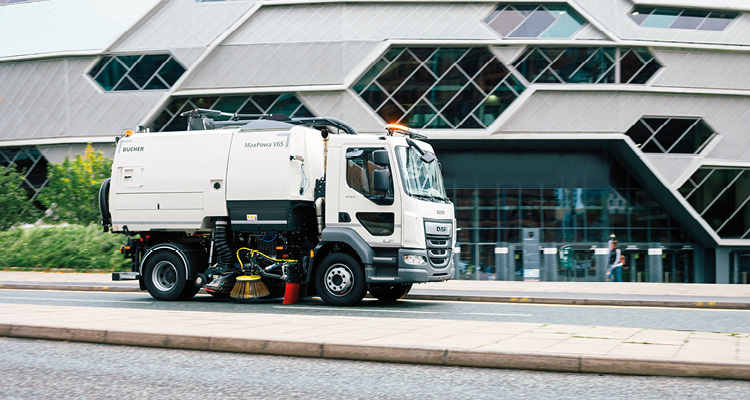
Bucher Municipal showcases SmartAssist, bringing AI and intelligent control to the next generation of street sweeping

For two centuries, Bucher Municipal – part of Bucher Industries – has engineered solutions that keep cities, roads, and critical infrastructure moving. Today, with more than 2500 employees, operations across five continents and net sales of CHF 605.2 million in 2025, the organisation has evolved into one of Europe’s leading suppliers of municipal vehicles and equipment.
The company’s heritage runs deep. Its roots stretch back to Switzerland in 1807, while its UK sweeping story began with Johnston Sweepers in 1904. Bucher acquired Johnston Sweepers in 2005, and its expertise now sits within a much broader portfolio – one that combines proven engineering with a clear focus on the future. Bucher Municipal was an early pioneer of electrification, launching what it describes as the industry’s first all-electric truck-mounted sweeper in 2018. Today, its Dorking location remains Bucher Municipal’s centre of competence for truck mounted sweepers, where innovation continues to shape its MaxPowa range and deliver powerful performance across every model.
We sit down with Martin Starkey, Division President of Bucher Municipal, along with Angela Johnson, Engineering Director, and Gareth Knopp, Engineering Innovation & Simulation Manager, to discuss the company’s latest innovation – one set to create new standards in truck-mounted sweeping. This technology is suitably named ‘SmartAssist’, which has already been recognised with the Fleet Product or Service of the Year award at the 2026 Fleet Vision International Awards.
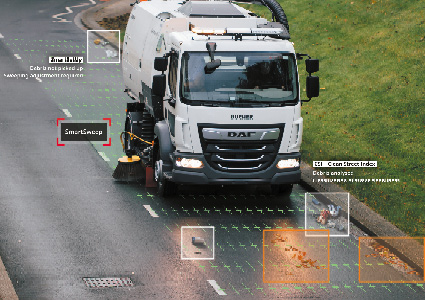
“SmartAssist combines AI, computer vision, and intelligent machine control to understand what is happening around the sweeping process. The SmartPickup element uses cameras around the suction equipment to monitor conditions at the nozzle and can use those inputs to automatically adjust functions such as nozzle operation and fan speed,” Martin describes. “For the operator, it reduces the number of continual adjustments they need to make, reducing cognitive load and allowing more attention to remain on the road, pedestrians, cyclists, and other hazards. From an operational perspective, using the machine only as hard as the conditions require also creates the opportunity to reduce unnecessary fuel consumption, operating cost, and associated emissions.
“A particularly important part of SmartAssist is SmartCSi, our Clean Street Index,” he adds. “Cameras view the road before and after sweeping and computer vision assesses the condition of the surface and the effectiveness of the cleaning operation. Longer term, that opens the door to much more evidence-led street cleansing. Rather than relying entirely on fixed schedules, you can begin using information about actual street condition, cleaning outcome, and machine utilisation to help decide where resources are needed.”
Research and development
Delivering that level of intelligent sweeping has required more than adding cameras and software to an existing machine. Gareth explains how the programme came together. “SmartAssist is the result of a staged R&D programme that has been developing over several years rather than a single software project. Our work in this area really began in 2017 with AutoSweep, our first project looking at autonomous and automated sweeping. We then deliberately built our own capability through a Knowledge Transfer Partnership with Harper Adams University from 2020 to 2023. From there we moved progressively from research hardware into real vehicles,” he details.
“In 2024, we publicly demonstrated the SmartAssist concepts at Mercedes-Benz World and then moved into Alpha trials with internal and selected customer operation. During 2025 we established our Command Centre and moved through pre-Beta into customer Beta operation, including vehicles operating across London. We are now expanding that learning across a wider UK Beta fleet.
“The development process itself is deliberately iterative. We collect representative road and debris data, label and train the models, test them through deterministic replay and controlled testing, integrate them onto the vehicle, and then validate them again in real-world sweeping conditions. The trials have demonstrated that the underlying concept is viable. Computer vision can identify relevant conditions around the sweeping process and SmartAssist can use those inputs to influence machine operation. Our early SmartCSi repeatability work has provided encouraging evidence that the system can distinguish between cleaner and dirtier road conditions and repeatedly identify similar contamination patterns. What the Beta programme is doing now is moving beyond that proof of concept and establishing the confirmations needed for a production product. We are testing repeatability, reliability, operating limits, operator interaction, machine-control behaviour, and whether the information generated is genuinely useful to customers.”
Intelligent equipment
The development journey is not simply about proving that the technology works, but about translating that capability into tangible operational benefits. As SmartAssist moves through Beta testing, the focus is increasingly on demonstrating the benefits of automated machine control and reliable cleanliness data. “For drivers, the biggest advantage is that the machine can automate repetitive sweeping adjustments while the operator concentrates on driving safely and positioning the vehicle,” Angela explains. “For municipalities and fleet managers, SmartAssist has the potential to make street cleansing measurable in a way that has historically been difficult. Cleanliness scoring, before-and-after data, and route information can help identify where intervention is genuinely required, where repeated problems occur and whether a route or sweeping set-up is effective. That supports a move away from purely fixed schedules towards evidence-led deployment. The strategic benefit is therefore broader than automation on one vehicle. Better control can reduce unnecessary energy use and machine intervention; better data can support route planning and resource allocation; and objective cleanliness information can help authorities demonstrate outcomes.”
The SmartAssist platform represents a significant step forward in the evolution of street cleansing. “The traditional road sweeper is changing from being purely a piece of mechanical cleaning equipment into an intelligent, connected operating platform. The fundamentals still matter enormously, but they can now be combined with AI, sensing, automation, and data in a way that was not previously possible,” Angela affirms.
“Bucher Municipal has a particularly strong platform from which to lead that change. In truck-mounted sweepers, we combine more than a century of UK sweeping heritage with decades of continuous V-series development, a dedicated engineering and manufacturing base in Dorking, and an innovation programme spanning simulation, alternative power, ADAS, and SmartAssist,” Gareth adds.
“Our ambition is not to add technology for technology’s sake. It is to help customers achieve cleaner streets with greater consistency, quantifiable evidence, lower operational burden, and safer working conditions,” Martin emphasises, concluding our conversation. “If we can combine that with machines that continue to deliver the durability and whole-life value the sector expects, then we believe we can continue setting the benchmark for the next generation of truck-mounted sweeping.”