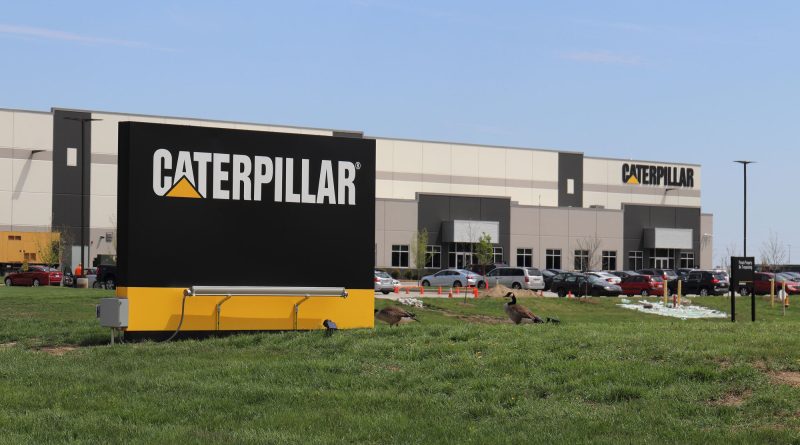
Caterpillar targets $890 million boost to manufacturing capacity

Subscribe to our free newsletter today to keep up to date with the latest manufacturing news.
Caterpillar is considering an investment of about $890 million at its Lafayette, Indiana, manufacturing operation, adding to a major expansion already underway at the site.
The proposed program would include about $350 million for renovations, upgrades or expansion and $540 million for manufacturing equipment. The project is also tied to the retention of 1,995 employees.
The scale is significant. Caterpillar previously announced a $725 million expansion of its Lafayette Large Engine Center. Together, the existing program and proposed investment would represent about $1.615 billion tied to the site.
The newer project still requires local action. The Lafayette Redevelopment Commission scheduled resolutions related to Caterpillar property tax abatements for its Aug. 27 meeting. No final outcome was available when this article was prepared.
The investment comes as Caterpillar works to increase production of large engines used in power generation, industrial equipment, marine applications, oil and gas and rail.
It also points to a wider shift in industrial demand. Rapid data center construction is increasing the need for power equipment alongside servers and computing hardware. Manufacturers that supply engines, generators and electrical infrastructure are becoming part of the investment cycle linked to cloud computing and artificial intelligence.
Rising power demand is changing manufacturing priorities
Caterpillar has already linked its Lafayette expansion to growing demand for prime and backup power.
When the company announced its earlier $725 million investment, it said the project would expand production of large reciprocating engines and help meet increasing demand for power generation. Caterpillar also identified data centers, cloud computing and generative AI as sources of that demand.
This relationship is becoming more important as technology companies build larger computing facilities.
Data centers need large and dependable electricity supplies. They also require backup generation to keep operations running when grid power is interrupted. That means spending on digital infrastructure can produce more orders for equipment manufacturers far removed from semiconductor production.
For Caterpillar, the opportunity reaches across its engine and power generation businesses. The Lafayette Large Engine Center is part of that wider production network.
The plant manufactures large diesel and natural gas engines. Its output serves industries where reliable power is a basic operating requirement. Higher electricity demand from data centers therefore adds another source of growth to markets Caterpillar has served for decades.
This creates a different industrial effect from the more visible spending on chips and data center buildings. Each new computing facility also needs electrical systems, cooling equipment, generators and other physical infrastructure.
For manufacturers, this means AI-related spending is extending into established industrial sectors.
Caterpillar is adding investment to an expansion already underway
The latest proposal follows a $725 million Lafayette expansion announced in 2024.
That program included a 300,000-square-foot addition to the existing 1.6 million-square-foot Large Engine Center. Caterpillar said $625 million would go toward machinery, equipment and rail infrastructure, while about $100 million would fund the building expansion.
The project was expected to create about 100 jobs.
Caterpillar later described the program as one of the largest single manufacturing investments in its history. The company also committed up to $5 million for workforce development and training in Indiana.
The proposed $890 million program would extend that period of investment.
Its size also provides a measure of Caterpillar’s commitment to expanding and modernizing US production. Earlier in 2026, Caterpillar said it expected companywide capital expenditures of about $3.5 billion for the year.
The Lafayette proposal should not be compared directly with that annual figure because large industrial projects can be funded over several years. Even so, an $890 million project at one manufacturing location shows how much capital Caterpillar is considering for additional production capacity and equipment.
The split between property investment and machinery is also notable.
More than half of the proposed spending would go toward manufacturing equipment. That suggests the project is not simply about adding factory space. It would also involve the production systems needed to increase output, improve processes or manufacture newer products.
AI investment is reaching deeper into the industrial supply chain
The Lafayette plans show how changing electricity demand can influence manufacturing investment beyond the technology industry.
AI and cloud computing depend on physical infrastructure as well as computing power. New data centers need dependable electricity. Utilities need generation and grid equipment. Operators also need backup systems that can protect facilities where downtime can be costly.
That demand is creating business for manufacturers that may not traditionally be viewed as part of the digital economy.
Caterpillar is one example. Its large engines have long served industrial and power generation markets. Data centers now provide another use case for products built on much of the same manufacturing base.
The investment also shows why production capacity and workforce planning are closely linked. A larger factory footprint has limited value without enough skilled employees to operate and maintain its equipment. Caterpillar’s workforce training commitment in Indiana reflects that need.
For other industrial companies, the implications are broader. Growth in AI infrastructure extends beyond semiconductors and server racks. It reaches power generation, electrical equipment, construction and manufacturing supply chains.
If Caterpillar proceeds with another $890 million at Lafayette, the plant will offer a clear example of how rising electricity demand is shaping capital spending in traditional US manufacturing.
Source