
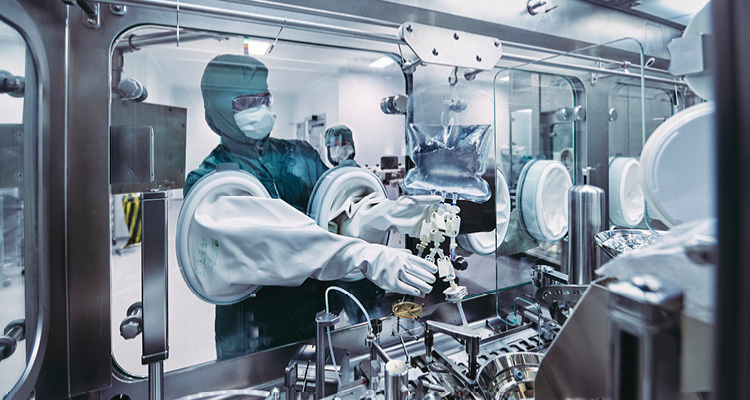
Chief Business Officer Dr. Sébastien Ribault tells us how OXB is expanding its manufacturing network and preparing for product launches

Two years ago, OXB set out to show customers it could do more than develop viral vector technologies. Now, the business is adding manufacturing capacity on two continents as more projects move into late-stage development and commercial production.
The transformation marks a period of growth that has touched nearly every part of OXB’s business. With a larger footprint in Europe and the US, more commercial manufacturing, and a growing program portfolio, OXB has changed its scale and its standing in the cell and gene therapy sector.
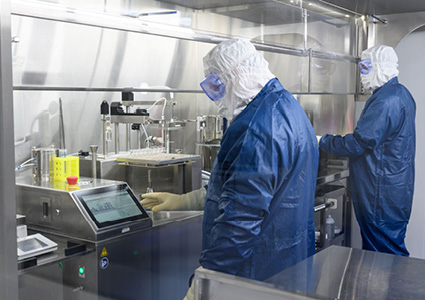
Chief Business Officer Dr. Sébastien Ribault has seen customer conversations evolve dramatically at OXB, once known as Oxford Biomedica. “Oxford Biomedica was really known as a product developer and technology company. It took a couple of years to reposition the business and establish it as a true contract development and manufacturing organization (CDMO). The market’s perception of the company has changed in several ways. We’re now seen as both a lentiviral and adeno-associated virus (AAV) company, and more than a developer – we’re recognized for our manufacturing capabilities as well.”
The market now brings in a wider range of opportunities and sees customers engaging with OXB both earlier and later in their journey. Many are planning ahead for manufacturing challenges, not just seeking development support.
Sébastien has played a key role in shaping this transformation since joining OXB in 2022. He has driven the commercial strategy behind OXB’s expansion, adding new facilities, new capabilities, and a bigger presence in the US and Europe. With experience in biotechnology, manufacturing, and gene therapy development, he still draws on that background to guide OXB’s growth.
OXB started in 1995 as a University of Oxford spinout and has grown alongside the cell and gene therapy market. The company began as a business focused on innovation and platform development. Today, OXB operates as a viral vector CDMO across the UK, France, and the US, supporting lentiviral, AAV, adenoviral, measles, MVA, and other vector programs from development to commercial supply.
OXB did not make this transition through one big move. Instead, the company grew through acquisitions and capability expansion, transforming from a specialist lentiviral vector provider into a full-service viral vector CDMO.
OXB’s first real test came when demand outpaced its capacity. The company had planned to expand in Bedford, Massachusetts, and had started engineering work. Then, an opportunity arose to acquire a former National Resilience facility in Durham, North Carolina. That prompted OXB to reconsider how quickly, and in what way, it could add capacity. “We looked at the pros and cons of buying versus building. Acquiring the facility was faster than continuing the expansion in Bedford, and we weren’t just buying a shell. We were bringing in an experienced team that was already operating there.” The acquisition brought manufacturing suites, regulatory history, and operational experience into the business in a single move. “It has really been a game changer,” adds Sébastien.
Durham’s significance goes beyond the facility. It is visible proof of OXB’s new direction. Customers now see a bigger manufacturing footprint, broader capabilities, and a growing focus on late-stage and commercial work.
OXB made the acquisition to meet existing demand, not just future potential. “We weren’t expanding capacity in anticipation of new clients. We had already secured new clients, which led us to accelerate our US expansion and bring additional capacity online much more quickly.” That distinction matters. Instead of building capacity for possible growth, OXB responded to growth that was already knocking at its door.
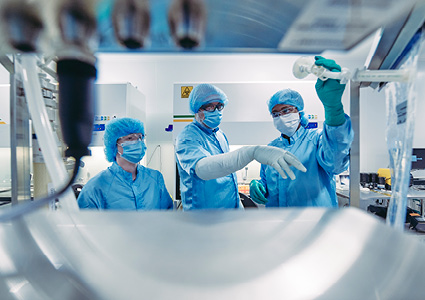
OXB’s expansion story does not stop in North Carolina. Across Europe, OXB has followed a similar playbook, building stronger links between sites and creating a manufacturing network that supports customers in every region.
Acquiring facilities in Lyon and Strasbourg was part of that effort. The goal was not just to add more space, but to establish key platforms across continental Europe and reduce reliance on a single location. Now, Lyon handles development and GMP-scale work for lentiviral and AAV programs.
With activity in Strasbourg and Oxford too, these facilities have helped create a network that gives customers access to the same capabilities in multiple locations. Building that network took more than physical sites. It required consistency.
Historically, process characterization capabilities sat primarily within the UK operation. As OXB expanded, customers increasingly wanted access to this expertise elsewhere in the network, as Sébastien explains. “Over the past 18 months, we’ve established a process characterization blueprint across all of our sites, giving customers access to the same capabilities across multiple geographies rather than relying on a single location.”
The result has been greater flexibility for customers and a different way of approaching timelines. “We’re currently supporting two customers by running process characterization activities in parallel across two sites.” The focus on time has become increasingly important as therapies move through development. Sponsors are under pressure to reach clinical milestones more quickly, and they want manufacturers to compress schedules.
Sébastien notes that rather than treating the timelines as fixed, OXB has challenged some of the assumptions behind them. “We’re delivering material for Phase I programs in seven to nine months for both vector types, compared with the typical 12 to 18 months seen across the industry.”
The fast-track strategies developed for lentiviral and AAV programs stem from a broader belief that manufacturing experience should create measurable advantages for customers. Achieving those gains, however, necessitates more than capacity and process improvements. It depends on using knowledge accumulated over decades of work.
With more than three decades of viral vector development and manufacturing behind it, OXB is increasingly focusing on how that knowledge can be applied across future programs. “The challenge is no longer generating information. It’s making better use of the information already available. Over more than 30 years, we’ve built a significant body of knowledge through development and manufacturing activities, and we’re paying particular attention to how we can leverage the huge amount of data we’ve generated across projects.”
As OXB takes on more programs, the opportunity lies in applying lessons from previous work rather than starting from the beginning each time. The next leverage may come not from new infrastructure, but from how effectively OXB can draw on what it has already learned. “We’re placing a strong focus on data analysis and how we can make better use of the vast amount of data we’ve generated across our projects.” The objective is practical. If previous programs have already generated useful insights, teams should be able to build on that foundation rather than recreate it.
Much of OXB’s recent growth has been driven by manufacturing, but investment in the underlying science has not slowed. OXB has continued investing in the technologies that will shape future therapies. One area receiving sustained attention is in vivo cell and gene therapy, where it continues to invest heavily in in vivo platform development for in vivo CAR-T therapies.
Work on expression systems, promoters, and vector design remains an active part of OXB’s development strategy, reflecting a belief that manufacturing and innovation must continue to evolve together. OXB wants higher yields without sacrificing vector quality. “It’s not just about productivity. We’re equally focused on the quality of the vector we deliver in the end,” states Sébastien.
The market has moved too. When Sébastien joined the company, oncology programs and ex vivo CAR-T therapies dominated discussions. Those conversations continue, but they no longer define the entire landscape. “If I look at the business today, the conversation is much broader. Alongside lentiviral vectors, we’re working across AAV, measles, MVA, and other platforms. Oncology remains a major area of activity, but we’re also supporting programs in ophthalmology, dermatology, neurology, and a growing range of other indications.”
The diversification is changing both the type of work entering OXB and the stage at which customers engage with the business. For Sébastien, evidence of that shift is in the numbers. “We’re seeing more than 30 percent growth in project volumes compared with last year. It’s not just coming from early-stage work such as process development and Phase I manufacturing. We’re also seeing strong growth in late-stage and commercial manufacturing.”
That mix may be one of the clearest indicators of where the company is headed. More programs are progressing through development. More customers are preparing for commercialization. And more manufacturing activity now ties directly to product launches.
As OXB looks toward 2027, that reality is shaping priorities across the business. “We expect several product launches over the next 12 months, with the latest currently scheduled for Q3 2027.” Preparing for those launches means continuing the US ramp-up, expanding manufacturing capabilities across the network, and ensuring facilities are ready to support increasing demand. It means delivering larger AAV programs from the UK while maintaining the consistency customers expect across every site.
For a company once defined largely by its platform technologies, the focus has shifted. Today’s conversation is less about what OXB can invent and more about what it can deliver as therapies move closer to patients.
