
Choosing the Right Man Lift for Your Paint Booth: 7 Critical Safety Factors

Paint booth operations expose workers to flammable vapors and confined spaces, where access equipment can impact safety outcomes. Many facilities still rely on ladders or scaffolding, which create fall hazards and force operators to work in awkward positions. The right personnel lift eliminates these risks while helping facilities meet regulatory standards and maintain efficient production in volatile environments.
Key Safety Factors for Industrial Lift Systems
Facility managers and maintenance supervisors evaluating top-rated man lifts for indoor paint booths must assess specific safety features that protect workers and maintain regulatory compliance. Seven factors determine whether a personnel lift system can operate safely in hazardous spray finishing environments.
1. The Importance of Explosion-Proof Certifications
Paint booths create highly volatile atmospheres in which flammable materials and vapors pose constant ignition risks. Standard electrical equipment generates sparks or heat during normal operation that can trigger catastrophic explosions. Proper certification for hazardous locations requires specialized construction where potential ignition sources are contained within sealed housings.
Operating without explosion-proof certified systems risks causing devastating fires and injuries. Workers may also face prolonged exposure to harmful coating vapors and airborne particles. Managers should verify that lift systems are properly certified for Class I Division 1 or Division 2 hazardous locations, depending on the booth classification.
2. Strict OSHA and NFPA Compliance
Meeting workplace safety regulations protects operators and helps avoid substantial fines. The National Fire Protection Association establishes requirements through NFPA 33 guidelines governing spray area design and operation when flammable materials are used. These standards address ventilation, electrical equipment and safe work practices.
The Occupational Safety and Health Administration (OSHA) enforces man lift design requirements through elevation controls that feature safety standards providing reasonable protection for operators. These stipulations cover structural integrity, emergency controls and operational procedures. OSHA also mandates that designated personnel conduct mandatory man lift inspections at regular monthly intervals. Emergency stops and other safety features must allow operators to respond quickly during emergencies.
3. Safe Maneuverability in Confined Spaces
Large workpieces often fill available booth space and leave minimal clearance for access equipment. Standard platforms often struggle to navigate these obstructions and risk collisions that damage products or injure workers. Personnel lifts for paint booth applications must move smoothly through restricted areas without compromising operator safety or workpiece integrity.
Appropriate footprint dimensions and turning radius enable workers to position themselves where needed. Smooth control systems prevent jerky movements that could cause operators to lose balance in elevated positions. Before making a purchase decision, managers should evaluate whether lift systems can safely navigate their specific booth layout and workpiece dimensions.
4. Optimal Vertical and Horizontal Reach
Workers who cannot reach all areas of large workpieces face two problematic choices. They either stretch and strain into unsafe positions or repeatedly exit the platform to manually reposition equipment. Both reduce productivity and increase the risk of injury.
Personnel lifts with adequate height and reach eliminate these problems and provide ergonomic positioning throughout the entire work surface. Operators can complete tasks from stable positions without overextending their bodies. Continuous platform availability means workers spend more time applying coatings instead of relocating equipment.
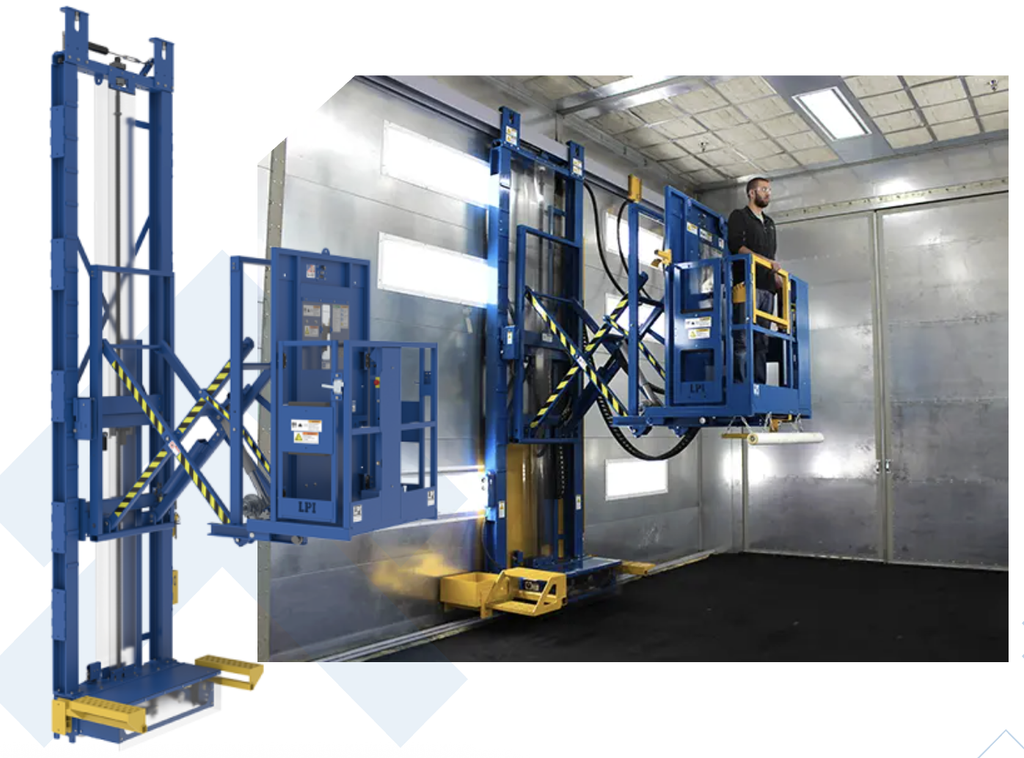
LPI Lift Systems equipment exemplifies advanced reach capabilities. Its stationary pneumatic scissor lifts and rail-guided self-propelled scissor platforms are great examples of machines that provide controlled vertical positioning for surface finishing applications. LPI Lift Systems’ wide range of machines features power options, including pneumatic-hydraulic and electric-hydraulic configurations chosen to meet facility requirements and available utilities.
Key features include:
- Configurability to specific height and reach requirements through custom or pre-engineered designs.
- Supporting pneumatic-hydraulic or electric-hydraulic power based on available facility infrastructure.
- Units that are factory-tested before delivery to confirm safe operation in surface finishing environments.
5. Heavy-Duty Equipment Durability
Spray booths subject equipment to overspray, chemicals and continuous operation, while degrading components introduce safety hazards as structural elements weaken or control systems fail. Personnel lifts operating in paint booths need robust constructions that maintain integrity throughout extended service life.
Harsh booth conditions demand heavy-duty materials and protective finishes. To prevent contaminant infiltration into electrical and mechanical systems, sealed components are essential. Managers should evaluate construction quality and material specifications to confirm that the system can handle the unique operating conditions of each environment.
6. Safe Load Capacity Limits
Every personnel lift has a maximum weight rating that accounts for operators, tools and materials. Exceeding these limits compromises structural stability and increases the risk of tipping. Calculating total platform loads before each use helps prevent dangerous overloading that threatens worker safety.
Equipment manufacturers provide clear capacity specifications that should never be exceeded. Supervisors must ensure workers understand these limits and follow proper loading procedures.
7. Ease of Routine Equipment Maintenance
Maintenance accessibility affects whether facilities can keep equipment in a safe operating condition. Complex systems with difficult access to components often receive delayed or incomplete servicing, allowing safety issues to develop. Technicians should complete daily maintenance procedures on personnel lifts.
When inspections occur regularly, worn components get flagged before they fail. That said, replacement parts should be readily available to prevent extended downtime. Anticipated maintenance costs an average of $3,000 annually, while unexpected repairs can be over $10,000. Establishing relationships with manufacturers that provide traveling technicians for on-site lift inspections, maintenance and repair helps organizations stay compliant with OSHA inspection requirements and maintain safe operations throughout the system’s service life.
Frequently Asked Questions About Man Lifts for Paint Booths
Facility managers have specific concerns when evaluating personnel lift systems for spray finishing applications.
Why does explosion-proof certification matter for paint booth lifts?
Paint booth environments contain flammable vapors that can ignite when exposed to standard electrical sparks or heat. Without proper certification, electrical components can trigger fires or explosions during normal operation. Class I, Division 1 or Division 2 certification confirms that the system uses sealed construction designed to contain ignition sources and operate safely in volatile atmospheres.
What happens if a facility uses equipment that exceeds load capacity ratings?
Overloaded platforms compromise structural stability and create serious tipping hazards. Before each use, operators must calculate the total weight, including themselves, tools, spray equipment and coating materials. Manufacturers establish maximum ratings for good reason. When equipment carries excessive loads, dangerous conditions can develop during what appears to be normal operation. Training workers on proper loading procedures reduces these risks.
How does proper reach capability improve both safety and efficiency?
Adequate vertical and horizontal reach eliminates unsafe stretching and the constant need to exit and reposition platforms. Workers maintain stable positioning throughout finishing tasks instead of overextending their bodies into awkward postures. This ergonomic advantage reduces injury risk while allowing operators to focus on applying coatings rather than managing equipment location.
Operator Safety Solutions
Selecting personnel lifts for paint booth work requires careful evaluation of equipment capabilities against safety requirements. The right system protects workers from fall hazards and explosion risks while providing ergonomic positioning that maintains productive finishing work. Managers should assess their current methods and contact reputable manufacturers to discuss lift solutions that meet both safety standards and operational needs.

*Please note that this list includes sponsored content. Some of the companies, products, or services featured have entered into commercial agreements for placement. Sponsored placements do not necessarily reflect an endorsement and should be considered alongside other options in the marketplace.