

Contractor-focused innovation and education remain central to Schluter-Systems’ disruptive growth strategy

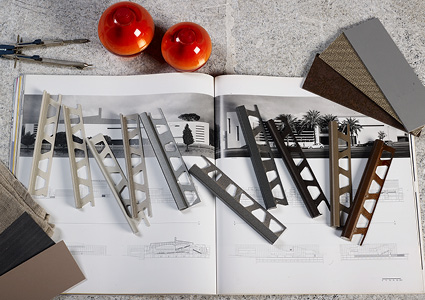
Founded in Germany in 1966 by master tile setter Werner Schlüter, Schluter-Systems has grown from a specialist tile installation business into one of the world’s most recognized manufacturers of tile and stone installation systems. The company’s breakthrough came in 1975 with the launch of SCHIENE, a metal edge-protection profile developed to prevent exposed tile edges from chipping while delivering a cleaner architectural finish. That innovation laid the foundation for a business now spanning more than 40 product lines and thousands of SKUs, including waterproofing membranes, uncoupling systems, drainage solutions and underfloor heating technologies used across residential, commercial and hospitality projects worldwide.
Today, Schluter is widely regarded as a pioneer in integrated tile assembly systems, particularly through products such as KERDI and DITRA, which helped redefine modern waterproofing and substrate preparation practices. Headquartered in Iserlohn, Germany, the family-run company operates across Europe and North America, with manufacturing, distribution and training facilities supporting contractors, architects, specifiers and distributors globally. Education remains central to the company’s philosophy, reflected in its long-running technical training programs and emphasis on correct system installation.
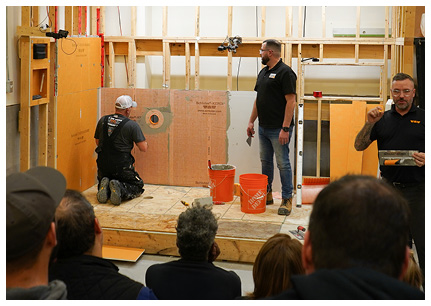
“We’ve always said that’s where we hang our hat as a company,” says Dee Degooyer, Chief Sales Officer. “We’re owned by a tile installer, and we sell to installers, but we don’t do it through traditional methods. We go to market in a very education-based way. The philosophy from the owner was always that you can’t sell our products, you must educate our products. So, we don’t hire salespeople; we hire installers and teach them how to sell. It’s a different approach to the market, but it’s a very core part of our business and always has been.”
Dee explains how that same philosophy continues to shape the company’s product development strategy as the construction sector evolves and skilled tile installers become harder to find. “We’re very solution-minded,” he elaborates. “The industry has changed and the craftsmanship side of tile installation is becoming more difficult to source, so we’ve evolved as well. We don’t just target the traditional tile installer demographic anymore; we look at everybody installing tiles, from remodelers through to DIY users. We try to manufacture products with all the belts and braces in mind, so we can offer solutions across all those customer groups.”
Investing in innovation
One of Schluter’s greatest strengths has also become one of its biggest competitive challenges. “Our success has made us a target,” Dee shares. “We’ve been a giant disruptor in the market because of the way we educate and the way we solve problems within the industry. Now a lot of companies are trying to replicate not just our products, but even our route to market.” He adds that products inspired by Schluter’s systems can now be seen across the sector, from tool manufacturers to chemical suppliers, often competing primarily on price rather than technical support or training. “We go out and do all the heavy lifting with education and investment,” he explains. “Then others come in with similar-looking solutions at a lower price point, but without the same level of backing behind them.”
Indeed, Schluter’s impact on the industry has come from identifying long-standing installation challenges and designing systems that rethink traditional methods. Dee believes this willingness to challenge established practices is what positioned Schluter as an industry disruptor. “A lot of our products go against traditional installation methods, but they offer a better solution for both the installer and the end consumer,” he says.
Education remains central to driving that shift in mindset. The company now delivers more than 300 seminars annually across the United States and Canada, training over 10,000 attendees each year. “Changing installation methods means changing mindsets, and education is the biggest part of that.”
Additionally, Schluter continues to invest heavily in manufacturing and infrastructure as demand for its technologies grows across North America, having recently completed its second thin-set and powder production facility in Roanoke, Virginia, one of the most technologically advanced plants of its kind in the industry. “You really can’t compare it to a traditional powder plant or even what most competitors are doing,” Dee enthuses. “The technologies we’re using there are on another level.” Schluter is also continuing to expand its manufacturing footprint, with further investments and future factory developments planned across the country to support its long-term growth and product innovation strategy.
“Sustainability,” he adds, “remains a key consideration across both product development and facility design. It’s always at the forefront of our thought process. We work with products like waterproofing membranes that are plastic-based, so we must look at sustainability differently.” Rather than focusing solely on material composition, Schluter prioritizes durability and lifecycle performance, designing systems intended to last for decades. “If a tile installation can last 50, 80 or even 100 years, that’s a very different sustainability story compared to installations that need to be repeatedly replaced,” he explains.
That philosophy also extends to the company’s manufacturing operations. Schluter has invested in environmental technologies that go well beyond standard industry practice, including geothermal systems, solar integration and multiple LEED Gold-certified production facilities. The company’s Reno facility is a flagship example. “It was built using technologies that nobody else in North America is really utilizing,” he says. “It comes at an additional cost, but the owners take a very common-sense approach to sustainability and long-term investment.”
For Dee, company culture is one of the defining characteristics behind Schluter’s long-term success. “Culture is part of our thought process in everything we do,” he shares. “I’ve been with the business for more than 20 years and there are a remarkable number of long-serving employees across the organization as evidence of that commitment. We have people who have been with the company for 30, 35, even 40 years.” In fact, Dee’s father was among Schluter’s first sales representatives in North America and remained with the business until retirement.
Looking ahead, Schluter remains focused on maintaining the same principles that have underpinned the business since its founding. As a privately held, family-owned company led by Werner Schlüter’s sons, Mark and Udo, the business has been able to prioritize long-term value over short-term profitability. “A lot of companies are driven purely by profits, but the philosophy here has always been that if you do things right, the profits will follow,” he explains. “That mindset came directly from Werner Schlüter, and the family has stayed true to it.” Even during periods of market volatility or geopolitical uncertainty, the company avoids reactive decision-making and instead focuses on the fundamentals that have consistently delivered growth.
“Our culture is one of the few things that competitors cannot replicate. Every company talks about culture, but this company takes it to another level. It’s something we protect very carefully.” That commitment is closely tied to the company’s premium positioning in the market. “We’re a high-value product and an expensive product,” Dee concludes. “Our job is to make sure customers understand that the value we bring goes far beyond just the price of the product.”
www.schluter.com/schluter-us/en_US
