
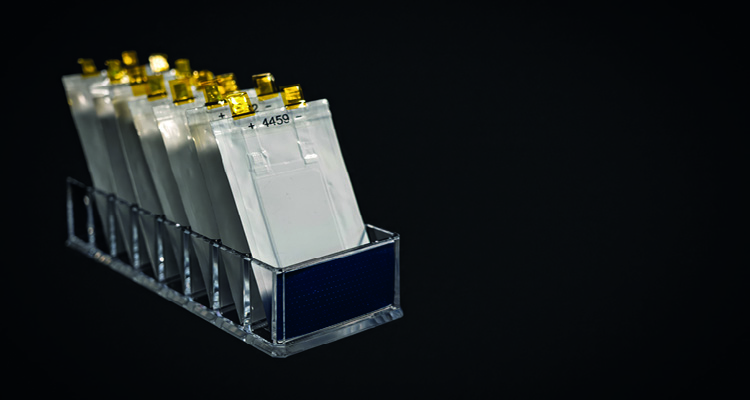
Delivering safety and high-performance, Blue Current is scaling the battery of the future

Blue Current is on a mission to deliver an inherently safe, high-performance battery technology powered by silicon, one of the most abundant materials on Earth. From AI infrastructure to electric vehicles (EVs) and robotics, Blue Current’s advanced technology uses silicon elastic composite chemistry to create a safe, energy-dense battery that delivers long cycle life.
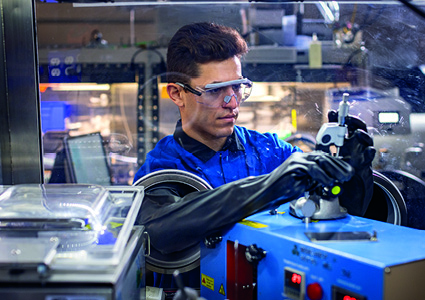
Established 12 years ago, the company initially focused on research and development to secure confidence in its product and technology before moving to pilot – and eventually full-scale – manufacturing. With a pilot manufacturing line now operational, we speak with Veeral Hardev, Vice President of Business Development, about how the company is navigating this transition period.
“Everything we do aims to derisk battery technology by building a battery that is inherently safe and simultaneously delivers state-of-the-art performance,” Veeral begins. “We’ve spent years experimenting and conducting both internal testing and external validations, and we’ve raised around $150 million to date, including our latest Series D extension round, which was anchored by Amazon. Support from a company like Amazon is not only active recognition of our battery technology but also a reflection of the urgent need for energy resiliency around stationary storage.
“Having gained full confidence in our technology and design over the last 12 years, we’re now transitioning from a true R&D phase into pilot-scale production, with a view to full-scale efficient manufacturing. Our pilot line at our facility in California is currently producing 2Ah battery cells, which is the size used for in-depth validation on performance and safety certifications.”
Elaborating on the technology, Veeral continues: “Our core offering is what we call a fully dry silicon elastic composite battery platform, which is naturally more sustainable as silicon is an earth-abundant material. We’ve successfully removed flammable liquids from our battery design while maintaining performance, meaning it has excellent energy performance across all the main metrics in the battery space, such as high energy density and long cycle life.”
Founded around the concept of creating a safer battery with good energy performance, Blue Current’s approach to design and development is embedded in this value proposition. “The first thing we did was eliminate all flammable and hazardous liquid material from the battery,” Veeral says. “Secondly, we introduced silicon in our designs. Although silicon has faced challenges historically due to the way it expands and contracts depending on temperature, we’ve developed a composite platform that allows the silicon to bend and flex to a certain degree without impacting the overall battery structure.”
The applications for Blue Current’s battery technology are wide-ranging, as Veeral explains. “The technology can be used in several end-user markets in both stationary and mobility storage, as it provides great performance without compromising current and historic safety concerns,” he elaborates. “Stationary storage includes data centers, AI infrastructure, and grid storage, whereas mobility storage ranges from EVs to robotics and drones, and our technology can serve each application without needing further specific research.
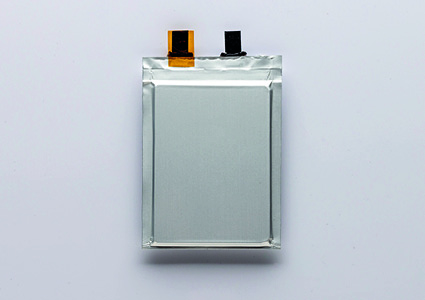
“Currently, we’re prioritizing the AI and data center market, as there is huge demand for reliable, high-density batteries not only in the domestic North American market, but also globally,” Veeral adds. “Safety is also becoming an issue in the data center industry as the infrastructure is very expensive, causing many developers and insurers to be concerned about the proximity to batteries. However, with no dangerous or toxic materials, our technology offers a safe and reliable solution for the AI and data center sectors.
“Micromobility and robotics applications are also very interesting because as they grow, traditional technologies are challenged to create products that are not only more efficient and have a longer range but are also lightweight and small due to the application size. Our solution provides a unique capability in terms of achieving these metrics without compromising in other areas, which enables greater design freedom for product designers in these markets.”
Today, as Veeral discusses, the company is running a pilot manufacturing line as it prepares to scale beyond its current operations. “We’re taking a pragmatic, systematic approach to development, and we’re constantly striving to improve our performance and safety metrics,” he states. “The rest of 2026 is about execution, and by the end of the year, we hope to sample our battery cells to gain more customer feedback and deepen our engagement with partners. Over the next two years, we’ll scale from 2 Ah battery cell size to larger form factors, and we’ll continue to improve the technology as we move toward mass production.”
Looking ahead to commercial adoption, Veeral outlines four milestones to clear before solid-state batteries can achieve widespread adoption. “The first is credibility through third-party validated data in terms of both performance and safety,” he shares. “The second is consistent, high-volume production that delivers repeatable scaled results. Next is real-world deployments with positive customer results. Lastly, and perhaps most critical, is having scaled production at a cost structure that is acceptable to both the market and the manufacturing supply chain. To be successful we need a super competitive product that makes sense for both our business and the wider market, particularly given pricing pressure from Asia.
“In summary, we’re building an inherently safe, state-of-the-art battery,” Veeral concludes. “We’ve secured great partners and investors, and our product can be used in several applications that traditional battery technologies cannot support. We’re growing and excited about our journey ahead toward mass production and commercial adoption.”
