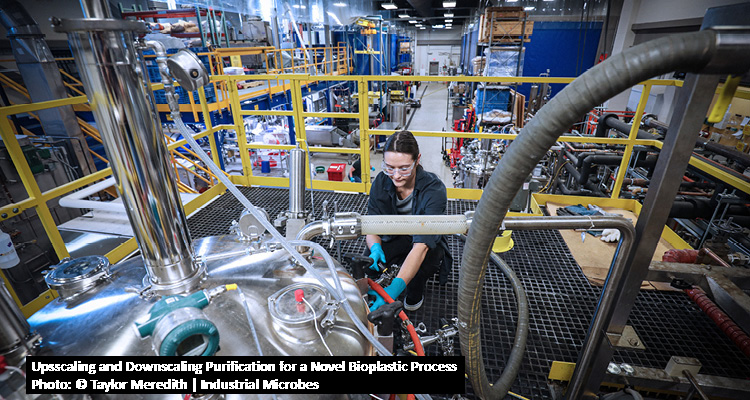
Discover how BioMADE is closing the gap between laboratory breakthroughs and commercial biomanufacturing

Funded through the Department of Defense, BioMADE is a public-private biomanufacturing partnership with more than 300 members, including universities, colleges, startups, and global businesses. Since our last conversation a year ago, three major developments have been unfolding at BioMADE. Jill Zullo, EVP and COO, takes us through each of them.
“On the technology and innovation front, we announced just over $21 million invested across 14 projects in April of this year. Seven focused on technical innovation, several on education and workforce development, and a few on safety and security, spanning the full breadth of what we do. Midway through this summer, we also published interesting research we commissioned on consumer attitudes towards bio-based products. We found that over 56 percent of Americans are interested in having more bio-based products in their lives, six in ten believe the US Government should invest in biomanufacturing to help these companies succeed, and 59 percent think the US should work hard to retain its leadership in this space. To see that level of agreement in today’s political climate, where consensus on almost anything feels rare, is truly encouraging. Beyond that, work on our Pilot Plant Network (PPN) has progressed significantly. We previously announced that three facilities had started engineering and design work, and now we are breaking ground and building out each of those sites,” she begins.
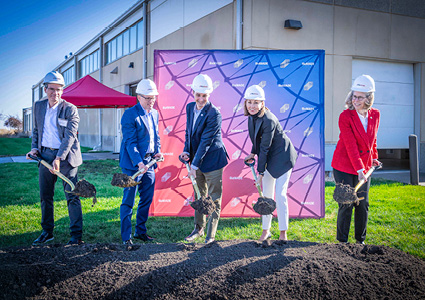
Iowa Governor Reynolds, Iowa State University, and BioMADE Break Ground on New $40M Biomanufacturing Facility
Photo: © Bhatt Photography | BioMADE
The centerpiece of that infrastructure investment is BioMADE’s new flagship facility in Minnesota, which has been a core priority over the past several years. Global inflation and rising steel costs required careful value engineering and additional time, but the result is a facility worth waiting for. The Minnesota plant will be structurally complete by October 2027 and will begin welcoming customers in early spring 2028. BioMADE’s largest facility at 120,000 square feet, it will house a 25,000-liter fermenter alongside a smaller 5000-liter unit used for piloting work. The larger fermenter opens up a different category of possibility by enabling real-scale demonstrations and the production of enough material to evaluate commercial viability, test performance in end applications, assess the economics, and validate functionality in a way that smaller-scale work cannot.
“In this facility, we will be able to produce a wide variety of products, including solvents and other materials of specific interest to the Department of Defense, which is our main investor. BioMADE was founded to strengthen national security. Bio-based products play a surprisingly significant role in that picture, given that certain supply chains can only be built through biology, and the pandemic showed all of us what happens when global supply chains are disrupted or shut down. In today’s geopolitical climate, having dedicated domestic supply chains for at least a portion of your products is essential. That is exactly what the Minnesota facility helps us address,” Jill elaborates.
Alongside Minnesota, BioMADE is developing a pilot-scale facility in the San Francisco Bay Area, which will be the first to open, welcoming customers in summer/early fall 2027. The California site is smaller, equipped with 4000-liter fermenters and scale-up capabilities, but its location is a major advantage. “We are surrounded by around 60 member companies within an hour’s drive, which makes it super convenient. We also expanded the facility by acquiring additional lab equipment, allowing us to create an incubator space. This development reflects one of the most pressing trends in our sector right now. Capital markets are really tight, so many companies that have completed their basic research are now trying to stretch their money and runway by stepping out of expensive long-term lab leases,” Jill enlightens.
BioMADE’s incubator offers companies the ability to come in for weeks or months at a time without the burden of a long-term commitment or rental agreement. “We are also talking to investors about this,” she adds. “Typically, a company receives a big tranche of funding and immediately signs a ten-year lease. What if instead they came to us for six months or a year, figured out exactly what they need, and then made that commitment? It is a more efficient model for everyone, and in the Bay Area, we think it will resonate strongly with the startup comunity.”
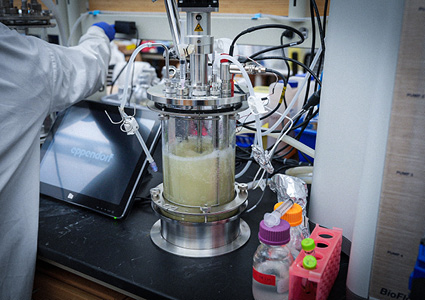
Photo: © Schmidt Sciences | Iowa State University
In addition to Minnesota and California, BioMADE is also developing its Iowa pilot-scale facility, which plays a critical role in expanding biomanufacturing capacity across the Midwest. The Iowa site is designed to support fermentation, downstream processing, and applied research activities that help companies bridge the gap between early-stage development and commercial readiness. Its location provides strategic proximity to agricultural feedstocks, regional workforce pipelines, and established manufacturing infrastructure to further strengthen domestic supply chains and create new opportunities across the region.
Collaboration is at the heart of BioMADE’s model, and the organization invests actively in building and sustaining its own ecosystem. To foster collaboration, the company offers a variety of opportunities for members to connect, including pop-up discussions on specific topics, monthly committee meetings, annual gatherings, and targeted webinars. All these events are designed to give member companies exposure to one another as well as the opportunity to share best practice and advice.
BioMADE is also leading a significant effort to update its technology roadmaps, which capture the current state of biomanufacturing and identify the improvements needed to reach the next commercial phase. Rather than being purely technical documents, these roadmaps sit alongside a commercial landscape assessment that helps member companies understand market conditions, economics, and competitive advantages while aligning technical process with commercial viability.
Through these initiatives, BioMADE is building the infrastructure required for a stronger, more resilient US biomanufacturing sector.