
Ebara Elliott Energy is thinking generations ahead, with a strategy built to last 100 years

More than a century after its founding, Elliott Company has evolved into Ebara Elliott Energy (EEE) – and the business has never been more focused on the future. Under the ownership of Japan’s Ebara Corporation since 2000, and formally rebranded in 2023, EEE is now executing a bold strategy designed to secure its place at the forefront of the energy industry for generations to come.
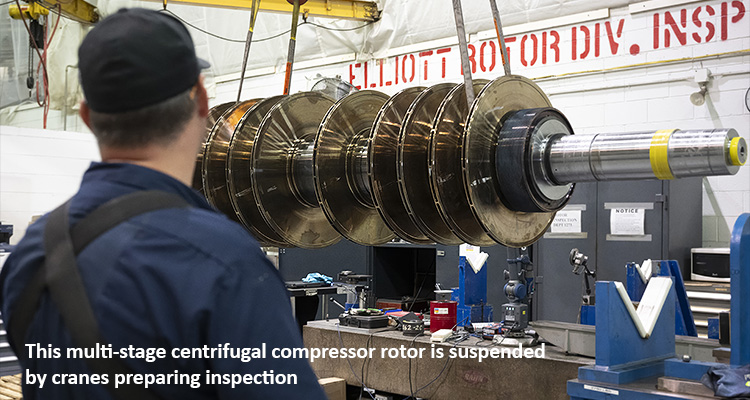
“What is interesting about Elliott Company and Ebara Corporation is that they were founded around the same time, with Elliott in 1910 and Ebara in 1912,” begins Shane Reph, Chief Operating Officer of EEE. The two organizations, one in the US and the other in Japan, followed separate paths until they finally converged in 1968, when Ebara began manufacturing Elliott equipment under license. These ties were strengthened in 1987 when Ebara was one of the investors supporting the Elliott management team’s MBO from UTC. Ultimately, the new millennium saw the formal union of the two businesses and today EEE stands as part of Ebara Corporation and is a world-class manufacturer of rotating equipment, serving critical applications in oil and gas, refining, chemical processing, and power generation.
“Supplying turbomachinery equipment for petrochemical refineries, ethylene, and LNG is our traditional business,” Shane confirms. “We still fully support all those products, but we are also now pivoting to support the transition to green energy and investing significantly in the equipment needed to move into areas such as hydrogen and ramp our ammonia segment back up. We’re also focusing on pumps and cryogenic solutions – we’ve really evolved from being a compressor company into an overall solution provider and we’re still developing.”
Each new area requires a different level of development. “Carbon capture and storage can use our existing products, with some adjustments to increase efficiency,” explains Shane. “Hydrogen is more challenging because of the molecular weights of the gas, so there’s extensive R&D going into that, including on the integrally geared compressor side, which can be used for hydrogen applications and is a brand-new product for us.”
EEE
January 2026 saw Ebara’s existing Hydrogen division added to EEE, under Shane’s remit. “We’re integrating almost 70 people, and we are still getting it fully synergized. One of the most exciting elements is a new hydrogen test facility in Japan, which is now part of EEE. Construction is complete and final testing is underway.”
This center is the world’s first real-scale commercial product test facility using actual liquid pumps for liquid hydrogen and will be a base for product performance testing and elemental technology development. “We also have a cryo test facility, based at our site in the US, in Jeannette, PA. This was a significant investment around five years ago and is for our cryogenic pumps and expanders.”
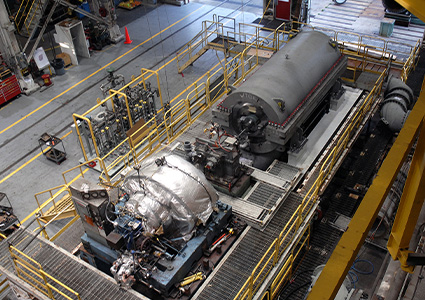
EEE has recently completed a power augmentation upgrade at its Jeannette facility, which enables the testing of compressors with up to 100 MW motors, and means the factory can provide a one-stop production solution. It’s a risk mitigation tool for its customers by providing full-load, full-pressure string testing. “Our focus on LNG drove this decision,” reveals Shane. “The new drive for clean energies has caused LNG to pick up and become one of our leading product areas. We’ve won a lot of projects in the US and Middle East, and we want to be positioned so that we can compete in the mid-size and larger markets.”
This willingness to invest is a thread that runs consistently through EEE’s recent history. “From an automation standpoint, we have invested approximately $70 million in new equipment, and we are already seeing significant increases in productivity, of up to 50 per cent. The last new machine is due in mid-2027, and by then we expect to see further substantial improvements.
“We are also doing a lot of AI training with employees, to demonstrate how it helps improve efficiency. Our leadership teams are pushing AI and while we recognize we must be cautious and assess solutions carefully, it is going to be very effective for us.”
Shane is clear-eyed about the timescale involved. “The Chairman and CEO of EEE, Nobu Miyaki, and I agree that, at this stage in our careers, we won’t see some of the products and projects we are working on being introduced to customers. Some of the projects will come to real fruition 30 years from now. But our job is to establish a company that is ready for the next 100 years or so and that’s where we are focusing our energy.”
He and Nobu were appointed at the same time in 2022 and over the past four years have established a great partnership. “We looked at the Group and when planning on how to move it forward, we decided to adopt a more strategic and less transactional approach. We’ve shifted from being a vendor that reacts to being a partner that anticipates. We started investing in 2023, across a range of different areas to secure that future, and it’s an exciting era to be part of.”
EEE organizes its investment strategy into three-year ‘E Plans’. “We’ve just completed E Plan 2025, which did very well, and now we’re starting E Plan 2028,” continues Shane. “If 2025 was about understanding the structure of the organization, and deciding how we adopt, adapt, and make the right investments, then E Plan 2028 is about execution. Let’s finalize all these projects so we can reap the rewards and move forward.”
While new approaches and investment can reshape a business, it is culture that determines whether change takes hold. “When I was appointed COO, I noted some areas of culture that needed to be improved,” says Shane. The list, which covers topics such as being a catalyst for change, passion, honesty, accountability and innovation, remains on his wall to this day. “I look at it every day and we are making progress. A challenge is ensuring our plans are defined for the whole world, as we are a global business.
“We’ve got the scale of a global leader with the speed of a local partner. We call that glocalization. Ultimately, we are more agile than the ‘Big OEMs,’ allowing us to solve complex challenges and meet deadlines that would paralyze a larger, more bureaucratic organization.”
Building confidence is part of this agility, by empowering staff to have their own voice and be strong advocates for their own ideas. “We tell the teams not to fear failure – we will move forward and fix problems, as we evolve systems and technology,” adds Shane.
That same ethos of empowerment underpins how EEE approaches safety. Although the company already performs better than the industry average, the goal is nothing short of zero incidents. “When people come here, they should go home to their families the way they came,” Shane states. Supporting that commitment is a culture in which every employee is authorized to stop work the moment they identify a risk – no questions asked, no permission needed. Growth, Shane is clear, only happens once safety comes first.
Concerted efforts in staff training are also helping to maintain this new company ethos. The business’ new EEE Academy is designed to be a leadership factory, from hands-on technician workshops to high-level leadership tracks. The focus is on reskilling all levels of the workforce specifically for sustainability and digitalization. “Ultimately, the goal isn’t just ‘training’; it’s creating an agile team that can pivot as the energy market shifts.
“Our HR leader, Jason Reynolds, proposed the idea of us starting a global training university, to unite all the separate programs that were in place. I loved the idea! We changed it to an Academy, recruited outside help to set it up, and have already had cohorts of executive and middle management candidates complete customized programs. That has gone well, and most of them are already in jobs that are a step or two steps above where they started.”
When Shane and Nobu began their work in 2022, the goal was never just short-term improvement – it was legacy. Yet their bold investment strategy has already delivered success. They have built a company that can change with confidence. “The last three years have been the best in the 110-plus-year history of the company, and we want to keep that momentum going,” Shane concludes. “Evolution is our only path to winning.”
