
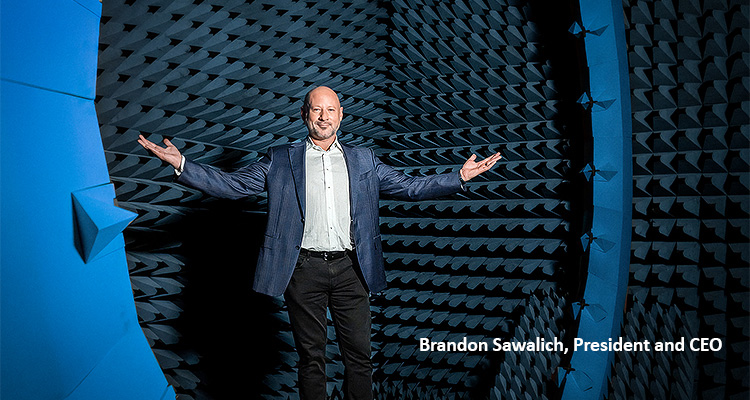
Explore how Starkey combines automation and patient-centered design to create life-changing hearing solutions

With almost 6000 employees and 29 facilities, Starkey stands as a global leader in hearing technology. In line with its core purpose, Starkey seeks to improve lives through better hearing, and the company’s advanced hearing aids and health-focused wearable technology are designed and manufactured in-house and used by millions around the world.
“Headquartered in Eden Prairie, Minnesota, we were founded in 1967 by William F. Austin as a small hearing aid repair business. Over time, we grew into one of the world’s largest hearing technology manufacturers, pioneering AI innovations that transformed hearing aids from simple purpose devices into sophisticated multifunctional health and communication tools,” opens Brandon Sawalich, President and CEO of Starkey.
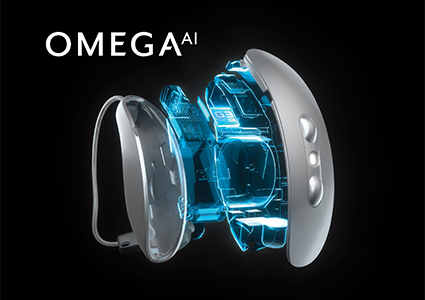
Through decades of research and development, Starkey has introduced significant advancements in hearing technology, rechargeable devices, and integrated sensors that monitor aspects of overall wellness. To-day, the company is recognized for combining its superior sound, innovations such as artificial intelligence, health tracking and connectivity, with a commitment to patient-centered care delivered through hearing healthcare professionals. Starkey continues to lead the industry by offering hearing solutions tailored to any patient’s degree of hearing loss and lifestyle needs. As Brandon explains, its product range spans the full spectrum of hearing device styles and wearing preferences.
“At the more discreet end, we offer invisible-in-the-canal (IIC) and completely-in-the-canal (CIC) devices, as well as our first-to-market rechargeable custom options in in-the-canal (ITC) and in-the-ear (ITE) formats. We also offer receiver-in-the-canal (RIC) devices, which are an industry favorite available in various sizes and in both rechargeable and zinc-air battery-operated variants. Two of our RIC styles also function as CROS and BiCROS devices, which are designed for people who have lost most or all of their hearing in one ear. For people needing maximum power, we offer behind-the-ear (BTE) devices.
“In addition to our range of advanced hearing technology, we offer a dedicated hearing protection line called SoundGear, which offers both custom and universal-fit options. These devices deliver high-fidelity hearing and reliable protection by enhancing the sounds that the user wants to hear while automatically suppressing any sudden or loud noises that are dangerous to their hearing,” he clarifies.
Art and science
Designing such advanced hearing solutions demands a high level of know-how and a detailed manufacturing process. For custom hearing aids, Starkey’s manufacturing approach blends art and science, guided by a strong team of talented technicians from start to finish. Brandon walks us through the process, step-by-step. “Orders are 3D-scanned and entered into our manufacturing system before impressions are digitized and uploaded to the modeling software. Next, the order is evaluated based on the patient’s specific hearing loss and ear shape to determine whether we need to make any design improvements to the final outcome. Our team then models the custom shell to fit snugly and comfortably in the ear. The modeled file is 3D printed using a biocompatible liquid resin and cured with UV LED lights at multiple wavelengths to create a tough, custom-fit shell. After that, the order is kitted with a pre-wired faceplate containing the electronics package and options specified by the hearing care provider. The fit of the electronics into the shell is verified, and the device subsequently moves to wiring, where components and options are added according to the wiring diagram.
“Once the completed wiring package is branded to the correct product and technology level, we perform our quality assurance checks to ensure all devices perform properly. Following that, we place all components into the shell, which is bonded to the faceplate using a UV adhesive. Naturally, we verify sound quality and option functionality before the order proceeds to the next step, where we remove excess faceplate material. Our technician then trims, bevels and buffs the hearing aid to its final shape all while ensuring the final device meets Starkey’s exact brand appearance. External components like wax protection or a removal handle are added next, and the device undergoes acoustic and wireless testing to meet performance requirements. Finally, the hearing aid is programmed to the patient’s settings, a custom data sheet is printed, and the finished product is packed for delivery to the customer,” he elaborates.
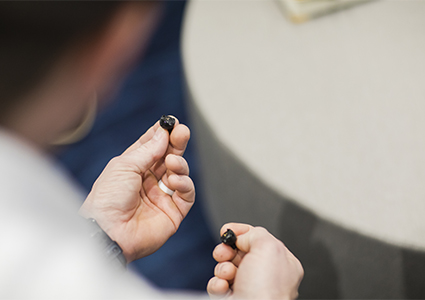
Starkey’s manufacturing process is complex and extremely meticulous, requiring the company to implement powerful tools and team member precision to maintain efficiency. In recent years, Starkey has made substantial investments in automation, particularly in quality control and distribution. Automated solutions to ensure the devices are waterproof, along with the introduction of a new shell resin that makes custom devices shock and drop-proof, have been game changers for patients with active lifestyles. Moreover, these advances have led to fewer returns due to damage from accidental mishandling. Starkey’s new automated laser soldering process has also eliminated solder joint issues, resulting in higher quality technology that has been very well received by both hearing professionals and patients. Its US distribution center has also benefited from numerous investments in automation, contributing to Starkey’s industry-leading on-time delivery rates averaging 99 percent. Together, these automation efforts have streamlined its pro-cesses and delivered significant improvements in product quality and delivery.
According to Brandon, these investments in automation have not only boosted quality and delivery performance in the United States but also laid the foundation for Starkey’s recent global expansion. “In the last 18 months, two large-scale international projects have optimized our ability to increase quality and scalability of production output to support our customers across both Europe and Asia,” he informs. “We opened a new distribution center in Europe, which has empowered us to better support our expanding customer base on the continent. The European distribution center drastically simplifies our supply chain across Europe while enabling us to maintain the level of quality and service excellence our customers have come to expect from us.
“More recently, we relocated a major manufacturing site to a state-of-the-art facility in less than 60 hours with absolutely no disruption to business operations. This brand-new Asia-Pacific Hub will support customer channels throughout Asia and the Pacific regions. The move reflects our ongoing pursuit of global operational excellence as we continue to build a more agile, resilient and customer-centric manufacturing network that delivers innovative hearing technologies faster and more reliably. Looking ahead, our roadmap includes integrating more AI technology into our manufacturing processes, with the same goals of increasing quality and scalability of production output to better serve our customers and their patients,” he ends.
Although it has come a long way from being a small hearing aid repair shop in Minnesota, Starkey’s conviction that better hearing changes lives remains unchanged. Sawalich describes Starkey as “legacy build-future driven,” supported by “the best talent in the hearing industry.” With increased automation processes and a growing global footprint firmly in place, the company is better positioned than ever to deliver on that promise and more.
