Forty years on, SUN Automation combines new machinery with digital innovation to serve corrugated manufacturers worldwide

Founded in 1985, SUN Automation Group (SUN) has spent more than 40 years focused on helping corrugated manufacturers improve productivity, reliability, and overall equipment performance. Although SUN originally started as an equipment and aftermarket-focused business, the company has evolved into a much broader organization – supporting customers with machinery, parts, service, upgrades, automation, and digital technologies.
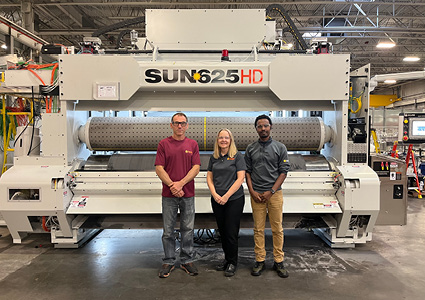
Today, SUN serves corrugated manufacturers around the world, building on an international presence established over decades. SUN products have been sold to more than 40 OEMs and into more than 60 countries globally. Senior Vice President (Operations), Patricia Carner, joins us 18 months since we last spoke with SUN, where she describes the period as “very active,” primarily due to the continued adoption of the SUN625 HD Rotary Die Cutter. “We have also expanded our aftermarket capabilities, invested in new upgrades and modernization solutions, continued the development of our Helios IIoT platform, and carried on tending our relationships with strategic equipment partners,” Patricia adds. “This includes Latitude Machinery Corporation and PARA, among others, which allows SUN to provide customers with a broader range of solutions across converting, material handling, digital finishing, and automation.”
Internationally, SUN is focused on reinvigorating and strengthening the global presence it has built over decades, in Europe and other markets. While that international activity has diminished in recent years amid a more limited cadence of new product introductions, the company is now investing in new machinery, engineering, manufacturing, service, and parts infrastructure to support renewed growth across global markets. “While the business has grown significantly, our focus remains very similar to where it started: understanding the challenges plants face and developing practical solutions that help them operate more efficiently. Our goal is to support the entire lifecycle of the equipment rather than simply selling a machine and moving on to the next project.”
SUN’s global footprint includes long-standing relationships with customers, OEMs, and partners across numerous international markets. Rather than treating any one region as a new market, Patricia explains that the priority is to strengthen the sales, service, parts, and technical support infrastructure needed to support customers wherever they operate. “Success for us is not simply measured by the number of machines sold. It means ensuring customers around the world receive the responsiveness and lifecycle support they expect in North America.”
Coordinating quality standards across a widespread operation is dependent on two main factors: communication and standardization. “Our engineering, operations, and quality teams work from common expectations regarding machine performance, safety, and manufacturing quality,” Patricia elaborates. “Having teams in different regions can be an advantage because the needs of corrugated manufacturers are not identical everywhere. The key is allowing local teams to innovate while maintaining consistent SUN standards for quality, reliability, and customer support.”
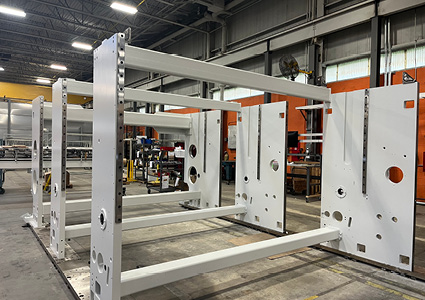
This innovation is most visible in the group’s new Servo machine, anticipated to launch in the second quarter of 2027, along with a Crushless Feeder developed at its Guangzhou site. With the Servo technology designed to simplify mechanical systems, improve control, shorten setup times, and provide greater repeatability, Patricia reveals the No Crush development came from listening directly to customers in the Asian market. The Crushless Feeder is designed to address a significant industry shift toward lighter-weight paper board, a trend that has been established in China for the past five to eight years. Its key advantage is the ability to handle these lighter board grades while still running at OEM-specified speeds. Competing feeder solutions can require machines to operate at roughly 50 percent of their specified speed when processing these lightweight materials, while SUN’s design is intended to maintain full OEM-specified production speeds. Combined with the Servo platform, the development is aimed at helping customers process evolving board grades without sacrificing throughput.
Although the production of innovative equipment is integral to SUN, continuing to expand its client offering beyond new machinery is another major area of focus for the company. “We are investing heavily in aftermarket solutions and modernization programs that allow customers to extend the useful life and productivity of existing equipment, including controls upgrades, servo conversions, mechanical improvements, and new technologies,” highlights Patricia. “Additionally, we’re continuing to develop Helios. The ability to combine equipment knowledge with machine data is becoming increasingly important.” With SUN claiming the largest inventory of corrugated parts in North America, she goes on to describe the aftermarket business as “extremely important” to the business’ overall value proposition.
“Having a deep parts inventory, knowledgeable technical staff, and experienced field service personnel gives us the ability to respond quickly. But aftermarket support goes beyond emergency parts, and we work with customers throughout the lifecycle of their equipment. Many machines in the corrugated industry have been running for decades. Customers do not necessarily need to replace those assets if there is a practical way to improve their performance. Helping plants make those decisions is a very important part of SUN’s value proposition.”
While labor remains one of the biggest issues in the industry at present, retirement of experienced operators and maintenance personnel is driving greater interest in automation, predictive maintenance, and digital tools, as plants endeavor to transfer human knowledge to the next generation. “Our strategy includes both new machinery and a significant focus on aftermarket upgrades, modernization, and digital technology,” notes Patricia. “One thing that is important to emphasize is that despite all the technology entering our industry, this remains a very relationship-driven business. Customers remember who answers the phone when they have a problem, who shows up when a machine is down, and who is willing to work through difficult challenges with them.”
“Over the next five years, I expect SUN to become even broader in terms of the solutions we can provide while remaining very focused on the corrugated industry,” Patricia closes. “We do not want growth simply for the sake of becoming larger. The objective is to add capabilities that make SUN a stronger long-term partner for our customers. We’ve changed significantly over the past four decades, and while our products and technology will continue to evolve, we maintain our commitment to supporting the customer as the company enters its next chapter.”