
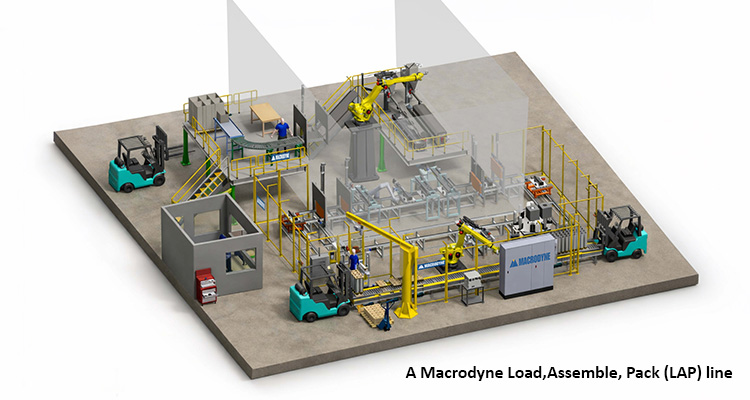
From custom presses up to 30,000 tons to turnkey automation and global support, Macrodyne helps manufacturers bring complex production systems to life

Most equipment manufacturers compete on catalog products, but Macrodyne has spent more than three decades focusing on the opposite. When Wes Blazejewski started his career apprenticing at Siempelkamp more than 50 years ago, he had no idea where his passion for hydraulic presses would take him. He first started working with Andrew Kirk and Gary Johnson in the late 80s, and together, they founded Macrodyne in 1990. The goal then was the same as it is today: to design and build state-of-the-art custom presses with the craftsmanship once associated with old-world Europe — robust, dependable and built to last for generations.
“Macrodyne builds the kind of equipment manufacturers usually come looking for when the easy answer doesn’t exist,” says Jeffrey Walsh, Macrodyne’s Director of Business Development. “Rather than a one-size-fits-all approach to press design, we design solutions engineered around the customer’s specific application. We’re a team of practical people and we thrive on helping customers navigate complicated problems.”
As customer programs become more complex, where and how equipment is designed, built, installed and supported matters as much as the engineering itself. Macrodyne is a registered small business in the United States, with manufacturing operations in the US, Canada and Mexico, alongside its DUNKES operation in Germany.
For US customers, Macrodyne USA provides a domestic contracting path with CAGE Code registration and ITAR registration. For European partners, Canada’s participation in the EU SAFE framework creates a clearer route for Canadian companies and Canadian-origin products to support eligible European defense procurement programs.
That global structure is not just about geography. It gives customers access to regional manufacturing, engineering depth and service support while keeping the project approach consistent across the group. Together, the Macrodyne group of companies form a stronger global organization. Whether customers are working with Macrodyne in North America or DUNKES in Europe, they experience the same practical mindset, technical focus and customer commitment. “Our global footprint gives customers confidence,” says Timo Kollmann, CEO of DUNKES. “We have manufacturing and engineering capability in North America and Europe, but we operate as one unified group.”
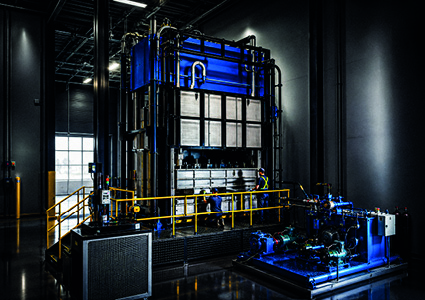
A recent lights-out production cell demonstrates the strength of Macrodyne’s combined press and automation expertise. Built for a major international customer, the factory is centered around four 10,000-ton hydraulic presses for forging and swaging semiconductor targets as well as aerospace and defense products. Each press weighs roughly 2.5 million pounds, with hydraulics delivering 625 gallons per minute at 7250 PSI.
Each press cell runs autonomously, automatically changing recipes, robot EoAT, and press tooling. The lights-out systems manage part handling, and the isolation of non-conforming parts, all tied into SCADA, ERP, and SQL-based data systems. “This is the kind of project where Macrodyne is an excellent fit,” Jeffrey reflects. “It is big, complicated, and custom, and it requires press engineering, automation and controls to be treated as one connected system from the start.”
Although the company’s product portfolio includes a vast range of hydraulic and servo presses, Macrodyne excels in creating custom-engineered systems up to 30,000 tons. “Some customers come to us for one press, others come to us because they need a complete production line that works together, and that’s where Macrodyne is strongest,” Kevin Fernandes, Macrodyne’s President, elaborates. “We’re not just building a press frame and shipping it out the door, but instead taking responsibility for the press, the automation, the controls, the material handling, the installation, the commissioning, the service, and the long-term support.
“The press is obviously important,” he continues, “but the success of the project usually comes down to how well the whole system is engineered around the process. We collaborate with our customers to understand their needs, and for many clients, the real value is the reduced risk associated with having a long-term maintenance and support provider.”
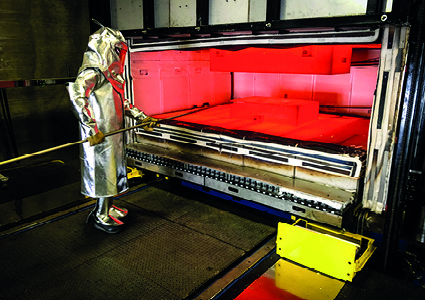
Beyond complete press lines, Macrodyne continues to develop technologies that help manufacturers improve how parts are formed, controlled and produced at scale. Gas Oscillation Superplastic Forming (GO-SPF) is just one example. “GO-SPF is our patented advancement to the traditional superplastic forming process. By introducing controlled gas oscillations inside the forming tool, GO-SPF enables faster cycle times, improved material flow, more uniform thickness, and more complex geometries than conventional superplastic forming.” For aerospace manufacturers under pressure to form lighter, more complex parts faster and with better control, GO-SPF offers a different path, taking a proven forming process and making it more practical for today’s production challenges.
Aside from aerospace, Macrodyne is experiencing strong demand from the defense sector, with many countries focused on production capacity, domestic readiness, and ammunition manufacturing. As a result, Macrodyne is applying its press and automation expertise to shipbuilding, armour production, artillery shell production, (including systems that support forming, handling, filling, and drive band crimping for 155mm programs) and more.
This is where Macrodyne’s systems-level approach becomes especially relevant. In ammunition production, the press is only one part of a much larger manufacturing challenge. “What military customers need right now isn’t just another press,” Kevin states. “They need stable production, throughput and repeatability; equipment that can be installed, commissioned, supported, and scaled without creating new bottlenecks somewhere else in the plant.”
That is where Macrodyne’s broader press and automation expertise comes into play. The company is building systems that support artillery shell production from bar to box, including forming, handling, process integration, and downstream coordination. “We’ve also developed specific technologies for shell production, including automated screw extrusion filling lines and drive band crimping systems built for production stability,” he adds.
As Macrodyne continues to grow, its practical, accountable, and hands-on culture remains at the heart of its success. “People on our team genuinely care,” Jeffrey shares. “We care when a customer is under pressure, when a machine must hit a certain production target, or when something needs to be solved quickly because the project is important.”
Prioritizing culture is just one aspect of Macrodyne’s strategy to execute careful growth in the near and distant future, as the business plans to maintain its customer focus, global presence, and willingness to take on complex work. Turning his thoughts to the future, Kevin says: “Defense manufacturing is changing quickly, with companies and governments putting renewed focus on domestic production capacity, supply chain resilience, and scalable manufacturing systems. A lot of that depends on advanced manufacturing. Macrodyne will continue to build its reputation in this space by supporting complex defense programs with reliable press systems, automation, and long-term technical support.”
Jeffrey adds: “Aerospace is another major focus and GO-SPF is something we believe more manufacturers need to see and understand over the next five years. It speaks directly to some of the problems aerospace companies are dealing with, offering a way to rethink what advanced forming can look like for complex aerospace components. We know the need is there, and it is exciting to think about where that technology can go as more customers see what it can do.”
Whether it’s aerospace, defense, or another industry entirely, Macrodyne helps manufacturers build the things that matter within a safe, reliable, and repeatable process. “I’d like to see Macrodyne recognized as one of the most trusted press and automation companies in the world for complex manufacturing programs,” Kevin concludes. “That doesn’t mean being the biggest for the sake of being the biggest. It means being the company customers call when the project is difficult, the equipment is critical, and the risk must be managed properly.”
