From Edison’s letter to AI copilots, Belden reveals how legacy inspires the company’s next chapter

Proudly displayed on the wall of Belden’s leadership offices sits a cherished letter that was written by Thomas Edison in 1920, thanking the company for its role in the inventor’s innovations. Not just a piece of history, this is a keepsake that speaks volumes about Belden’s future as well as its past. More than a century later, President and CEO Dr. Ashish Chand still labels the letter as one of the most precious items hanging in his workspace. It is a reminder of how integral Belden has been to new concepts, including the first radio transmission, the first television broadcast, flights into space, and infrastructure such as high-speed trains.

“Across the board, we’ve had the chance to participate in and enable many of these groundbreaking innovations,” begins Ashish. “Today, when you buy a Belden product, you know it’s going to work.” His statement of confidence is built on a 124-year history that began in supplying wire and cable and has expanded to complete networking solutions for industries such as mass transit, power transmission, and healthcare, where failure is simply not an option. “Customers repeatedly turn to us when they have applications that cannot go down, because that would result in loss of life and property,” he emphasizes. Belden’s reliability-first culture has contributed to both its longevity and contribution to pioneering inventions. “We were always very focused on reliability, but that wasn’t enough to bring us into the modern age – we had to support it with significant technological advancements.”
Nowhere is that shift more visible than in Belden’s solutions; the company’s approach to giving customers a single view across their manufacturing data. The logic behind these solutions came from observing how customers used Belden’s products, Ashish explains: “The analogy that came to mind was LEGO blocks. The LEGO company doesn’t sell blocks – they sell sets.” For years, Belden’s products were designed to meet industry standards so they could work with any compatible product. However, this openness had an unintended consequence: customers began mixing and matching components from different suppliers, often ending up with systems that lacked the reliability they were looking for in the first place.
That thinking gave rise to Belden Horizon, a software layer described by Ashish as “acting like a traffic cop,” due to its ability to manage data regardless of where it originates or where it’s headed. It also solved a second, less obvious problem. As Belden’s product range grew – switches, routers, wireless gear, protocol converters – each came with its own firmware. With every item effectively having its own language, Belden Horizon became a universal translator, letting customers speak to an entire network through one interface rather than mastering half a dozen.
After the first version was launched, Ashish tells us he took onboard feedback from those customers, leading to the simplification of the software platform. “Admittedly, we tried to do too much with Belden Horizon at the beginning,” he reveals. “We wanted to cover everything, but our customers told us it was too comprehensive and difficult to use. It was like a paper map full of legends, when people just want Google Maps!” The fix involved using intent-based networking, so clients could issue simple instructions – for instance, ensure redundancy here, or create segmentation there – without configuring the mechanics themselves. “The outcome is a totally different software today than it was five or six years ago,” says Ashish.

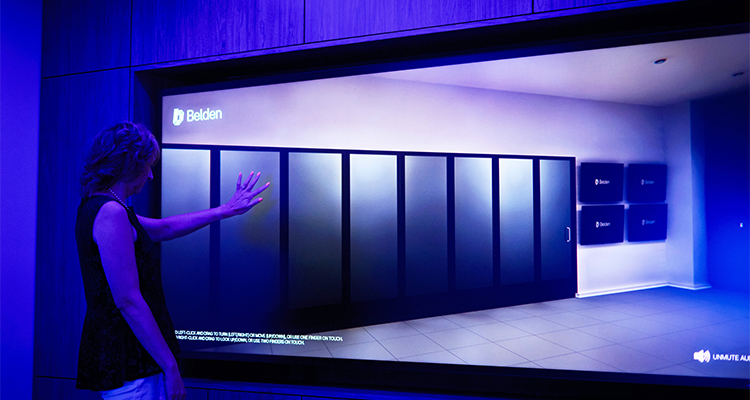
Belden’s instinct to test rigorously before customers have access to the final product kicked in following the Belden Horizon launch; a valuable lesson that now shapes its network of five Customer Innovation Centers (CICs). Located in Santa Clara, Chicago, Stuttgart, Bangalore and Shanghai, with more planned, these are validation environments as opposed to showrooms – a place where customers can stress-test complex networks and throw cybersecurity threats and electromagnetic interference at a system before it ever reaches a live nuclear power plant or metro line. Crucially, customers can adjust hardware and software configurations mid-test, and the commercial impact has been significant: conversion rates for customers who complete a CIC validation increase to roughly 80 per cent, compared with 30-35 per cent otherwise.
What’s more, Belden’s recent acquisition of RUCKUS Networks is one of its most momentous moves. Completed on 1 July this year, the investment brought crucial wireless and enterprise networking capability into the fold, along with a beneficial blend of cultures. “RUCKUS comes from an enterprise background, focused on speed, capacity and agility,” Ashish elaborates. “At Belden, we originate from an industrial background. We’re happy to go slower, but nothing should ever fail.” Uniting the two philosophies, he believes, positions the company among the first to achieve genuine convergence of IT and OT, wired and wireless, edge and cloud computing.
Ashish identifies physical AI as the next major shift for Belden, with AI agents moving out of the data center and onto the factory floor – acting as a ‘copilot’ for less experienced workers, as skilled staff retire. Alongside this, the drive toward simplicity continues, with customers increasingly searching for solutions that work straight out of the box, rather than demanding specialist expertise. As Belden heads toward its 125th anniversary, Ashish sums up the company’s direction with a phrase that captures both its heritage and its ambition. The goal, he says, is marrying “horizontal simplification” – the ease-of-use ethos RUCKUS brings from the enterprise IT world – with the “vertical complexity” Belden has always delivered for its most demanding industrial customers. “That’s where the world is heading,” Ashish closes. “And that’s where we need to move with it.”