
Gresham Office Furniture focuses on UK production, automation, and sustainability to navigate market challenges and capitalize on growth

Fifty years after launching with a single welded desk, Gresham Office Furniture (Gresham) is entering a new era built on investment and control. Managing Director Julian Roebuck guides the company through this evolution, bringing automation, in-house fabrication, and new product lines together to reinforce its role as a UK-based manufacturer serving an evolving workplace market.
“We’ve been making furniture in the UK for 50 years, and we’re incredibly proud of that heritage. Staying local hasn’t always been easy due to a mix of skills shortages, rising labor and energy costs, plus ongoing supply chain and regulatory challenges.”
Built to last
Founder Ted Smith, a typewriter engineer, saw an opportunity in the environments in which he worked. “He noticed a gap in the market while fixing typewriters, which were always sat on worn-out desks. So, he built a shed, made his own desk, and when he had trouble bolting it together, he welded the frame and added an MFC top. That’s how Gresham began,” Julian shares.
The company moved into its current Bolton facility in 2000, where production, design, and finishing all operate together.
Julian joined the family business in 2004 after a career in civil engineering, stepping in to support commercial work as Ted Smith prepared to retire. “I fell in love with the industry, the people, the business, and I asked my father-in-law if I could buy the company. He named his price, and I spent two years arranging an MBO to buy it. In August 2008, I made the business my own.”
Investing in control
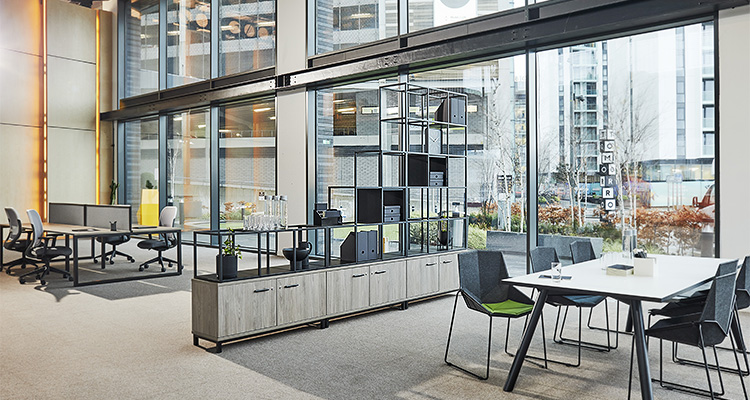
Gresham creates a broad range of workspace furniture, along with custom pieces for each project. “We design and build a full suite of office furniture: desking, seating, storage, screens, meeting booths, and pods. If you see it in a modern office, chances are we made it here in the UK,” Julian says.
“Beyond the furniture, we handle delivery and installation, space planning, interior design, and full project management. We support our customers every step of the way, from the first idea to final handover.”
Recent investments have centered on automation and building in-house expertise. “We have put over £7 million into new equipment, including more than £4 million in a batch size one board system. The advanced panel processing line handles one-off and mixed-order furniture parts efficiently.
“We use a board storage system to buffer materials, a double gantry feeding system, a robotic panel saw, and integrated edge banding. We have also added a tube laser cutting machine, a flatbed fiber laser cutter, and an electric press brake,” he elaborates.
“We’ve now brought all metal component fabrication under our own roof, whereas before, we outsourced about two-thirds of it.”
Alongside machinery upgrades, Gresham has overhauled its information management with a new ERP system that ties together orders, stock, and production. “The system acts as the brains of our organization. Our previous one was a decade old.” The new system brings in AI features, so more processes run seamlessly without manual work.
That investment has shifted the company’s focus from price to service, Julian notes: “We deliver faster lead times, higher quality, and better service to make staying local worthwhile. We don’t try to be the cheapest, but we do offer the best value for money. I honestly don’t think anyone can beat us on value when you look at the whole service we provide.”
Sustainable systems
“Our carbon reduction plan lays out a clear path to Net Zero by 2050, with a goal to cut emissions sharply by 2038,” Julian shares. “Since 2018, we’ve already reduced emissions by 17 percent. That progress comes from steady investment across the business. We keep investing in technology, renewable energy, and smarter manufacturing to shrink our environmental impact every year.”
That commitment shows up directly in how products are built and how long they last. “It’s built into every stage of our furniture design and production. As a UK manufacturer with full control from design to delivery, we make conscious choices about materials, energy use, durability, and waste reduction right from the start,” he observes.
“We design all our products to last, focusing on durability, modularity, and future adaptability. We’re not a throwaway company. Our in-house research, development, and testing create furniture that can be repaired, refurbished, or repurposed at the end of its first life cycle.”
Energy systems play a key role too. “In 2025, we generated over 1.4 million kilowatt-hours of heat energy from production waste that would have gone to landfill. We have solar panels across our entire factory roof, use renewable electricity, and run an on-site biomass boiler that heats the factory and offices with our own waste wood, off-cuts, and dust.”
Public sector partnerships have followed, with long-term frameworks now part of the workload. “We’ve secured over £30 million in new business in the past five years and held our place on key public sector frameworks. These wins reflect the trust our clients place in our UK manufacturing and service, and the strength of our partnership approach.”
Future outlook
The new panel processing line is already reshaping what Gresham makes. “We are developing a new student accommodation line and a locker storage range from MFC,” he notes. The line’s efficiency makes expanding the panel-based range the logical next move.
Gresham continues to plan around a made-to-order model, which means forward planning is often limited. “We aim to grow the business to about £50 million over the next five years, but we also want to stay independent and design-led, with a global outlook.” Growth will center on sustainable materials, circular design, and furniture built for hybrid workplaces.
“I want Gresham to be known for quietly dependable quality, thoughtful design, and real customer care. No matter how technology and trends change, we’ll keep doing what we’ve done for the last 50 years,” Julian concludes.
