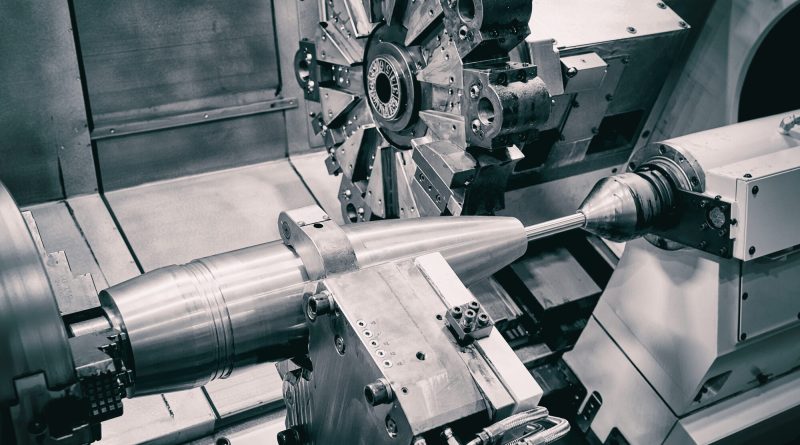
Hadrian raises $1.37B to scale US defense manufacturing

Subscribe to our free newsletter today to keep up to date with the latest manufacturing news.
Hadrian’s latest funding round looks like a venture capital story, but the larger significance lies on the factory floor.
The California advanced manufacturing company has raised $1.37 billion in Series D financing at a $7.87 billion valuation. Its investors are backing a model built around automated factories, precision manufacturing and software-led production for aerospace and defense customers. The financing comes only a little more than a year after Hadrian raised a $260 million Series C.
That pace of capital formation would stand out in almost any manufacturing sector. In defense, it points to a change in what investors and government customers increasingly consider strategic technology.
For much of the recent defense technology investment cycle, attention centered on drones, autonomous systems, AI and new weapons platforms. Hadrian is making a different argument. Better designs have limited value if the industrial base cannot manufacture enough components, assemblies and systems at the speed required.
Hadrian produces precision components and operates what it describes as factories-as-a-service. Its plants combine skilled operators with robotics, automation, AI and proprietary manufacturing software called Opus. Customers include major defense companies such as Lockheed Martin and RTX, alongside newer defense companies including Anduril. The company now controls just under 3 million square feet across four manufacturing sites.
The investment thesis is straightforward: production capacity itself is becoming a strategic asset.
Defense capacity is becoming a technology problem
The constraints facing the US defense industrial base extend beyond designing advanced weapons. Manufacturers must machine parts, qualify suppliers, train workers, maintain tooling, meet strict tolerances and deliver repeatable output across long production programs.
Those constraints have gained more attention as conflicts in Ukraine and the Middle East have increased scrutiny of weapons inventories and replenishment rates. Axios reported that US forces have used some high-cost interceptors and missiles faster than domestic production has replaced them, although the Pentagon has disputed claims that inventories are being depleted.
Hadrian’s Alabama operation shows how the company intends to attack part of that problem.
The 2.2 million-square-foot facility in Cherokee, Alabama, is designed to manufacture submarine components for the US Navy. The Navy plans to use the facility to support both Virginia-class attack submarines and Columbia-class ballistic missile submarines.
The project is tied to more than $2.4 billion of public and private investment, including $900 million in Navy funding and $1.5 billion in private capital. The Navy has said the facility could create as many as 1,000 manufacturing jobs.
The facility is part of a distributed shipbuilding model intended to shift selected manufacturing work away from major shipyards. That allows shipyards to concentrate more resources on submarine modules and final assembly while outside factories tackle components that can otherwise become production bottlenecks.
This distinction matters for manufacturers. Defense production shortages are not always caused by a lack of final assembly space. They can emerge deep in the supplier base, where shortages of machining capacity, qualified labor, tooling or specialized processes can slow an entire program.
Hadrian’s proposition is that highly automated factories can add that capacity faster and more predictably than traditional manufacturing expansion.
The Navy’s schedule also illustrates the limits of the model. Full-rate production at the Alabama site is expected to require roughly 18 to 24 months from project initiation. Automation can compress parts of factory deployment and production, but defense manufacturing still involves qualification, training, process validation and customer acceptance.
Automation could change how manufacturing capacity is added
Hadrian is not presenting its factories as worker-free production sites. The model combines people with software, robotics and automated processes.
That approach addresses one of the persistent difficulties in expanding advanced manufacturing: adding output without requiring experienced workers to manually manage every stage of every process.
Standardization could prove just as significant as individual pieces of automation.
Traditional factories often evolve around particular products, machines, workflows and institutional knowledge. Building another plant can mean recreating much of that operating system at a new location. Hadrian is attempting to make more of the factory itself repeatable.
Its Opus software sits inside that strategy, coordinating production in facilities designed around a common operating model. The commercial goal is to make new manufacturing capacity something that can be deployed repeatedly rather than engineered from scratch for every program.
Hadrian is pairing that approach with aggressive physical expansion. Its footprint includes operations in Torrance, California, along with newer facilities in Mesa, Arizona, and Alabama. The company also plans further factories and intends to move into production areas including munitions and autonomous systems.
That expansion pushes Hadrian beyond the role of a precision-parts supplier.
If the company can apply a repeatable production system across multiple defense programs, it could function more like manufacturing infrastructure. Defense primes and newer contractors could use Hadrian capacity without developing every new production line internally.
For smaller defense companies, that model could be particularly valuable. A startup may have the engineering team and government contract needed to develop a system but lack the capital, manufacturing expertise or time needed to build a large production operation.
For established primes, outside production capacity can provide another route around constrained suppliers or overloaded internal facilities.
The $7.87B valuation now has to become factory output
The Series D gives Hadrian the resources to test its model on a much larger scale.
WCM Investment Management, Washington Harbour Partners, Valor Equity Partners, 137 Ventures and Baillie Gifford co-led the financing. JPMorganChase’s Strategic Investment Group joined as anchor co-lead through the bank’s Security and Resiliency Initiative.
Capital alone will not solve the manufacturing problem.
Defense production operates under demanding technical and regulatory requirements. Components need to meet qualification standards. Processes need to remain consistent at volume. Production programs can run for decades, making reliability more important than a short burst of output.
Hadrian must prove that its automated model can deliver those characteristics across a growing number of factories and product categories.
The expansion into munitions and autonomous systems raises the difficulty further. Moving from precision parts into broader production responsibility requires more supply-chain coordination, systems integration and quality control.
That is what makes the funding round more interesting than its headline valuation.
Investors are not merely pricing a software company that happens to own machines. They are betting that manufacturing capacity can be built as a scalable technology platform, and that the US defense sector will pay for faster access to that capacity.
The next measure of Hadrian’s progress will not be another fundraising number. It will be how quickly new factories reach qualified production, how much throughput they add to constrained programs and whether the same operating model works across submarines, munitions, autonomous systems and other defense products.
If it does, one of the most consequential technologies in the next phase of defense investment may not be a weapon or an AI model. It may be the factory that can build them.
Source