
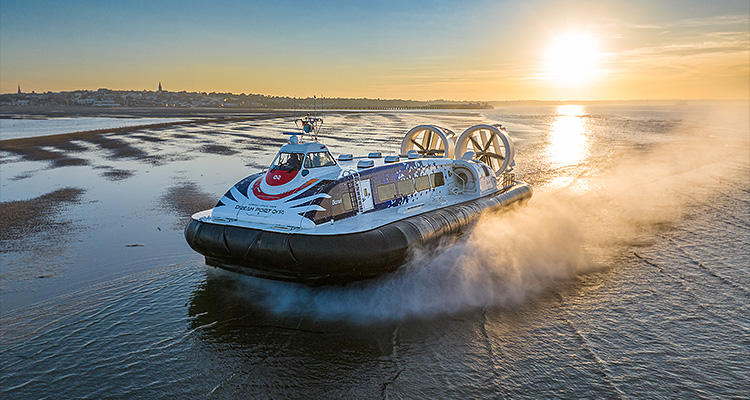
Hovercraft and small boats specialist, Griffon Marine, is reshaping the future of defense and marine innovation

With over six decades of expertise, Griffon Marine specializes in vessel design, manufacture, and consultancy, helping clients navigate the evolving challenges of marine operations across maritime border security, amphibious insertion, riverine patrol, and highspeed near-coastal ferry services. Whether designing new vessels from the ground up or enhancing existing fleets, the company’s tailored solutions improve performance, sustainability and compliance, thus preparing vessels for the demands of a rapidly changing maritime landscape.
“Griffon Marine was established in the 1960s, and today we are the result of an amalgamation of several British hovercraft manufacturing businesses from that decade onwards. At the time, many British companies started research, development, prototyping, and, ultimately, the commercialization of hovercraft. However, from the 1980s into the 1990s, they started to realize that the marketplace was challenging for various reasons, so companies began to shift away from those vessels. This led to many mergers of technology and intellectual property (IP), where one company would acquire the IP from another that was exiting the sector. The IP, knowledge, and competencies built up over that period carried through into the 2000s. Griffon Hoverwork, the previous form of who we are today, came into being in 2009 as the merger of the last two significant UK hovercraft manufacturers: Griffon Hovercraft and Hoverwork. The latter carried the longer history and a substantial body of IP, while Griffon Hovercraft was a family-run business with close-knit ties with many of the same shareholders and key individuals involved from its earliest days,” begins Mark Downer, CEO.
From 2009 until last year, Griffon Marine existed first and foremost as a hovercraft design, manufacturing and support company, and remains the last of that specialization in the world outside of Russia and China. In 2025, the business rebranded from Griffon Hoverwork to Griffon Marine, with a clear strategic objective to retain its hovercraft expertise as a backbone while broadening into the wider marine market, particularly at the high end of innovation and new technology. Having developed deep expertise around an exceptionally lightweight specialist marine vehicle, the company restructured into three business units to bring those capabilities to the broader marine market.
Griffon Marine Solutions
The first is Griffon Marine Solutions, a design consultancy bringing together 20 specialists, including naval architects, aerodynamicists, marine engineers and regulatory experts, who can apply their expertise across hovercraft, hydrofoils, surface effect vessels and beyond. The second is Griffon Marine Shipyard, originally a hovercraft-building facility which has since expanded into broader aluminum boat construction with considerable early success. The third is Griffon Marine Support, a global support network, built on decades of experience servicing over 200 hovercrafts across 50 customers worldwide, now extended to serve the wider marine market.
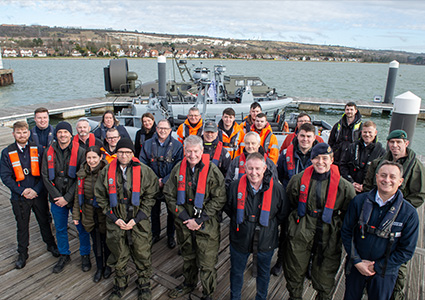
For the last seven years, Griffon Marine has been carrying out maintenance on all Royal Marines boats used at HMS Tamar in Plymouth. Mark tells us more about this exciting scheme: “As part of this project, we were tasked with converting and modernizing an old boat class to align with the Future Commando Force, which is the Royal Marines’ new doctrine. Essentially, they wanted us to take an old hull that was still in reasonably good condition and modernize it, so that it could be operated in accordance with their new doctrine. Rather than following the traditional procurement model, we worked closely with the users and trials and testing teams to develop six iterative versions, literally standing on the boat, moving things around and building mock-ups until everything was right.
“The outcome was fantastic, as we transformed the offshore raiding craft into the new commando raiding craft, with 22 hulls completed around a month ago. We were proud to receive a visit from senior members of the MOD to celebrate what was, in their own words, the first time a project had run to budget, to timescale, and delivered everything they wanted and more. From our point of view, our collaborative, agile approach not only gained us invaluable knowledge but is also now influencing how the MOD thinks about developing new products more broadly. It is an approach we have since taken to other customers, using the Royal Marines project as a proof point for what is possible when users and engineers work closely together from the very start.”
Griffon Marine’s expertise shines both at home and abroad, with Finland being a major returning customer for hovercraft. The country last purchased hovercraft from the company 20 years ago. Following their strong operational performance, Finland recently committed to procuring additional vessels, a decision likely accelerated by the increased defense spending seen across Europe in response to the current geopolitical climate. Griffon Marine was able to apply the collaborative development approach refined through the Royal Marines project to this new order. The base hovercraft is a standard platform shared by customers across the world, including Poland, Sweden, Peru, and Colombia, but it is a vehicle that can be extensively reconfigured to suit different operators and environments. For example, Colombia’s version has an open top to cope with the heat, while Finland’s is fully insulated for cold conditions. Each country also has entirely different operational requirements, meaning different sensors, system fits, and more.
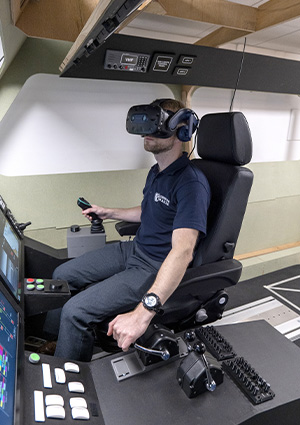
“The Finland project allows us to channel all our accumulated expertise and apply it afresh, and we’re getting the user community directly involved in refining the design,” Mark elaborates. “To achieve that, we are using VR technology, where everything is built up as a 3D model. Given that we have a production line already running, Finnish operators can put on a VR headset to sit inside an existing hovercraft and see a virtual representation of exactly how their own customized version will look and feel. Rather than interpreting drawings or specifications on paper, they are immersed in the configuration they would get, and we can adjust and move things around in real time until everything is exactly right. It is a brilliant collaboration, with the user, designer and production engineers coming together to make sure that when we actually produce the hovercraft, it meets the customer’s specific requirements.
“The hovercraft for our Finnish client is now being built, and they will get their first one delivered later this year. Therefore, we are highly confident that when it arrives, it will be exactly what they want, since they have been involved in the design every step of the way,” he ends.
