
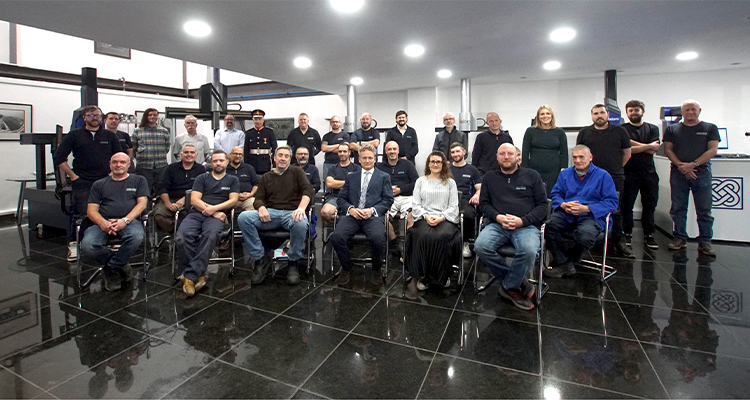
How Aberlink built success through maintaining UK manufacturing, rejecting subscription models and sharing ideas onsite

When Marcus Eales formed Aberlink in 1993 with business partner Gavin Bailey, his aspiration was to make coordinate metrology accessible and affordable to all. Initially launching the company with subcontract machining services, they discovered an obvious gap once the machine shop was set up – no affordable new or used coordinate measuring machines (CMMs) existed.
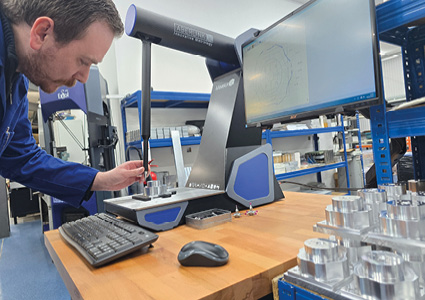
Now the largest UK-owned manufacturer of CMMs and 3D measurement software, Aberlink’s innovative range of metrology products are renowned globally for affordability, reliability and ease of use. Marcus meets with Manufacturing Today, alongside Sales Director, Chris Davies, to discuss achieving those early ambitions, winning awards and how crucial team creativity is in research and development (R&D). “When Aberlink began, CMMs were the preserve of very high-end aerospace businesses and, even second-hand, they were prohibitively expensive,” opens Marcus. “We did buy a second-hand machine, and it just wasn’t accurate so I decided our first product should be a manual CMM.” The market confirmed the need for this product. “When we launched at the MACH show at the NEC, we immediately got a full order book, and we’ve been riding that wave for at least 25 years.”
Aberlink’s competitive advantage centers on user-friendly software. “Our software is genuinely easier to use,” continues Marcus. “We know this because people who have never used CMMs before always feel comfortable after a demonstration. The software typically takes half a day to learn, whereas many others take up to five days training, which is impractical for all your machine tool operators.” Marcus explains that the shift toward shop floor measurement also drives demand. “Coordinate metrology is moving from being the domain of aerospace OEMs to becoming the quality control necessity on the shop floor, next to ma-chine tools. Engineering companies cannot afford to wait until final inspection and find they’ve been producing scrap.”
Measur3D
In addition, Aberlink’s recently launched Measur3D manual CMM addresses production realities, whereby fully automated production lines are highly efficient, but lack flexibility. “Most people require flexible manufacturing and the ability to check first-offs or key features,” highlights Marcus. “Our Measur3D man-ual machine is a couple of steps on from Vernier calipers – it doesn’t make sense to create a CNC CMM inspection program because machine tool operators want to jump on to a manual CMM and quickly check one or two dimensions.”
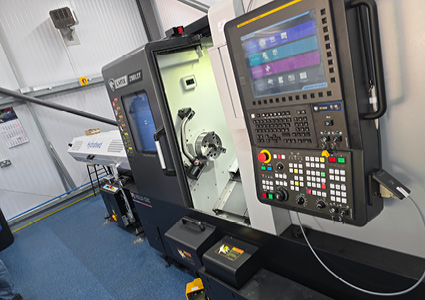
Chris adds: “If your software is difficult to use, it simply won’t get used. We’re not in the business of sup-plying manual machines that collect dust.” Regarding vertical integration, Aberlink maintains in-house machining despite decades of offshoring trends. “It was quite unfashionable to have in-house manufacturing, but we’ve always bucked that trend because vertical integration means complete control over your own quality,” Marcus reveals. “It gives you incredibly quick turnaround and I love the fact that it’s manufactured here on site.” Chris emphasizes the credibility of its new DN solutions machine tools, which were in-stalled in the facility last year: “We had a recent site visit, and the guests specifically told us it was nice to see Aberlink CMMs being used to measure parts that will be used in Aberlink CMMs.”
When it comes to innovation methodology, the company disregards conventional corporate structure and strives to establish a creative environment. “I’ve read an awful lot of books on creativity and finding that spark that suddenly makes you think, ‘Why don’t we do this?’ And a shout across the office, followed either by the reply ‘Hey, that might work’, or it’s completely shot down in flames – which is also fine!” Marcus elaborates. “The important thing is to have the ideas, ensure they’re openly discussed, and at least every 18 months one will stick.”
Marcus accentuates how important physical environment is in reinforcing such accessibility. “There’s a well-known expression in management comprising of ‘my door is always open.’ As the company owner, I don’t even have a door because I sit where everybody else is – we all just talk to each other across the office,” Marcus states.
Aberlink’s inspiration and ingenuity led to it being recognized for breakthrough work on Delta mechanisms, used in the design of its Extol CNC CMM, with the 2024 King’s Award for Enterprise in the Innovation category. Often associated with pick and place machines, Delta mechanisms can be extremely quick but not always accurate. “We managed to come up with a way of mapping all the errors on the Extol machine,” shares Marcus. “We were the first to error map it in order to reach 2.5-micron metrology accuracy.”
Moving forward, the company’s current development priorities are focused on gear measurement software driven by electric vehicle adoption. “Electric cars are intrinsically much quieter, so consumers are noticing the whine from gears,” explains Marcus. “Gear inspection has suddenly had much more interest, and we want to be the leaders of this technology. We want something useful to feedback from inspection to the manufacturing process, to monitor the cutting process, and ensure it is always in specification.”
Furthermore, the company continues to contradict industry trends by offering a free lifelong software up-date policy to all clients. “I don’t like subscription models,” Marcus states. “I think it’s a constant drain on your business. I do like the idea that our customers can buy one of our machines and if, for example, they just want to use it for the next ten years, they can do so. This model has become much more popular among people, and we recently held a demonstration for a company switching over to our software, with one of the reasons being the subscription that every other CMM manufacturer enforces. There’s a lot of pushback against that now.”
Looking to the future, Aberlink’s three-to-five-year vision maintains its focus on the continual growth it has enjoyed from day one. However, Marcus reveals he has no plans to branch out at present. “There’s still so much to do with coordinate metrology,” he concludes. “We live in a 3D space – what our machines do is measure 3D points in space, and clever software turns that into useful information. In five years, we’re still going to be carrying out 3D coordinate metrology, but outputting that data to more sophisticated automation systems.”
From launching at the MACH show with a full order book in the 1990’s to winning the King’s Award in 2024 for innovation, Aberlink proves that vertical integration, open-office creativity, and rejecting software sub-scription models create a sustainable competitive advantage. Chris summarizes: “The business is based on providing affordable, easy-to-use, innovative metrology. We’re not a ‘me too’ offering and we’re never going to follow convention.”
