
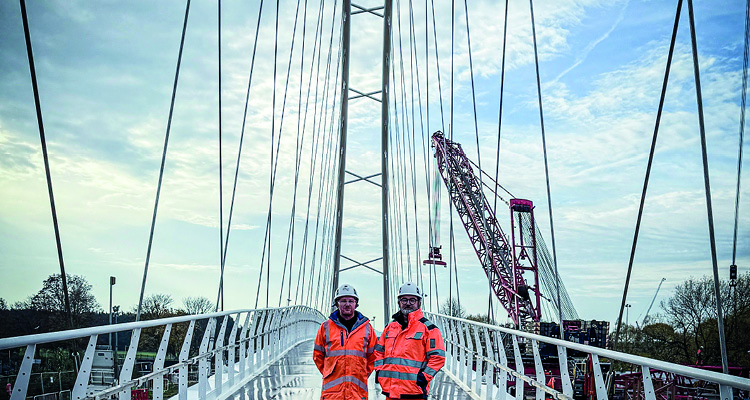
How Briton Fabricators Limited builds some of the UK’s most complex infrastructure from a workshop in Hucknall

Briton Fabricators (Briton) is a family-owned business established in 1973, predominantly set up to service the industries around Hucknall, namely coal mining. Not long after its inception, significant regeneration in inner cities created demand for footbridge structures, so the company entered that market and established itself as a specialist in the process. Today, Briton stands as a leader in the UK infrastructure market, designing, building, delivering and installing road bridges, rail bridges, motorway bridges, pedestrian bridges and more. Dean Morcom, Managing Director, elaborates on the company’s current capabilities.
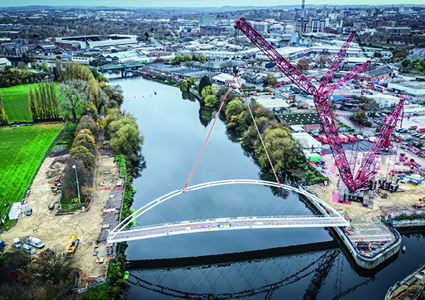
“Over the last 20 years, we have also established a strong presence in motorway sign gantries, pedestrian bridges, and road and rail bridges. We are now one of the UK’s largest infrastructure fabricators, focused solely on steelwork for clients like National Highways, Network Rail and HS2. Every process is completed in-house, from 3D modeling in our drawing office and fabrication at our Hucknall facility, through to our own installation teams and construction managers. This month [at time of writing] we have invested further in our capabilities by acquiring a transport company to facilitate the movement of abnormal loads on the UK network. Within the group, we now have modular transport units and heavily plated vehicles capa-ble of moving steelwork loads of up to 200 tons, which complements everything else we offer. We have grown steadfastly and carefully over the years by investing in our operations, and now turn over in the region of £22 million a year almost entirely through bridge work,” he begins.
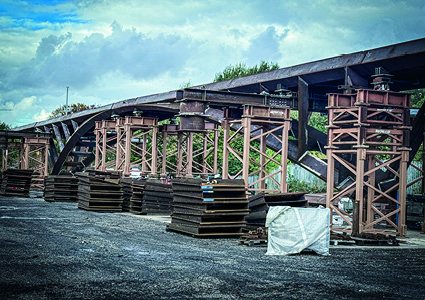
Some of Briton’s most recent investments to enhance its capabilities have totaled approximately £1 million in new fabrication equipment alone. The primary catalyst for this expansion came when Cleveland Bridge, a renowned bridge-building company, went into administration, presenting Briton with an opportunity to further cement its market position, absorb some of the work Cleveland Bridge had been delivering and acquire its temporary work inventory. This included the steel trestles themselves, along with the associated designs, which Briton brought in-house and developed further over the following three years, expanding the range of its trestle systems in the process. That investment, totaling around £250,000, has since paid dividends through the temporary works designs Briton now produces for the installation of its own products.
Modular transport
More recently, the company invested approximately £400,000 in modular transport, acquiring multi-axle vehicles that can move loads of up to 550 tons, and tractor units currently plated to 200 tons, enabling complex and demanding site moves. Another tractor unit is currently on order at an investment of around £280,000, which will supplement the stock within the transport company Briton just procured. On the shop floor, the firm has also invested in profile machines capable of profiling plates and cutting preparations for more complex welding details, an investment running to upwards of £2 million.
Despite its investment in equipment, most of Briton’s projects still require highly skilled, hands-on work. Seeking to pass down that skill base to the next generation, the company maintains a comprehensive apprenticeship program, ensuring that experienced people who retire pass on their enviable skill. As part of its robust apprentice scheme on the shop floor, Briton takes on four platers and welders per year. At any given time, the company has between ten and 12 apprentices progressing through the program at various stages. What makes this program particularly special is the role its most experienced tradespeople play in delivering it.
“Some of our older hands who were ready to retire have chosen to stay connected to the business, coming in a couple of days a week to help train the apprentices, effectively running a small apprentice school
within the workshop. This approach allows us to retain and pass down the knowledge, and after four years, those apprentices become qualified platers working alongside the experienced team. It is physically demanding work, but the continuity it creates is invaluable. Our apprenticeship program extends beyond the shop floor. In our drawing office, we currently have two apprentices working on 3D fabrication modeling, taking clients’ designs and turning them into detailed fabrication models. These apprentices follow a different college pathway given the more technical requirements of the role. Additionally, we have an ap-prentice health and safety advisor working under our health and safety consultant and a trainee quantity surveyor working through college to supplement our quantity surveying team,” Dean continues.
With a well-trained team and stronger capabilities, Briton is more than ready to take on its most significant current project: HS2. “As the new phases of HS2 have progressed, many tendering opportunities have come our way through Balfour Beatty Vinci (BBV) one of the main contractors on the program. The first job we secured was a straightforward road bridge over a rail line, and during construction, we were invited to tender for something more complex: up to four 77-meter arch bridges to go over the railway. The designs are broadly similar across all four, so there are real synergies in being able to repeat the build process. We have just secured the third of the four bridges and are currently on site installing the first.
“That first bridge has been fully trial erected in our yard by our own site teams, with a complex temporary works procedure and trestling system developed to support it. The trial erection was completed success-fully, the bridge has been fully welded on site, and we are now in the process of stripping the temporary works back to reuse on the next bridge. At present, the second bridge is in production on the shop floor. It is not exactly the same as the first and did require some remodeling, but there are enough similarities that we have been able to standardize the temporary works across both, allowing us to carry the same system forward. And with the third now awarded, the drawings are being done,” Dean ends.
Securing the HS2 contracts are a sign of how far Briton has come over its five-decade long history. By reinvesting in capabilities and ensuring the knowledge that built its reputation is passed down to the next ge-eration, the company has laid the foundations to support long-term success. In an industry that demands both precision and experience, Briton is making sure it never runs short of either.
