
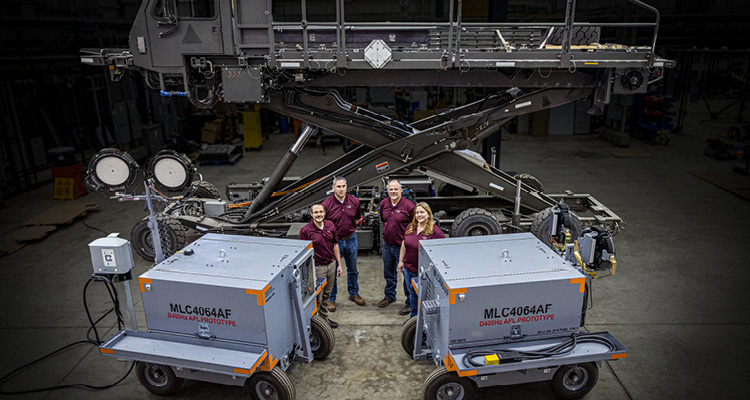
How Concurrent Technologies Corporation is leveraging its friction stir welding expertise to help build a commercial space station

Founded in 1987 as Metalworking Technology Inc., Concurrent Technologies Corporation (CTC) began as a subsidiary of the University of Pittsburgh Trust, established to operate the National Center for Excellence in Metalworking Technology. Rapid growth and national recognition led to an expanded mission, and in 1992 the organization became CTC. By 1994, the company had become fully independent, broadening its work to serve both government industries with innovative technology solutions.
“Today, CTC is an independent, nonprofit, applied scientific research and development organization delivering innovative technology and management solutions. In partnership with our affiliate, Enterprise Ventures Corporation, we provide full lifecycle support, from research and development through to testing, prototyping, and deployment. Our areas of expertise include engineering and advanced manufacturing, digital mission solutions, energy, resilience, sustainability, and readiness solutions. With more than 400,000 square feet of facilities, we deliver robust, practical solutions that help safeguard national security, maintain U.S. technological advantage, and strengthen American manufacturing,” begins Tim Tibbits, Vice President of CTC’s Engineering and Advanced Manufacturing Division.
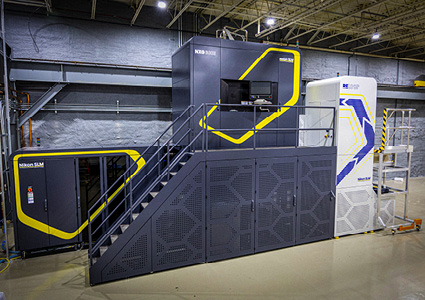
Central to CTC’s ability to deliver at that level of support is a set of manufacturing capabilities that few organizations in the world can match. Among them are some of the largest additive manufacturing machines in existence and the full-scale implementation of friction stir welding. Ed Sheehan, President and CEO, explains what makes these capabilities and technologies so significant.
“At CTC, we are consistently pushing the boundaries of additive manufacturing. We were recently selected by the Air Force Research Laboratory to develop, test and implement a next-generation additive manufacturing machine specifically for advanced weapon system components fabrication. This is not just any 3D printer: it is one of the largest in the world. It is capable of producing long, single-piece parts that would normally require multiple joints, which is important because joints can introduce strength issues and inconsistent mechanical properties. With this machine, we can streamline production and improve part performance considerably.”
Friction stir welding
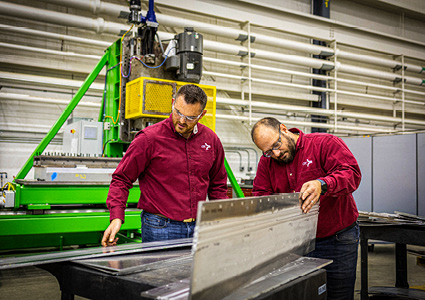
Complementing its additive manufacturing capabilities, CTC was the first organization to fully implement friction stir welding at scale – a distinction that continues to set it apart. Unlike traditional welding, friction stir welding joins materials in a solid state, softening and stirring rather than melting them. This results in stronger, more reliable joints particularly suited to thick aluminum structures. “We can take a client’s part from design for manufacturability all the way through tool design, process optimization, testing and low-rate production. Our team, which includes some of the brightest and most dedicated professionals in these technologies, handles equipment design, implementation, and qualification to standards including AWS D1.2, D17.3 and ABS. For customers, that means reduced costs, higher performance and faster deployment,” Tim adds.
Those capabilities sit within a broader strategic framework that CTC recently refreshed. Indeed, the company has just implemented a new three-year strategic plan built on the lessons of its previous efforts, designed to position it for continued growth and stronger performance. “The plan emphasizes staying aligned with key market trends and evolving client needs, while making thoughtful investments in technology, infrastructure and workforce. We are also refining how we track and measure progress to ensure our teams remain focused and accountable. Overall, our plan provides a clear framework for sustainable growth while staying true to our mission and values,” Tim reveals.
CTC’s strategy is already bearing fruit in the form of some of its most innovative projects and partnerships to date. Among them is a significant piece of work supporting the development of Starlab, the next-generation commercial space station being built in partnership with one of CTC’s closest partners, Vivace Corporation. “This project highlights our expertise in advanced manufacturing, particularly friction stir welding, which is essential for producing the ultra-thick aluminum structures used in aerospace,” Ed informs.
“On a technical level, we are providing engineering support for fixtures, weld development and qualification, as well as final assembly welding to ensure the highest quality standards. It is a great example of how our team pushes the boundaries of engineering design in large-scale manufacturing, not just for aerospace, but for industries like shipbuilding, agriculture and energy. By working with Vivace Corporation and Starlab, we are helping build a commercial space station that could play a pivotal role in the next era of space exploration,” Tim emphasizes.
The Starlab partnership perfectly reflects CTC’s strategic focus on leveraging its core strengths to expand into new markets and deliver solutions for the most demanding applications. Similarly, CTC is involved in several ongoing projects that illustrate the breadth of its innovation and problem-solving capabilities across various sectors. “One example is our work advancing 3D printed sand-casting mold technology. Many critical metal castings for the Department of Defense are obsolete or difficult to source, and our team is developing cost-effective and rapid methods to produce them using 3D printed molds. This effort combines decades of metalworking expertise with the strengths of our partners to create a reliable supply solution for components that are hard to source.
“Another area of focus is resilient energy systems. At Kirtland Air Force Base, we are expanding a DC microgrid project that enhances energy reliability while improving efficiency. By integrating multiple microgrids with advanced control systems, we can reduce dependence on the utility grid, save energy and maintain critical power during outages. Together, these projects demonstrate how we are applying technology to address both immediate operational needs and longer-term strategic challenges,” Ed concludes.
Nearly four decades after starting life as a metalworking center, CTC is solving the hardest defense supply chain problems with expertise and innovation.
