
How EMR is pioneering circular solutions to turn end-of-life materials into tomorrow’s sustainable products

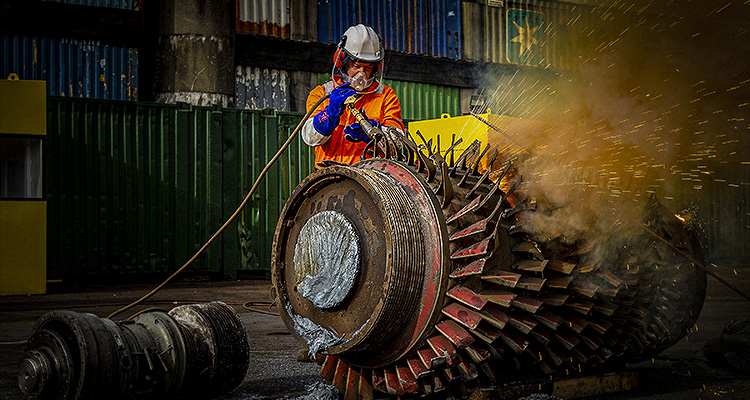
The terms circularity and decarbonization are far from new for EMR, a global leader in sustainable materials. With a history spanning 70 years, EMR has grown from a single business in the northwest of England into a UK-based global organization recycling an average of ten million tons of end-of-life materials per year. The company recycles everything from drinks cans to aircraft carriers, transforming these into more than 200 grades of recycled materials that will go on to become the next generation of products.
As consumers continue to prioritize environmentally conscious products, governments around the globe push net-zero agendas and resource security rises up the global agenda, EMR is working across several sectors – like automotive, energy, construction, and electronics – to responsibly transform end-of-life products into valuable resources. Innovation is at the core of EMR’s operations, as the company must continue to solve challenges that many don’t see on the horizon yet, because if you’re only thinking about recycling at the end-of-life, it’s already too late.
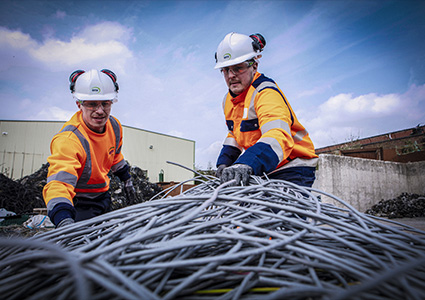
“EMR is a global leader in sustainable materials, operating more than 150 sites with a footprint in the UK, US, and across Europe,” opens Patrick Davison, Sustainability Director. “We handle ten million tons of material every year – around nine million tons of this is ferrous material and the other one million tons is non-ferrous like copper and aluminum. Our underpinning philosophy is that no materials should go to waste if they can be recovered, reused or recycled into something new. We’re both the grave and cradle for materials.
“From domestic households to manufacturing and construction companies, we work across sectors, sources and suppliers to get a reliable stream of feedstock and turn it into the materials that manufacturers will need tomorrow. Products and manufacturing processes are constantly changing, and the materials we recycle are very complex by nature, meaning we must stay ahead of the curve and try to anticipate the products coming to us in ten, 15, or even 20 years’ time.
“We’re passionate about supporting our employees and fostering the next generation of people to lead the business,” he states. “We have excellent apprenticeship and training schemes, as well as other incredible opportunities across the organization. It’s a fantastic place to work for anyone interested in recycling to develop green skills and continue to push EMR as a socially responsible business.”
Collaboration and R&D
To get ahead of the challenges the industry will be facing in years to come, the company emphasizes collaboration and R&D with its customers. “You can’t achieve a circular economy on your own; you need a systematic, collaborative approach to achieve tangible benefits,” Patrick explains. “We work with manufacturers, for instance, to make products easier to recycle, as well as evaluating our own processes to ensure our secondary materials are easy to incorporate into new products. We’ve established laboratories where we can bring designers, manufacturers, recyclers, and material experts together to innovate new processes that foster circularity.”
This collaborative approach is particularly important in the automotive industry, where EMR is the UK’s largest End-of-Life Vehicles (ELV) recycler. Although it’ll be roughly ten years before electric vehicles (EVs) arrive at EMR’s facilities in the same quantities that petrol-powered vehicles do today, EMR has a dedicated electric battery recycling plant in Birmingham capable of handling more than 2000 tons of EV batteries per year, where the company is innovating today to make tomorrow’s battery recycling at scale seamless.
Helen Waters, Commercial Director for End-of-Life Vehicles (ELV), elaborates: “The transition to EVs is an exciting development for the automotive industry’s net-zero journey, but being truly sustainable requires an effective circular EV battery supply chain. Our RECOVAS project, which helped us to establish our EV battery recycling center in Birmingham, encouraged collaboration with both OEMs and academics, leading us to discover several key elements of battery recycling processes, including how to extract valuable metals like lithium, manganese, and cobalt.
“Being part of the design process and seeing how a product is assembled is incredibly valuable when figuring out how to take products apart for recycling. No two days are the same in the world of EVs, but we’re continuously investing in electrification processes to extend or improve our ELV capabilities, including shredding our own black mass in the future.”
Although material recovery and recycling have remained at the core of EMR’s operations for decades, the company has also had to navigate and adapt to new products, demands, and challenges. “The electrification of society requires several products with metals like cabling, copper, magnets, and infrastructure with steel and aluminum, and at the same time, decarbonization is a huge driver for many of our customers,” Patrick explains. “Recycled materials typically use less water and have a smaller footprint in terms of biodiversity, helping to lower the carbon density of manufactured products they go into.
“It’s important to note that the regulatory requirements around the materials we collect are complex and always changing, and data is becoming more important to both us and our customers,” he adds. “We’re evaluating recovery rates, for example, as well as how much carbon our processes and operations emit, and how emissions differ between secondary and virgin raw materials. By making this information available to our customers, they can glide through audits and share their own reporting.”
One recent example of how EMR has navigated complexity and change is in its wind turbine recycling. “With no consistent practices for wind turbine recycling, we were fortunate to receive funding support from Innovate UK for the Re-Rewind project in 2023, which pioneered a circular economy for rare earth magnetic materials recovered from wind turbines,” Bill Firth, General Manager for Business Development explains. “Our Re-Rewind partnership also enabled the development of our first dedicated wind turbine processing facility in Glasgow. This allows us to accept every part of a turbine where we can recover as many parts as possible for reuse whilst recycling other materials which previously had no scalable recycling option.
“Wind turbines provide an excellent Material Bank where we can recover, reuse, remanufacture, and recycle valuable materials. As is our approach to all end-of-life processes, we apply circular pathways. These start with considering the whole turbine, and we have partnerships with several companies looking to reuse the turbine. We then move to component recovery, extracting everything from major items like generators and gearboxes to minor components, such as braking systems and control boards. This second pathway addresses demand for spare parts for existing turbines where the model has been discontinued, and in many cases, this could be the difference between continued function or early decommissioning.
“The last pathway sees us recycle nacelle metals like high-quality steels, cast iron, aluminum, copper, and rare earths, which we segregate and process ready for manufacturing supply chains,” Bill says. “There are several elements to consider. The tower steel, which we call low-residual steel, is well suited to electric arc furnace steel production, for example, while the fiberglass blades are mechanically recycled into polymers and steel is extracted from the turbine’s foundations. We’ve recently completed a project for a large energy generator where we’re proud to have achieved a 99 percent recycling rate for one of their first offshore wind turbines.”
As EMR continues to embrace technical innovations and work with manufacturers to establish new processes, its capabilities are constantly expanding, positioning the business at the forefront of circular supply chains. Recycling ten million tons of material each year, EMR’s operations are ensuring that today’s discarded materials become tomorrow’s sustainable products, and ones that can be easily recycled time and time again.
“We’re constantly striving to understand what our customers need and innovating to design recycling solutions to meet those needs,” Helen affirms. “There’s always so much change in the recycling world, and we’re passionate about working with our customers to play a leading role in the design of new, low-carbon products that are easily recyclable when they reach end-of-life.”
Offering his final thoughts, Patrick concludes: “The stock of materials available in the products of today will be turned into the building blocks of tomorrow’s innovations, which will be returned to us for recycling once again. That’s the beauty of circular economies; they’re ongoing and so our mission will never end.”
