
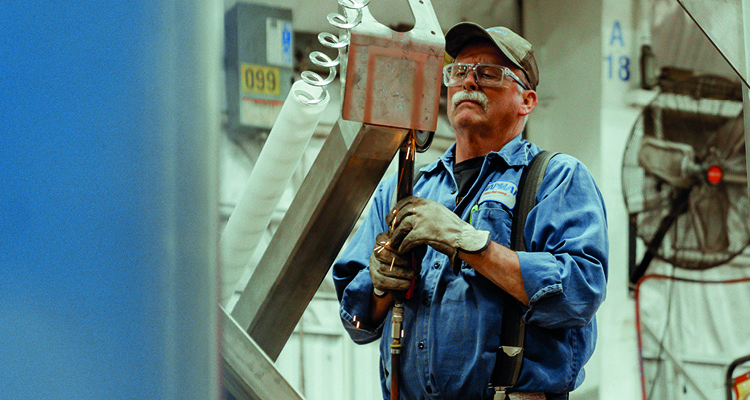
How Hapman’s invention of the tubular drag conveyor grew into one of bulk handling’s most comprehensive offerings

With over 80 years of history and thousands of successful applications across a range of industries, Hapman continues to lead the industry in bulk material handling equipment and complete material handling systems. We spoke with Rob DeHaan, Director of Strategic Sales & Marketing, and Matt Richardson, Vice President, to discover what lies behind one of the industry’s most enduring success stories.
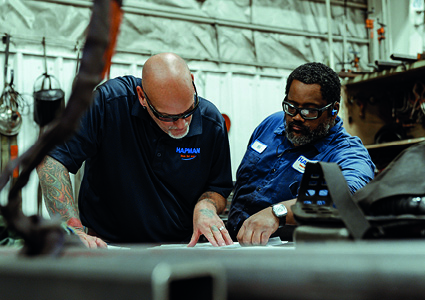
“The business began in 1945 with the invention of the tubular drag conveyor,” Matt explains. “In the 1970s it was acquired by Prab, a local competitor specializing in moving scrap metal. Since then, the companies have evolved into increasingly separate entities, with Hapman focusing on powder handling for food, chemical, and pharmaceutical processes, with its scrap metal operations continuing under Prab.”
The company’s product offering has come a long way since Henry Hapman’s invention. It now encompasses a range of conveyors, material processing equipment – including feeding and bag handling – and complete turnkey system solutions. Additionally, its own control and automation department enables the business to produce panels and logic systems. These capabilities help Hapman’s clients overcome their challenges.
Building upgrades
To increase its capabilities, the business has recently made significant investments in its facilities, upgrading its testing laboratory and introducing a new building for final assembly, full-scale equipment run off, and shipping. Matt outlines the impact of these investments: “Firstly, it meets a practical need. Some of our systems are so tall they can be difficult to set up and test without a specialized space. The laboratory has also been significantly upgraded with equipment of the latest specification, even down to the controls. This allows us to fully showcase everything that we can do. It also helps our customers as we can run simulations, letting customers see the product performing exactly as required.”
“The layout of the additions means there is now a great flow throughout the facility with no major choke points or unnecessary shuffling through the building,” Rob adds. “This means we’re able to get jobs through more quickly and more efficiently, with less confusion.”
Alongside these upgrades, Hapman has been incorporating automation where possible. The business has recently installed a new laser burn table, which can perform at a higher quality and significantly faster. There is also new CNC equipment, bringing automation to processes traditionally performed on a lathe or by machining. The Director of Manufacturing is also looking at a tube laser which can operate across multiple axes. Hapman combines the best of both worlds, incorporating the technical skills and expertise of its fabricators with the precision and efficiency of automated processes.
One of the benefits of this approach, which is passed on to customers, is that Hapman’s systems are de-signed to minimize energy requirements and wastage. Matt expands on the advantages: “As well as ensuring that the equipment consumes no more energy than is required, we provide various solutions to minimize waste. All of our products have options for integrated dust collection, for example. Our solutions can collect the dust from the powders being transported and then reintroduce it to the value stream to eliminate waste. In blending and batching systems this benefit can compound. You could have two or 100 ingredients you are dosing into the process; this could also change between batches. Without sufficient material recovery in place this can cause a significant amount of waste.”
This commitment to overcoming customer challenges and working closely with them to fully understand how to improve their set-up has been a key factor in Hapman’s longevity. Company culture also plays a major role in its continued success. Summing up these values, Matt quotes former president Jack Wallace,
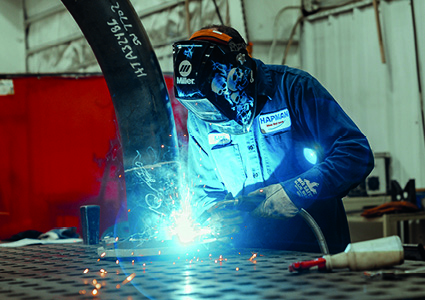
who once said of the company, “we sleep well at night.” “That really captures what we stand for,” he ex-plains. “We don’t expect our employees to do anything that compromises their values, there’s no rule bending or cheating, and as a result, nobody is kept up at night because of their work. The family who owns the business prioritizes taking care of the employees.” Rob then expands: “I always describe it as a traditional worker-owner relationship. We have company picnics, and golf days. We give people turkeys at Thanksgiving, and ham at Christmas. One of the advantages of this is that we have a loyal workforce, and when we do need to recruit, we often fill positions through referrals.”
Through listening to customers, continuously innovating, and evolving its equipment, Hapman has continued to grow. The success of its philosophy is reflected in the fact that 75 percent of its sales come from repeat business. “Customers stay with the company because if we say we are going to make something work, we are determined that we will provide the solution,” Rob explains. “Customers appreciate that approach and continue to choose Hapman over other manufacturers who are less steadfast in that commitment.”
For the rest of the year, the priorities are to continue the evolution of the equipment, and pursue further updates and expansions while meeting the workforce demands that growth will bring. There are new product lines in development, and improvements in workflow and processes underway. Matt takes a moment to reflect on these ambitions: “As we work towards continuing our expansion, I want to emphasize that this is a really special place to work, our customers feel it right away.” For a company built on integrity as much as innovation, the next chapter looks every bit as solid as the last 80 years.
