

How Jaguar Land Rover’s Reimagine strategy is building a sustainable business from supply chain to showroom

The automotive sector is at a critical juncture, transitioning into an era defined by electrification and sustainability. While many manufacturers are still debating the pace of change, Jaguar Land Rover (JLR) has been steadily building the architecture of a sustainable business. Its ‘Reimagine’ strategy is now entering its fifth year, with full electrification of its Range Rover, Defender, Discovery and Jaguar brands at its heart.
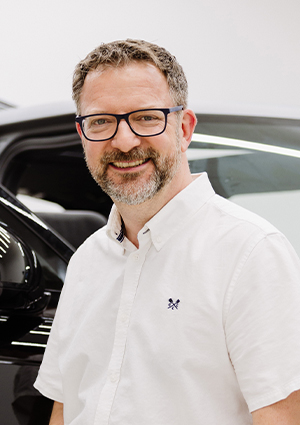
Industrial Operations Director
Through Reimagine, JLR is targeting carbon net zero across its supply chain, products and operations by 2039. As electrification is central to this strategy, it has committed to ensuring the Range Rover, Discovery, and Defender brands will each have a pure electric model, while Jaguar will be entirely electric. It is launching five new BEV options over the next two years, including Range Rover Electric, Range Rover Sport Electric and Jaguar Type 01, followed by further new additions to the Range Rover and Defender brands on its new Electrified Modular Architecture. Globally, JLR has committed £18 billion over five years to the transformation to EV production.
That investment is already visible across JLR’s UK sites. Reuben gives details on what this means for its historic Halewood plant, which is now over 62 years old and has been undergoing a £500 million transformation to enable the parallel production of internal combustion engine and electric vehicles. “We’ve been installing new EV build lines, new robots and training facilities, while also laying the groundwork for that site to become our first Net Zero manufacturing facility. Its unique location has presented opportunities for an on-site aquifer and hydrogen, with new infrastructure due to be completed in 2031. We are therefore upgrading equipment to be ready, including installation of a new hydrogen-enabled boiler,” he adds.
To ensure the most effective results from such significant investments, JLR is considering each plant individually – creating bespoke projects to ensure the right balance of enhanced capability and long-term efficiency. For example, in Wolverhampton, the formerly named Engine Manufacturing Centre (EMC) is now the Electric Propulsion Manufacturing Centre (EPMC), indicating its evolving capabilities.
“At EPMC we’ve installed new build lines and advanced machinery for building electric drive units and battery packs for EVs,” explains Reuben. “That site also has a newly expanded rooftop solar installation, making it the largest automotive manufacturing rooftop solar array in the UK, able to meet almost 40 percent of the site’s energy needs.
“Meanwhile at Solihull, we’re preparing to produce pure electric variants of Range Rovers alongside PHEV and combustion versions, as well as the all-new electric Jaguar. We have also needed to invest in skills development to ensure our workforce has the right knowledge and capabilities.”
To gain further insight into how JLR plans to deliver what it calls ‘a fully electric future’, Manufacturing Today joins Reuben Chorley, the company’s Sustainable Industrial Operations Director. “Our facilities were designed and built to produce internal combustion engine vehicles, so the transition to electric vehicle production is a huge undertaking, which requires significant investment,” he begins.
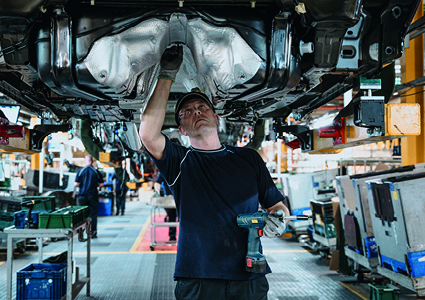
This focus on upskilling its workforce began in 2022 with the launch of JLR’s Future Skills Program, which has seen over 20,000 employees globally, trained in skills vital to electrification, digital and autonomous vehicles. In January 2026, JLR took further steps to address the skills needed for a net-zero economy. “We’re helping to strengthen alignment between education, industry and lifelong learning to help close capability gaps,” explains Reuben, pointing to the company’s role in developing a new Level 3 Certificate in Sustainability for post-16 students with Cambridge OCR.
JLR’s own early careers program offers apprenticeships and graduate schemes with sustainability at their core – supply chain and logistics apprentices explore resource-efficient distribution while finance apprentices learn about environmental reporting and governance. Over 1000 STEM Ambassadors share their career journeys with students, strengthening the pipeline into engineering, production, and logistics.
That investment in people extends beyond JLR’s own walls – and so does its thinking about long-term resilience. As the shift to electric vehicles accelerates, the company has turned the same forensic attention to its supply chain. A key priority for JLR is to ensure it has a secure supply base as it transitions to electric vehicles. “We’re taking a proactive approach to supply chain risk management. We have streamlined our supply chains, working in partnership with suppliers to improve planning and parts visibility, and reducing the impact from disruptions on the company,” Reuben reveals.
JLR has created specialist teams that are responsible for supply chain mapping across its components, so it can build a detailed picture. Having greater visibility better enables the business to proactively assess risk, find solutions to potential stoppages, and drive compliance with current and future legislation. “We also work with specialist partners to carry out physical audits for critical materials, to accurately trace and monitor standards down to mine sites,” notes Reuben.
Reuben advises that when considering supply chain mapping, to map as you source and build the requirement for it into your contracts. “This way the suppliers can do the same with their supply chain. Try and find ways to compliantly share mapped data with others in your industry, so once a supply chain is mapped, others can use it too,’ he says.
Supply chain resilience is also a driver for adopting a circular approach. “A closed loop system would give more control over material availability, or we could have local closed loop systems that would take end-of-life (EOL) material to create new components. These will help reduce exposure to global market volatility.”
Another consideration is the need to balance supply chain transparency with the commercial sensitivities that come with data sharing across a global network. To address this, JLR is increasingly working with carefully selected, trusted partners. “Transparency is essential to both reporting on sustainability measures and identifying areas for innovation and growth. As we electrify our brands, the need for transparency, traceability and partnership across the whole value chain becomes even more important to ensure we address both social and environmental challenges,” says Reuben. That partnership approach sits at the heart of JLR’s net-zero ambition, with low carbon materials, lightweighting and climate targets embedded directly into sourcing processes. “Our procurement team work with suppliers to secure sustainable materials during sourcing which means we can build it into the product as it’s developed.
“Rather than traditional supplier/client relationships, we’re really working closely together on problem statements so we can push towards our shared goals and truly explore the limits of what is possible. Working this way provides a real opportunity for new technical breakthroughs and industry firsts,” he says.
JLR’s Circularity Lab brings together cross-functional teams and external partners to overcome barriers to reuse and recycling, feeding data directly into early vehicle development decisions to test the feasibility of returning materials such as glass, steel, aluminum, and polymers back into production.
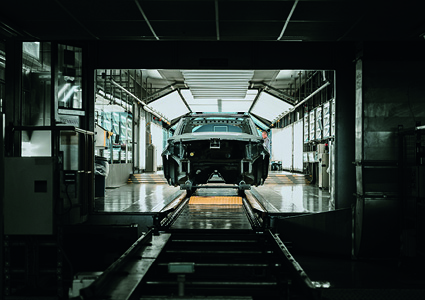
Reuben reveals that JLR has been able to take this a step further with a new initiative, named Project Cornerstone, which translates insights and advancements from the Circularity Lab into physical product solutions. “Our design, engineering and sustainability teams have worked collaboratively with 40 supplier partners to co-engineer 49 more sustainable automotive components and integrate them into a physical demonstrator vehicle. The aim is to establish clear pathways to convert insights and breakthroughs from the lab into production ready solutions that can be delivered onto future vehicles,” he says.
Those partnerships are already delivering tangible results – Reuben offers some examples. He details a fully working front seat, which JLR developed alongside Adient, supported by several other material/supply chain partners (Dow, Borealis, Ineos, Luxus and Bridge of Weir). It utilizes the industry’s first closed loop seat foam, incorporating 62 percent post-consumer recycled plastic (some of which originated from EOL JLR vehicles), and bio-tanned leather trim, which enables EOL composting (avoiding it being sent to landfill or incineration). Combined these changes achieve a 13.5kg CO2e reduction per seat, with ongoing investigations into frame and electronics reuse providing the opportunity to increase that to around 31kgCO2e.
“Another great example is recycled door glass, developed alongside Pilkington,” he continues. “It is made from 100 percent recycled glass recovered from EOL windscreens, which has now been sourced onto future JLR vehicle programs, and also includes a 100-percent-recycled PVB interlayer, a material that, although being very low in mass traditionally, has a very high CO2e impact. These solutions together are estimated to reduce the CO2e impact of the glass by 36 percent.”
Working with ZKW Group, a company specializing in innovative automotive lighting and electronic solutions, JLR has developed a circular headlamp lighting concept that utilizes 30 percent recycled content derived from EOL vehicles. “This includes extremely challenging applications such as the lens itself where performance is safety critical,” notes Reuben. “We’ve also been able to design the lamp to allow the lens to be removed from the assembly, enabling product repair, something that was previously impossible.”
By using In2tec’s debondable conductive adhesive to replace conventional solder, chips and PCBs can be recovered for reuse and recycling. At EOL, their ReCycle solution is used in an ultrasonic bath to reverse the adhesive, making it possible to separate chips from the PCB.
“This removable lens concept will be used on future vehicles and is an example of how we can design differently to support future supply resilience as well as improved repairability and recyclability,” Reuben elaborates. “By improving repairability, damaged or defective lamps don’t need to be replaced with new ones, which also reduces cost to the customer.”
These solutions are the result of close multi-party collaboration throughout the value chain. “For example, the polymer suppliers Luxus, LyondellBasell, and Borealis combined their deep technical knowledge with Adient’s injection-molding capabilities to help identify and produce the most suitable materials for each component. Continuous communication and feedback loops enabled the teams to optimize production conditions, ultimately ensuring delivery of the highest-quality product.”
Project Cornerstone is designed as an ongoing iterative initiative – as new breakthroughs emerge, components will be updated to reflect the most sustainable solution available at that point in time. “I think this really sums up where we are currently in the industry, and the idea that we’re evolving and continuously moving forward is key. We’re not going to reach Net Zero in a single linear pathway, but every incremental step forward counts,” emphasizes Reuben.
Understanding where those steps need to happen requires a clear-eyed view of where emissions come from. Reuben is clear where priorities lie: “In terms of Net Zero – our key focus has been on upstream/supply chain emissions and use phase emissions. From our baseline position, these two categories account for over 90 percent of our carbon footprint. As we transition to EV, we’ll see tailpipe emissions reduce, and the supply chain emissions become even more important.
“Circularity is a key priority to enable that decarbonization, as well as building long-term resilience, and ensuring we can meet the rapidly expanding body of legislation being introduced globally. The upcoming revision to the ELV directive will mandate a minimum percentage of post-consumer and even automotive closed loop polymer content so it is imperative that our supply network evolves to meet these and other requirements.”
Meeting those requirements is the floor, not the ceiling. For Reuben, the broader case for sustainability goes well beyond compliance. “Driving sustainability into your business, whatever it is, is not just a good thing to do for the environment; it gives you real, tangible, business levers. These can be to improve resilience, reduce cost, ensure compliance, raise your brand’s profile or value and of course, make the planet a better place for us all to live. The trick is to get sustainability into the DNA of everything you do, a hygiene factor, that way everyone can contribute,” he concludes.
