
How Janicki Industries has made itself indispensable to the most ambitious engineering programs on the planet

A year on from our last conversation, we catch up with John Janicki, President of Janicki Industries (Janicki), a renowned manufacturer of tools, parts, prototypes, and assemblies for the aerospace, defense and space industries. With customers ranging from private space companies to flying car start-ups, Janicki’s work is as varied as it is complex, as John explains: “What is quite fortunate is that these sectors are, to a degree, in-dependent of one another. In the US, private space companies such as Blue Origin, SpaceX and Relativity are getting money from the government for their job but they’re privately funded, meaning they make decisions based on their own long-term visions, whether that is reaching Mars or focusing on satellite deployment. We have been able to identify and secure specific components we can build for them. As a result, our work in this space is independent and largely insulated from broader economic or geopolitical factors, which is a real advantage.
“The other area seeing significant growth is vertical take-off and landing (VTOL) transport, which is basically the flying car. Companies like Joby, as well as Uber, are among more than 100 organizations that have been competing to develop vehicles capable of taking off and landing vertically to serve big cities. Their goal is to do this electrically, so that their VTOL vehicles meet the sustainability requirements that come with operating in urban environments. It is extraordinarily difficult from an engineering standpoint, but that complexity is precisely where a company like ours adds value by being agile and specializing in manufacturing the kind of advanced components these programs demand,” John states.
Expansions
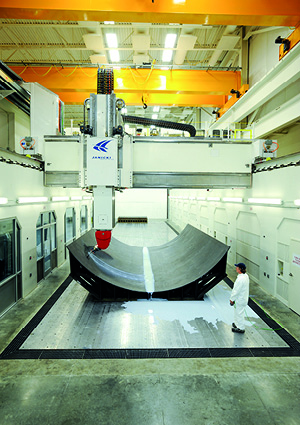
Manufacturing specialty components for such a broad combination of sectors has generated a level of demand that has required Janicki to expand its own footprint. Recently, the company added 162,000 square feet of manufacturing space and an extra 20,000 square feet of storage at its facility in Hamilton, Washington. This investment made sense for Janicki, as customer satisfaction has translated into a steady stream of repeat custom. Since Peter Janicki, John’s brother, founded the company in 1993, it has grown consistently through reinvestments at every stage. As a family-owned company, Janicki’s decisions are driven by how best to support customers and employees rather than by quarterly profit targets. It is this long-term thinking that has allowed the company to keep scaling and expanding its manufacturing footprint. The 12th facility has just been completed, which means that Janicki has constructed roughly one new building every two years over the past 25 years. By building facilities and investing in equipment, the company strives to take the best care of its customers, as that is what it was built on.
Additional manufacturing space would not mean much without the talented people to occupy it, and Janicki has hired 300 new employees to staff its expanded facility. John explains how the company approaches recruitment in what remains a challenging labor market. “We hire at all levels and prioritize cultural fit, wanting to find people who genuinely want to work with us. As a non-union shop, our approach is that everyone pitches in regardless of their role. For instance, engineers regularly work side by side with technicians on the factory floor, which results in better designs and a deeper understanding of how things actually get built.
“This approach is something the British engineering education system understands well. In the UK, it is a requirement for engineers to spend time on the factory floor as part of their degree. The difference it makes is remarkable, as those engineers typically graduate with a real understanding of how things go together, the tolerance issues you encounter and all the other problems a factory throws at you. Meanwhile, in the US, an engineer can graduate with a perfect grade point average but will not know a single thing about working in a factory.
It is a gap we work around by hiring people from entry level and training them ourselves. We have reached a point where we can also attract experienced professionals who don’t want to work for a large company due to the high amount of bureaucracy it often involves, which is something we strive to limit at Janicki,” John elaborates.
With the right people now in place, John’s attention turns to what comes next, and his vision for the future is closely tied to the success of its programs and customers. “Looking ahead, much of our future expansion will depend on the success of the programs we are currently involved with. Take a VTOL start-up, for ex-ample. If that company and its products become successful, their volumes will increase, not decrease, and if we are one of their key manufacturing partners, we will need to scale our capacity accordingly. Of course, we are only responsible for small structural components, we are not involved in producing the engines, avionics, software and other critical elements, which will all have to come together successfully as well. Our growth is tied to theirs, and that is something we are very conscious of,” John ends.
While Janicki’s future may be tied to the success of the programs it supports, that is less a vulnerability than a reflection of the company it has built. Serving customers who are actively trying to reach Mars or reinvent urban transport is no small feat, and as the VTOL and private space programs continue to scale, Janicki is well placed to grow with them.
