
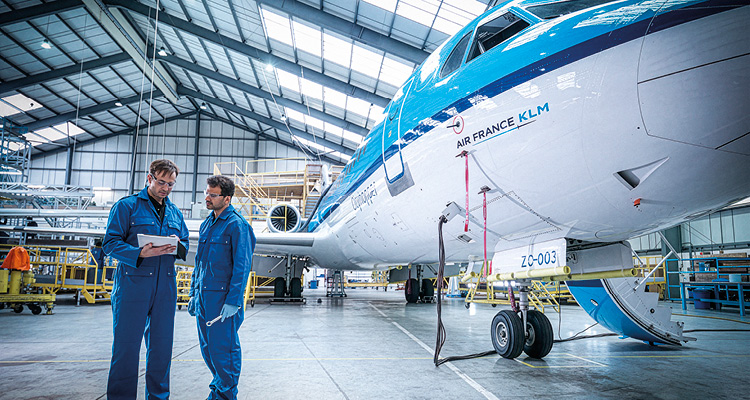
How KLM Engineering saved thousands by fixing a ‘small’ print workflow problem. By Mat Buttrey

In manufacturing, or in any task that involves repeating the same process thousands and thousands of times, inefficiencies can often creep in from unexpected places. Like your site printer.
For KLM UK Engineering, a subsidiary of KLM that specializes in maintenance on a range of commercial aircraft, the culprit wasn’t a broken machine, or a bottleneck in the supply chain, or even user error. It was something deceptively ordinary. So ordinary, in fact, that management had missed it completely: the distance between the job site (in this case, the aircraft hangar) and the printer.

What seemed like a small annoyance actually turned out to be a hidden tax on productivity, not to mention the second biggest company-wide problem flagged in KLM staff surveys. And it was just sitting there, in plain sight. But by modernizing their print workflow, KLM unlocked substantial savings, sustainability benefits, and smoother shop-floor operations all around. And it didn’t involve scrapping their existing MRO infrastructure, either.
Here’s how they did it.
Spotting hidden print problems
Often, the biggest impediments to efficiency are invisible in daily operations. That’s because they’re generally both small and innocuous – an annoying combination. To uncover them at KLM, we began with a simple print audit:
- Tracking engineer movements: First, we mapped the routes that engineers took to collect printed documentation and identified worst-case walks of 273 yards each way
- Measuring reprint rates and job-card errors: Next we reviewed how often printed job cards went un-claimed, were reprinted, or ended up in the wrong location, forcing engineers or managers to take corrective action
- Helpdesk burden assessment: KLM’s IT team then started logging support requests tied to printing issues such as driver troubles, misrouted files, or incorrect destinations
- Volume analysis: We quantified how much paper was used per inspection or non-routine job, discovering that a single aircraft check generated anywhere from 5,000 to 20,000 sheets of paper
Multiplied across 100 engineers across the company and thousands of checks a year, this audit revealed the true cost of what we call a ‘walk-to-print’ problem. Not just the walking time, which is obvious, but also the lost productivity, the reprinting, and the general engineer frustration (which is a factor you should never underestimate).
Putting a dollar figure on inefficiency
What does a 273-yard walk cost? That’s the big question. And if you complete the audit steps listed above, the answer is quite easy to calculate.
Let’s imagine a loaded labor rate of $60/hour. Just those walking trips alone, which took an engineer ap-proximately ten minutes, translated into roughly $240,000 in annual expense across a busy maintenance facility. And that was before we even factored in reprint waste, downtime from missing job cards, or helpdesk overhead. You can see how even small inefficiencies on the floor scale fast when multiplied by dozens of engineers and frequent print jobs.
Once KLM integrated a print management solution, they began reclaiming that lost productivity. And bet-ter yet, turning it into measurable value.
Cutting paper and boosting ESG performance
In modern manufacturing environments, sustainability is everyone’s business. And one flow-on benefit of KLM’s print modernization was significant ESG gains, which become obvious when we think in terms of volume.
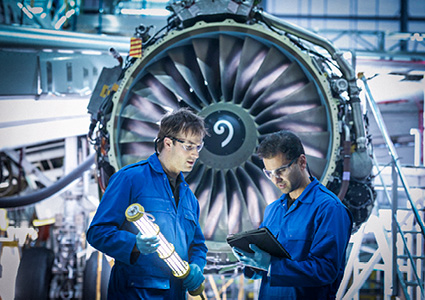
Given the paper-heavy nature of KLM’s operation (up to 20,000 sheets per check), even a modest five per-cent drop in unnecessary print volume means tens or hundreds of thousands of sheets saved annually. Each un-printed job meant less paper, toner, consumables, and time, not to mention less waste.
By adopting a simple combination of Secure Print Release and Find-Me printing, which meant that jobs could only be released by authenticating at the printer itself, KLM not only enabled engineers to print at the machine most convenient for them; they also cut down on unclaimed print jobs. These improvements aligned neatly with the organization’s broader sustainability goals.
Protecting quality and compliance on the floor
In highly regulated manufacturing and maintenance environments, missing or misplaced documents rep-resent a significant compliance risk. For KLM Engineering, delayed or lost non-routine job cards could mean holding up critical signoffs, slowed inspections or maintenance cycles, and even audit challenges, when regulators requested traceable, signed documentation.
By deploying a print management tool that supports Secure Release, not to mention advanced job logging and tracking, KLM made sure all their documentation was reliably delivered and accounted for. This immediately eliminated many of the delays and compliance risks linked with manual handling and misrouted prints, and KLM’s IT department could instantly see who printed what, and when.
Delivering high-impact wins
Perhaps the most compelling part of KLM’s story is how fast and cost-effective these changes were. We didn’t need to overhaul existing legacy MRO infrastructure. We didn’t need to embark on an expensive digital transformation project. Instead, we were able to deliver measurable ROI with limited capital in-vestment.
Within months, KLM reported that helpdesk printing tickets dropped to just one or two per week, a big win for the IT team, not to mention the engineers themselves, who would much rather be fixing planes than walking to a paper tray. Meanwhile, the organization also saved roughly $4,000-$5,000 in print costs, which more than offset the initial investment in print management software.
What we can learn from KLM
In a lean-manufacturing or MRO context, leaders face pressure from every direction all at once. Tightening margins, ESG regulations and sustainability goals, regulatory compliance, and the ever-growing constraints of traditional digital transformation. It’s by no means an easy system to balance.
But KLM’s experience gave us a powerful insight: you don’t always need a multi-million-dollar transformation project to deliver meaningful impact. Sometimes addressing the small problems – like the distance between a job site and a printer – can yield huge gains in productivity and profit. By targeting a small operational hitch, and leveraging intelligent print management, KLM turned marginal waste into meaningful value.
So, if you want to save big, try thinking small. It might just pay dividends.
Mat Buttrey
Mat Buttrey is a Senior Product Manager at PaperCut. For over 20 years PaperCut has made industry-leading print management software that reduces paper and saves trees.
