

How NanoXplore has pioneered the use of graphene as a sustainable high-performance material since inception

With a production capacity of 5000 tons per year and ownership of approximately 40 per cent of the global capacity, NanoXplore Inc. (NanoXplore) is the world’s largest graphene producer and, critically, the only one able to supply graphene cost-competitively at industrial scale. The company produces multiple grades of graphene engineered for distinct end-markets, from composites and plastics to oil and gas, thin films and insulation foams, backed by a decade of proprietary process IP and hands-on application expertise most competitors simply don’t have. That expertise extends to purity as well: at 99.8 per cent for its premium grade, NanoXplore’s graphene ranks among the purest commercially available. Rocco Marinaccio, President and CEO, charts the evolution of the company’s expertise, from its founding to today. “NanoXplore was founded in 2011 as a technology startup company, and operated in R&D mode until 2018, which is when I joined and when we began scaling up production. We went from 25 tons to 4000 tons, and most recently pushed that to 5000 tons. We are also the only company legally certified at large scale to produce and sell graphene in Canada, US, UK and EU, holding EPA certification, ECCC and Health Canada certification and UK and EU REACH certifications in Europe,” he begins.

Obtaining that certification is vital, given that graphene is a relatively new material that was only discovered in 2004 by two scientists at the University of Manchester, who isolated it by exfoliating graphite from a pencil. Graphene is a single-atom-thick layer of carbon that sits at the base of graphite, which itself is around 200,000 layers thick. Through a proprietary process of exfoliation, NanoXplore separates graphite into six to ten graphene layers. However, the challenge of introducing an entirely new material was that, even after it became feasible to produce it at scale, its potential commercial applications remained largely unknown. NanoXplore’s response to that problem was to become the largest graphene producer in the world, and to subsequently acquire companies in downstream industries to demonstrate the true value of graphene.
“We started acquiring composites companies in 2018 for two reasons,” Rocco continues. “The first reason was to demonstrate the power of graphene in real-world applications. The second was to generate stable cash flow from operating businesses, because developing and marketing a new material is an expensive endeavor. Starting from zero revenue, we have grown to approximately $117 million, with the majority of that now coming from graphene-enhanced composites and plastics. Customers experience the benefits of graphene firsthand, which has translated into growing relationships with companies like PACCAR, Volvo Truck, Club Car and General Electric. We also are on track to launch an additional $35 million of business in the next 12 months.”
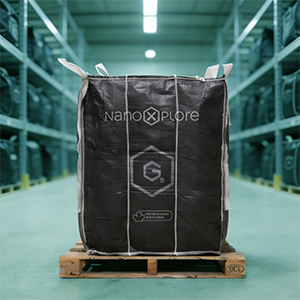
Beyond composites and plastics, NanoXplore has focused on expanding into several other market segments where the value proposition of graphene is becoming increasingly well understood. Oil and gas is one of the most successful of these markets. At the end of 2025, the company signed a five-year agreement with Chevron Phillips Chemical (CP Chem) under which NanoXplore’s Tribograf™ additive is used to enhance the performance of drilling fluids. CP Chem markets the resulting formulation commercially as Nanoslide™. The mechanism is straightforward: Tribograf™ reduces the coefficient of friction in the drill string, increasing lubricity and allowing operators to reach their target depth faster and with less resistance. In practice, that translates to an approximately 17 per cent reduction in drill time; in one head-to-head comparison, a competing solution required six days of drilling, while the Tribograf™-enhanced formulation delivered the same result in five days.
Thin plastic films represent yet another high-potential market. NanoXplore recently announced a partnership with Techmer PM, an expert in compound and masterbatch formulation, focused on using graphene to increase the strength of plastic films by up to 70 percent. “By increasing strength, we can reduce the amount of plastic needed in the production of thin plastic films and achieve the same performance with approximately 20 per cent less material, making it a more sustainable solution. It is a very exciting new product that we filed a provisional patent on and formally launched at the latest Flexible Films Innovation and Recycling Conference in Milwaukee,” notes Rocco.
NanoXplore is also very close to commercialization in the insulating foams segment and is pursuing two value propositions. One such value proposition is increasing the R-value of insulating foams by using graphene as an infrared barrier to reduce heat transfer. The other is positioning graphene as a viable replacement for TCPP, a flame retardant that is in the process of being banned across the UK and Europe. “Graphene has been tested against numerous alternative materials in multiple studies, and it is proving to be one of the only substitutes that actually works,” Rocco elaborates. Its deep understanding of graphene has enabled NanoXplore to establish itself as a world leader with different products that can be effectively used for multiple applications. All these solutions are currently produced in a single facility in Montreal, Canada – though each process differs.
“The most recent innovation among our production technology is a process we call dry exfoliation, or D-series graphene. It is a dry process, which eliminates the need for chemicals and water, that starts with graphite and produces graphene as the output. Our production modules are very compact, with approximately 2000 square feet of space capable of supporting up to 500-1000 tons of annual capacity, and each module represents an investment of around $2 million,” he explains. Each module can be installed directly within a customer’s own facility, opening up a decentralized model for future growth. “Essentially, we tested and refined our solutions internally to ensure that our technology never became a constraint on market growth. By continuously enhancing both our technology and production capabilities, we have built the capacity to serve every market segment we target,” Rocco concludes.
Graphene has always represented a strategic core for NanoXplore. The company recognized its transformative potential well before others sought to produce it at scale, and today, NanoXplore continues to benefit from the material’s growing range of commercial applications.
