

How Supacat is redefining military mobility and championing UK manufacturing

With decades of engineering design success, Supacat has evolved into one of the world’s leading companies specializing in the design and development of military off-road vehicles. Operating in various harsh environments, Supacat’s range of wheeled and tracked vehicles is continuously expanding in line with new requirements for high-mobility cross-country defense vehicles.
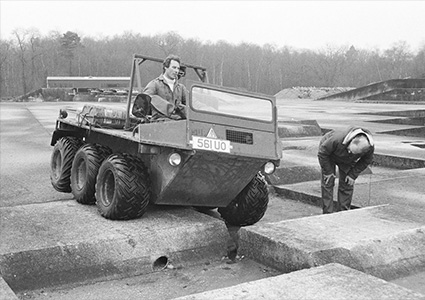
Supacat was co-founded in 1980 by Nick Jones, who continues to play a pivotal role in the company’s operations four decades on. Driven by Nick’s passion, the company developed a range of groundbreaking all-terrain vehicles, including the innovative All-Terrain Mobility Platform (ATMP) in the early 1980s. In 1982, Supacat created the first iteration of the ATMP, named Jura, after the Isle of Jura where the vehicle was demonstrated to the UK’s Ministry of Defence (MoD). This resulted in an order for six vehicles and a later order of another iteration in 1987, marking the start of Supacat’s longstanding partnership with the MoD.
Between 1997 and 2001, the High Mobility Transport Vehicle (HMTV) was developed and officially commissioned by British Special Forces in 2003, with subsequent adoption by various global defense forces. In 2007, an Urgent Operational Requirement (UOR) was signed for vehicles to support the British Army in Afghanistan, leading to the introduction of the HMTV into the Green Army, known as the Jackal and Coyote by British soldiers. Since then, there have been several iterations of the HMTV platform with more than 1000 vehicles in service globally today.
Having started life in a small engineering shed but today operating a large site next to Dunkeswell Airfield, Supacat has clearly evolved exponentially. The company is now part of SC Group, which was formed to be the holding company for Supacat, Supacat Australia, Proteum, Blackhill and SC Innovation-Global. In the last 20 years, Supacat’s engineering expertise has led to contracts outside of the defense industry for civilian applications, including the RNLI Shannon Lifeboat Launch and Recovery System (L&RS), the Bolt wave energy device, and autonomous vehicles.
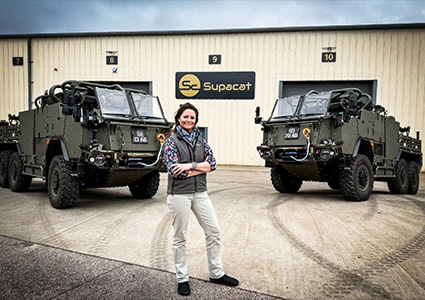
Today, the company’s capabilities include all aspects of vehicle design, comprising engineering, testing, prototype manufacturing, certification, low-rate production, and fleet support. As part of SC Group, Supacat leverages a full range of engineering skills to deliver bespoke, innovative solutions in collaboration with its customers. While Nick Jones remains a director, overseeing SC Group’s product portfolio and providing strategic technical guidance, his daughter, Lizzie Jones, now manages day-to-day business as Operations Director. Having joined the company in 2000, Lizzie is now responsible for all Dunkeswell-based planning, procurement, logistics, production, and delivery, and she joins us to elaborate on Supacat’s ongoing evolution.
“The entire business started with engineering services, and the design and manufacturing of innovative vehicles remains at our core,” Lizzie opens. “We’re currently manufacturing two fleets of the HMT Mk3, a 4×4 vehicle termed the Jackal 3 by the British Army. The first fleet of 70 vehicles was delivered to the customer in 2022, and the latest iteration features a range of enhancements to support operational requirements. It will provide a step change for users in terms of capability, comfort, serviceability, and improved protection, and it also has an increased Gross Vehicle Mass for greater load carrying.”
Updates and adaptations
Indeed, the HMT is considered Supacat’s flagship product and is used by armed forces across the globe. Since its first service application in 2004, the HMT base vehicle has been upgraded or adapted in various configurations for several specialist uses. Within the British Army, the HMT 400, a 4×4 vehicle, is termed the Jackal, while the HMT 600, a 6×6 vehicle, is known as the Coyote. The HMT 400 proved its performance in the harsh terrain of the Afghanistan battlefields, and its unique air suspension system allows the selection of a variable ride height to match the terrain and enable internal loading. The HMT 600, on the other hand, provides the same impressive level of cross-country performance, yet provides a significant increase in payload.
HMT Mk1 and Mk2 were class-leaders in off-road mobility, but the new suspension in the HMT Mk3 will deliver even better performance. While procured as a 4×4 vehicle, the HMT Mk3 can be easily transformed into a 6×6 vehicle by installing an Extenda module, which more than doubles its load carrying capacity. As an easily adaptable platform that can be modified for different requirements, the HMT Mk3 program supports the British Army’s Land Industrial Strategy (LIS) to reduce the number of vehicles in the British Defence Force fleet.
“We’re also currently manufacturing a second fleet of the 6×6 HMT Mk3 at our Dunkeswell site, and we’ve recently signed an order for a fleet of Jackal 3s to be exported to Czechia,” Lizzie explains. “In terms of contracts, we’ve also signed a memorandum of understanding (MoU) with defense company KNDS to manufacture a range of light and medium protected vehicles in the UK. We have a strong partnership with KNDS, and, using our combined expertise, we’ll produce variants based on the Dingo 3 platform and the Armoured Command and Liaison Vehicle (ACLV).”
As Lizzie explains, this partnership aligns with the MoD’s Land Mobility Programme (LMP), which aims to update and streamline the British Army’s land vehicle fleet by replacing vehicles with standard platforms that incorporate digital capabilities. It also supports the UK’s Defence Industrial Strategy (DIS) by strengthening domestic manufacturing capabilities, supporting skilled engineering employment, and creating export opportunities within the UK.
Both Lizzie and the other Supacat leaders are passionate about domestic manufacturing and the value it brings to the UK. “We always use local suppliers where possible, and we aim to build close, long-term relationships,” Lizzie says. “As well as being easier to manage, especially after events like Brexit and the Covid-19 pandemic, using local suppliers also means we’re putting money back into the local economy.”
The British Army’s previous order for 70 HMT Mk3 vehicles in 2022, for example, has had positive consequences for local economic growth. With nearly 100 percent of the supply chain sourced in the UK, and 98 percent specifically from the Southwest, this scheme highlighted Supacat’s commitment to not only delivering improved products for its customers but also supporting local economic and social values.
From a business perspective, Lizzie is also pushing for greater support when it comes to the UK’s import and export strategy. “The import and export of goods is becoming increasingly harder, particularly when crossing multiple borders, and when a UK business sells abroad, we usually have to sign an offset agreement before contracts are agreed,” she explains. “The UK needs a specific offset policy or procedure for companies importing goods, as this would force them to provide in-country value to the UK. This would support all UK businesses and reinforce our sovereign manufacturing capabilities.”
When it comes to manufacturing, Supacat is implementing new technologies to enhance the efficiency and productivity of its operations. “We build complex vehicles with thousands of parts, so we’re bolstering our ability to see real-time progress,” Lizzie says. “We’re constantly striving to improve our processes, and we’re currently rolling out a new ERP system with integrated AI capabilities. We’re also creating a digital twin of our vehicles to enable data collection while they’re in operation, with the aim of moving away from a scheduled maintenance regime.”
With a constantly evolving product portfolio, decades of engineering expertise, and a passion for UK manufacturing, Supacat is not only building vehicles for today’s demanding environments but shaping the next generation of military off-road vehicles.
Offering her thoughts on the future, Lizzie concludes: “We have several ongoing projects throughout 2026, including specific products for customer agreements and continued innovation to create the next generation of vehicles, and we’ll also be opening our new production facility. Looking at the next five years, we’d ideally see some steady production with a mix of UK and export vehicles. We enjoy working on a variety of projects, whether it’s something we’ve designed from scratch or a product we’re working on in collaboration with our customers or partners.”
