
How TEP has insulated itself from market pressures by diversifying its capabilities and customers

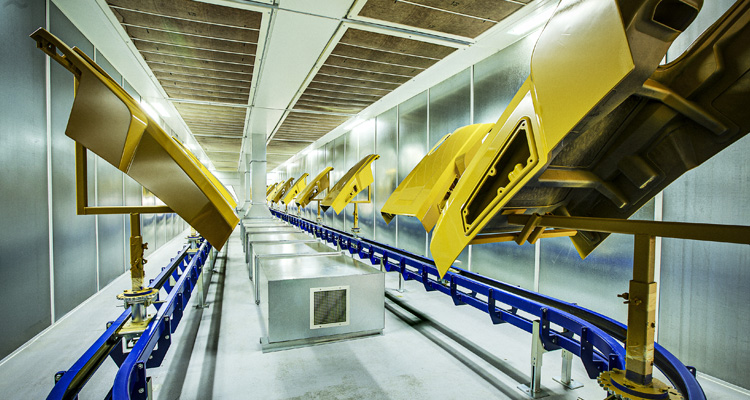
Taylor Engineering and Plastics (TEP) began its journey as a patternmaker and toolmaker serving the automotive industry. After the company was acquired by a large local business, it expanded its scope by incorporating plastic molding, utilizing the tooling that was already being manufactured for its customers. By 1977, TEP was established in its current format and continued its expansion with further injection molding, structural foam molding (ESF), dicyclopentadiene (DCPD) technologies, and, in particular, the development of its painting and finishing facilities.
Scott Taylor, Managing Director, explains: “We have continued to develop innovative thermoplastic and thermoset molding solutions and now serve a wide range of industries – construction equipment, business machines, and medical products to name a few. One commonality across our customers is that we provide extensive painting and finishing capabilities, giving cosmetic finishes to 80 to 90 percent of our product range.”
The company also offers assembly services, sourcing components from metalwork and electronics to harnesses and lights. “We pride ourselves on our ability to offer added value above and beyond molding and tooling. We have quite an extensive range of facilities in Rochdale geared towards providing turnkey solutions,” Scott adds.
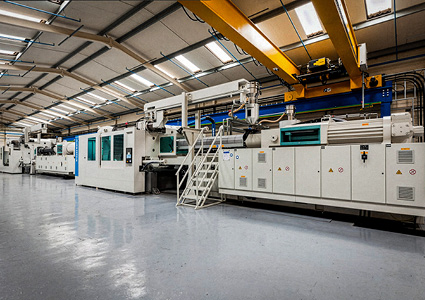
“This diversification presents many benefits including insulating the business from some market volatility. For example, as the polyurethane market reduced, we introduced the DCPD molding process. We are also on the cusp of introducing our biggest ever investment into the business in the form of two SMC molding presses. This enables us to make very large enclosures and bonnets for both existing and new market sectors. Our extensive processes have been our strength which have become a defining characteristic. Rather than being confined to molding for just one industry, we have become known for our ability to make products in a wide range of sizes and base materials for any sector”
While such a breadth of capabilities is undoubtedly impressive, working with OEM manufacturers requires high levels of accuracy and precision. Scott explains how the business ensures the quality remains at the highest levels across the different processes: “One aspect of maintaining such a high quality is ensuring rigorous checks and reviews. Traditionally, the skills and systems are introduced in staff training, and the level of analysis present are the greatest controls. Our business is focused on processing small-to-medium-sized volume runs of products, which often require several stages. Our quality procedures include strict process control with the end results able to demonstrate world class levels for our processes of less than 500 parts per million.”
While TEP is known for its high capacity, high shot weight machines (capable of producing large parts), it is also benefiting from its latest investment in a new 2200T injection molding machine: “The new equipment will not only enhance the capacity of our current range of machines, but it will also help strengthen our position as low to medium volume specialists. There are several companies in the industry that use these size machines for very high-volume productions, but there is a notable gap in capacity regarding large products being produced at lower volumes. This presents significant opportunities for the business; we see further potential and are already engaged with prospective customers and potential new projects.”
This, alongside the compression molding system that represents the business’s largest ever capital investment will extend the company’s reach. Scott expands: “Compression molding allows TEP to provide products that perform at higher temperatures while opening new market sectors. Being such a diverse business, we will consider all opportunities from a broad range of market sectors. Expanding our services has enabled us to offer current customers more options and open new sectors in the UK, Europe and beyond.”
Beyond molding capabilities, TEP’s ability to take projects from design through to delivery sets it apart. “Many OEMs have their own specialist materials and may be unfamiliar with processes we offer. We can help them optimize their designs so they can be manufactured while maintaining quality and commercial viability,” says Scott. Once compression molding launches in early 2027, TEP believes it will be the only European manufacturer offering such a comprehensive range of molding processes under one roof – a unique position for a family-owned SME.
Looking forward, Scott outlines the company’s ambitions for the coming years: “I took over managing the business at the start of the 2020 pandemic, so as much as we are preparing strategic plans and investments for the future, we are also building resilience into our operations. We will continue increasing our services and customer base alongside maintaining our reputation for quality and delivery times. We want businesses to carry on looking to us as the first port of call when launching new products or projects.”
