

How to Choose HCl Gas Detectors for Chemical Manufacturing

A small leak at an acid transfer connection can turn a routine task into a safety concern. Workers may notice irritation, but waiting for discomfort is a poor way to recognise a hydrogen chloride (HCl) release. This guide explains the selection mistakes that are easy to make before buying an HCl gas detector and difficult to correct afterwards.
Start with the Hazard
HCl is a colourless to slightly yellow gas with a sharp, irritating smell. Dissolved in water, it forms hydrochloric acid. Exposure can irritate the nose and throat, cause coughing or choking, and, when serious, damage the respiratory system.
List where HCl could escape: storage connections, transfer lines, valves and reaction equipment. Then decide what must be measured. HCl gas and airborne acid droplets are different sampling challenges. If mist is possible, confirm that the instrument measures it, or plan separate exposure sampling. An “acid gas monitor” does not automatically cover every form of airborne acid.
Choose by Task First
Define the problem before comparing models.
| Main task | What to examine first |
| Continuous monitoring of a defined process area | Where the fixed detector sits, who receives the alarm, and how people respond |
| Protecting a worker who moves between locations | Whether the device suits personal monitoring, and whether the worker will notice its alarm |
| Sampling from a distance | Whether the model supports an HCl-compatible remote-sampling configuration |
Three mistakes follow from skipping this step.
Assuming “portable” means “suitable for personal wear”. Check the datasheet for the intended use.
Assuming one location represents another. A fixed unit near the transfer point says nothing about a valve room down the corridor, and a personal monitor cannot cover the whole plant. Many facilities need both.
Assuming a portable detector can take a pump and hose later. If the task requires people to stay outside and sample from a distance, choose a model with an HCl-compatible remote-sampling configuration. A diffusion-only model measures gas at the instrument and may not suit the task. Treat pump, tubing and accessory support as a screening condition before purchase, not something to improvise afterwards.
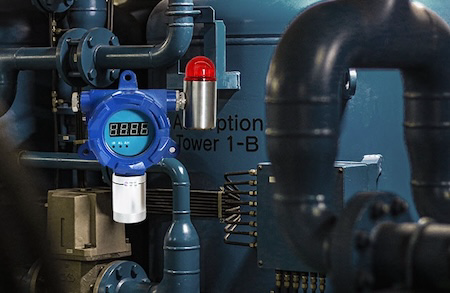
For fixed monitoring, also match the detector’s output to the existing control system before buying. A relay provides a switching signal rather than a continuous concentration reading. For RS485, check the communication protocol as well as the interface; matching interface names alone does not guarantee compatibility.
Decide What the Reading Must Tell You
The detector should name hydrogen chloride as its target gas. Do not assume a chlorine detector or standard multigas monitor gives equivalent protection.
Next, decide whether you need a warning of a possible acid-gas release or a measurement specific to HCl. Some HCl sensors also respond to other gases, so a reading in a mixed atmosphere may not identify HCl alone. If you must distinguish HCl from other gases present, select a measurement method that can do so.
Check the manufacturer’s cross-sensitivity data against a list of the chemicals used nearby. A sensor that performs well in clean air may behave differently in a mixed environment.
Read the Specifications Critically
A wide range does not mean better protection. What matters is performance near the concentrations you care about.
For context, the NIOSH Pocket Guide lists both the US OSHA ceiling limit and the NIOSH recommended ceiling limit for HCl as 5 ppm. A ceiling limit should not be exceeded at any time.
GasDog’s portable and fixed HCl detectors, for example, list an accuracy of ≤±3% of full scale and offer several measuring ranges. On that stated basis, a 0–10 ppm range corresponds to ±0.3 ppm, while a 0–100 ppm range corresponds to ±3 ppm. These values describe the stated accuracy limits, not the display resolution.
Choose a range that covers the intended task while retaining useful accuracy at the concentrations that matter. A higher upper limit is not automatically an upgrade, and a display with more decimal places does not necessarily provide more accurate measurements. Also note how accuracy is expressed: percentage of full scale, percentage of reading, or a fixed ppm value. These behave very differently at low levels.
Alarm settings should follow applicable requirements and a qualified exposure assessment. A factory default is not a complete safety decision.
Count the Whole Sampling Path
HCl is reactive and can stick to surfaces (adsorption), delaying its arrival at the sensor. Sensor response time alone therefore does not describe how quickly a pumped system will detect gas at a remote sampling point.
GasDog’s portable HCl detector, for example, includes a built-in sampling pump and offers an optional extension probe. However, a built-in pump does not make every hose or probe suitable for HCl. Before buying, check the supported tubing material and length, and the response time with the intended accessories fitted.
Place the Detector Around the Process
Do not choose positions simply because wiring is convenient. Consider likely leak points, airflow, ventilation, occupied areas and maintenance access. Check temperature and humidity limits against real conditions; a detector suited to a dry room may need a different arrangement near washdown areas or condensation. Where flammable substances are present, confirm that the complete instrument has the appropriate hazardous-area approval. An enclosure rating alone does not establish suitability.
Check Maintenance Compatibility Before Buying
A detector that cannot join your existing maintenance routine adds cost that the purchase price hides.
If your site uses an automatic test station, check that it supports the exact HCl model before buying. Compatibility with other detectors from the same brand does not guarantee compatibility with this one. Include any separate test equipment and manual testing requirements in the purchase decision.
Also confirm that replacement sensors and test gas can be bought long term, and who will service the equipment. Compare total ownership effort, not just detector price.
Putting It Together: The Transfer Point
- Goal: continuous monitoring of the unloading area. Decide what a fixed system must cover, who receives the alarm, and what happens next.
- Workers inspect multiple potential leak points. Consider a portable HCl gas detector for checks at valves, transfer connections and process equipment. Do not treat the fixed reading as representative of the route.
- Sampling must be done from a distance. Screen out models without an HCl-compatible remote-sampling configuration, then compare response for the whole path.
- Other acid gases are present. Decide whether a general warning is enough or whether the reading must be HCl-specific.
- Mist is possible. Settle what is being measured, and whether the method suits it, before comparing gas-detector specifications.
- An automatic test station already exists. Confirm it supports the exact model, or budget for separate equipment and manual work.
The same site can lead to different choices depending on the monitoring goal. Detection also works alongside ventilation, leak prevention and safe working procedures, not in place of them.
Use Suppliers to Verify, Not to Decide
Choose the detector and its required accessories as one working setup. Before ordering, check that the selected configuration suits the monitoring task, provides useful accuracy in the intended range, and works with the site’s control and testing equipment. A wider range or more features cannot make up for a mismatch in these essentials.

*Please note that this list includes sponsored content. Some of the companies, products, or services featured have entered into commercial agreements for placement. Sponsored placements do not necessarily reflect an endorsement and should be considered alongside other options in the marketplace.