
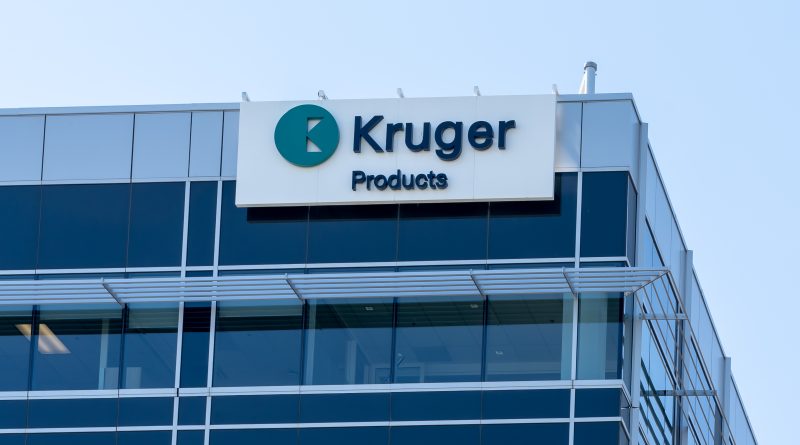
Kruger’s $333M bet signals a new era for sustainable wipes

Subscribe to our free newsletter today to keep up to date with the latest manufacturing news.
For decades, pulp and paper manufacturers faced a difficult question: how to grow in markets shaped by declining print demand, volatile commodity pricing and rising sustainability expectations. Kruger’s $333 million investment into nonwoven wipe materials offers one possible answer.
The Canadian manufacturer announced plans to build a new production facility in Trois-Rivières, Québec, marking its entry into the rapidly expanding nonwovens sector. The project will include Canada’s first industrial line combining wet-laid and dry-laid nonwoven technologies to produce materials designed for consumer and industrial wipes.
The move carries implications far beyond a single factory expansion. It reflects how forest-product companies are repositioning themselves around advanced materials, circular manufacturing and plastic alternatives as environmental scrutiny intensifies across global supply chains.
Demand for sustainable wipes has risen sharply in recent years. Regulators in Europe and North America continue tightening rules around single-use plastics, while retailers and consumer brands face pressure to reduce synthetic content in disposable products. Traditional wipes made with polyester or polypropylene increasingly sit at the center of that debate because many contribute to microplastic pollution and wastewater blockages.
Kruger’s strategy targets that pressure directly. The company says the new materials will be plastic-free, biodegradable and compostable, using natural wood fibres sourced from Canadian forests. That positioning places the business within one of the fastest-growing segments of the hygiene and personal care market.
Kruger’s move into nonwovens reflects a wider industrial shift
Kruger is not alone in rethinking the future of fibre manufacturing. Across North America and Europe, established pulp and paper groups are investing in engineered biomaterials, sustainable packaging and specialty substrates that offer stronger margins than conventional paper products.
Nonwovens represent an attractive growth category because demand remains relatively resilient across economic cycles. Wipes are used throughout healthcare, industrial cleaning, hospitality and household applications, giving manufacturers access to diverse end markets.
Global growth expectations remain strong. Industry analysts continue forecasting expansion in sustainable wipes and hygiene materials as consumer brands reformulate products to reduce petroleum-based inputs.
The technology behind Kruger’s investment matters because it expands the range of products the company can manufacture. Wet-laid systems are known for producing uniform fibre distribution and softness, while dry-laid processing improves strength and bulk characteristics. Combining both technologies within a hybrid production line allows manufacturers to tailor performance for different wipe applications.
That flexibility could become a competitive advantage as brands increasingly demand custom materials balancing durability, absorbency, biodegradability and cost.
The project also demonstrates how legacy industrial regions are attempting to preserve manufacturing relevance through specialization rather than scale alone. Trois-Rivières has long been associated with Québec’s pulp and paper industry. Advanced nonwovens production offers a pathway into higher-value manufacturing categories tied to sustainability trends.
Government participation reflects the strategic importance attached to that transition. Financial backing from Canadian and Québec authorities suggests policymakers increasingly view biomaterials and low-carbon manufacturing as industrial priorities rather than niche environmental initiatives.
Canada’s first hybrid nonwovens production line could reshape supply chains
One of the more significant aspects of Kruger’s announcement involves geography. Much of the global nonwovens supply chain remains concentrated in the US, Europe and Asia. Building domestic Canadian production capacity may reduce dependence on imported materials while giving North American brands access to shorter and potentially more stable sourcing networks.
Supply chain resilience became a major concern during the pandemic, particularly across hygiene products and medical materials. Manufacturers throughout the wipes sector experienced raw material shortages, transportation disruptions and pricing volatility. Those disruptions accelerated interest in regionalized production models.
Kruger’s planned facility may benefit from proximity to fibre supply, existing industrial infrastructure and integrated paper operations at the adjacent Wayagamack site. That integration can lower transportation requirements and improve production efficiency.
The company also appears to be targeting a premium segment of the wipes market rather than competing solely on volume. Sustainability claims now influence procurement decisions across major retailers and multinational consumer brands. Compostability and plastic elimination increasingly function as commercial differentiators.
That creates opportunities for fibre-based materials capable of meeting both environmental standards and performance requirements. Historically, manufacturers often faced trade-offs between sustainability and durability in wipe substrates. Hybrid technologies aim to narrow that gap.
The economic implications are also substantial at the regional level. Kruger estimates the project will create 56 permanent jobs alongside hundreds of temporary construction and installation roles. In industrial communities shaped by cyclical commodity markets, investments tied to advanced manufacturing carry broader significance because they support specialized technical employment and long-term operational stability.
Sustainable materials are becoming a competitive requirement
The wipes industry sits within a larger transformation affecting nearly every consumer goods category. Companies are under pressure from regulators, investors and customers to demonstrate measurable reductions in plastic usage and environmental impact.
Environmental, social and governance targets increasingly influence sourcing decisions throughout global supply chains. Consumer brands now face scrutiny not only over packaging but also over product composition and disposal outcomes.
That shift changes how manufacturers evaluate material innovation. Sustainability is no longer treated exclusively as a branding exercise. It is becoming part of procurement strategy, risk management and regulatory compliance.
Kruger’s investment highlights how traditional resource companies may benefit from that transition if they can reposition existing expertise toward renewable materials. Fibre processing, industrial-scale manufacturing and forest supply management remain core strengths for pulp producers entering biomaterials markets.
The challenge will be execution. Sustainable materials markets continue evolving rapidly, and competition is intensifying as manufacturers race to commercialize alternatives to plastics across wipes, packaging and textiles.
Still, the scale of Kruger’s investment signals confidence that demand for fibre-based nonwovens will continue growing through the next decade. If successful, the project could help establish Canada as a more significant player in advanced sustainable materials manufacturing while offering a blueprint for how legacy paper producers adapt to changing global markets.
Source
