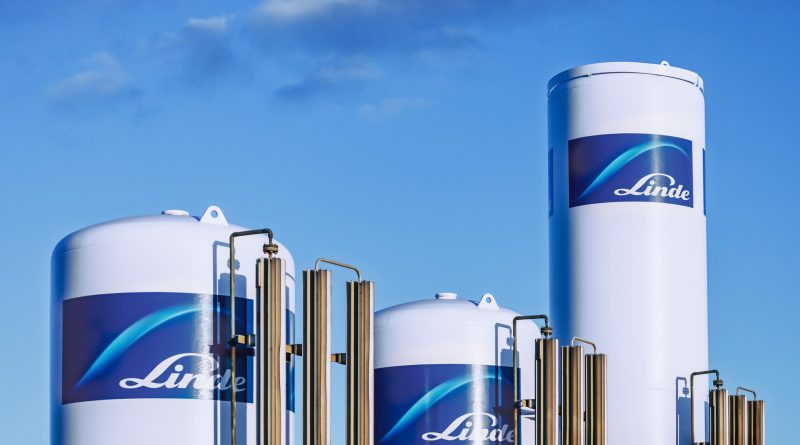
Linde’s $1 billion semiconductor investment strengthens US chip manufacturing

Subscribe to our free newsletter today to keep up to date with the latest manufacturing news.
When semiconductor manufacturers announce multi-billion-dollar fabrication plants, attention naturally turns to the chips those facilities will eventually produce. Yet every advanced fab relies on an extensive network of suppliers whose investments often determine whether production can operate efficiently from day one.
Linde’s announcement that it will invest more than $1 billion in a new industrial gases complex in Phoenix, Arizona, illustrates this reality. The project, which will support Taiwan Semiconductor Manufacturing Company’s expanding Arizona campus, represents one of the largest industrial gas investments tied directly to semiconductor manufacturing in the US. It also reflects a broader shift in how the semiconductor supply chain is evolving as domestic chip production accelerates.
Rather than responding to immediate demand, suppliers are making long-term infrastructure commitments that will influence where semiconductor manufacturing expands over the coming decades.
Building semiconductor capacity means investing beyond the fabrication plant
Constructing a semiconductor fabrication plant requires much more than cleanrooms, processing equipment and skilled engineers. Advanced manufacturing also depends on continuous supplies of ultra-high-purity industrial gases that support almost every stage of wafer production.
Linde’s new Phoenix complex will produce and distribute gases including nitrogen, oxygen and argon through dedicated infrastructure designed specifically for semiconductor manufacturing. These gases are delivered directly to fabrication facilities through integrated pipeline systems engineered to operate continuously with exceptional reliability.
For chipmakers, reliability is just as important as purity. Modern fabrication plants operate around the clock, and production interruptions can carry substantial financial consequences. Even brief disruptions to gas supplies can halt manufacturing processes, affect wafer quality and reduce plant efficiency.
This explains why industrial gas suppliers increasingly build, own and operate facilities adjacent to semiconductor campuses under long-term supply agreements. The model gives manufacturers dependable access to essential materials while reducing operational risk as production volumes increase.
Linde’s investment also reflects growing confidence in Arizona’s role as one of North America’s leading semiconductor manufacturing hubs.
Industrial gases are among semiconductor manufacturing’s most critical technologies
Industrial gases rarely receive public attention, yet they perform essential functions throughout semiconductor fabrication.
Ultra-high-purity nitrogen provides inert environments that protect sensitive materials during processing. Argon supports deposition and sputtering applications, while oxygen contributes to oxidation processes used to form transistor structures. Hydrogen, helium and other specialty gases also play important roles in etching, cleaning and advanced manufacturing processes. Even microscopic impurities can reduce production yields, making gas purity and delivery systems as important as the gases themselves.
Maintaining these standards requires significant engineering expertise. Suppliers must design air separation units, purification systems, storage facilities and distribution networks capable of delivering gases continuously while meeting increasingly demanding semiconductor specifications.
As chip architectures become more sophisticated and manufacturing nodes continue to shrink, maintaining consistent process conditions becomes progressively more challenging. This places greater emphasis on supplier expertise, operational resilience and long-term infrastructure investment.
Industrial gas companies have become strategic partners rather than conventional raw material suppliers.
Supplier investment reflects a broader shift in US manufacturing
Linde’s Phoenix project highlights how semiconductor expansion is increasingly measured by the strength of the surrounding industrial ecosystem.
Public discussion often focuses on semiconductor manufacturers and government incentives. Advanced fabrication facilities, however, cannot operate without parallel investment across supporting industries. Chemical suppliers, equipment manufacturers, logistics providers, utilities and industrial gas companies all contribute to manufacturing clusters capable of supporting long-term growth.
Arizona demonstrates how this ecosystem is developing. As semiconductor fabrication capacity expands, suppliers are locating production facilities nearby to improve reliability, reduce transportation complexity and strengthen regional supply chains.
This approach aligns with broader efforts to increase domestic manufacturing resilience while reducing dependence on overseas production for strategically important technologies. Building fabrication plants is only one part of that effort. The supporting supply chain must also expand alongside production capacity.
For companies such as Linde, that means investing years before manufacturing capacity reaches full utilization, creating infrastructure designed to support multiple generations of semiconductor production rather than a single project.
Linde’s latest investment represents more than another industrial expansion. It demonstrates that future semiconductor competitiveness will depend not only on producing advanced chips but also on building resilient supplier networks capable of supporting them. As semiconductor manufacturing continues to expand across the US, investments such as this may become one of the clearest indicators of where the industry’s next growth opportunities will emerge.
Source