
Lippert builds scale across markets while aligning people, products, and purpose through a sustained growth strategy

2026 is a significant year for Lippert, a supplier of engineered components to the outdoor recreation and transportation markets. From chassis and axles to seating, glass, and climate systems, Lippert’s components power vehicles and environments across the RV, marine, automotive, and transportation markets. What started in 1956 as a manufactured housing supplier is now a global manufacturing powerhouse producing thousands of parts daily, built through a mix of fabrication, engineering, and assembly across its worldwide network.

Braxston Cave, Senior Vice President, manages Lippert’s vast operational footprint. He works across brands, facilities, and product lines, bringing teams together and aligning output in a business where manufacturing, integration, and delivery operate in sync. His role keeps him close to the decisions that drive Lippert’s growth, extending into new markets while building on core strengths.
“There is no shortage of projects going on across the company with lean manufacturing and automation. But at our core, execution comes down to our people,” Braxston notes. His responsibility sits where scale meets execution. Outcomes depend on how manufacturing, integration, and people work together in real time.
Building the platform
Lippert’s story is one of steady, focused expansion within its core disciplines. Since 2000, more than 70 acquisitions have added new capabilities and deepened expertise. Instead of abrupt shifts, Lippert uses a targeted approach to enter new markets. “Some of the larger, key acquisitions are CURT Group, which took us into the automotive aftermarket; Taylor Made, which opened the marine market; Furrion, which added electronics and appliances; and Freedman, which strengthened our presence in transportation,” Braxston explains.
This methodology connects different industries through shared strengths: fabrication, assembly, and systems integration. The model depends on daily execution as much as long-term strategy.
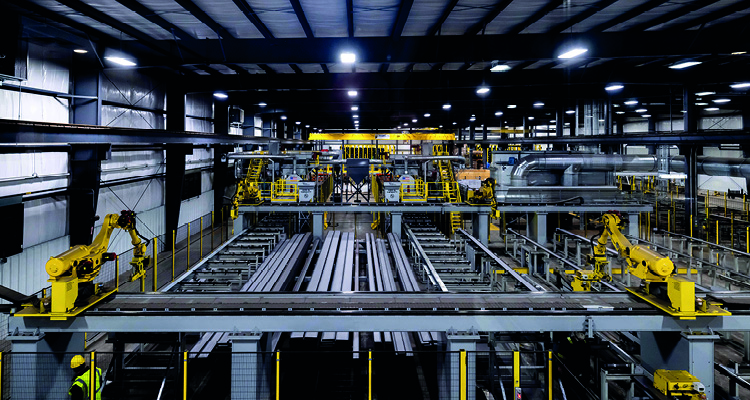
High-tech investments like the chassis beam processing center in Goshen, Indiana, bring consistency to high-volume production. Still, the human element remains irreplaceable. “Lippert’s product manufacturing will always be largely fueled by the more than 12,000 team members who build most of our products by hand,” he adds.
Innovation in practice
Lippert’s innovation model works across more than 100 sites, with teams contributing ideas tied to specific product lines or customer needs. These ideas flow into a central engineering hub in Elkhart, Indiana. “Our team of professionals, led by VP of Engineering Tim Schultz, brings many of these ideas to life. Many of our new product ideas come directly from our customers; they have a problem to solve, and they trust us to innovate the solution.”
The transport and HVAC sectors show how that problem-solving model translates into real-world applications. Safe Ride Essentials focuses on passenger safety by activating and illuminating exits in emergencies. The RT80 HVAC unit improves airflow and integration in transit vehicles. “Seating systems from Freedman respond to accessibility and durability requirements.”
Specialist teams drive each area, often with a single focus. “We have a team of HVAC veterans in Mesa, Arizona, who wake up every day focused entirely on heating and cooling. That kind of dedication makes Lippert successful,” notes Braxston.
Braxston’s role intersects these activities by connecting product direction with operational delivery. His background, which includes steady progression through leadership roles since joining the company in 2016, spans both plant-level execution and broader portfolio oversight. His experience directly informs how projects move seamlessly from concept into scaled production.
Culture and accountability
Lippert connects operational precision with its corporate culture, building consistency through both behavior and process. “In 2012, we embarked on what I call our cultural improvement journey,” he recalls. Leadership development became anchored by five core values that align teams across sites.
That effort expanded into a dedicated team focused on developing leaders and reinforcing expectations across the organization. Culture, in this context, connects directly to manufacturing output. “Disengaged team members could build a poor-quality product that upends someone’s vacation. There’s nothing worse than hearing from an RV customer who’s stuck at their campground and can’t get moving because of a product issue,” Braxston says.
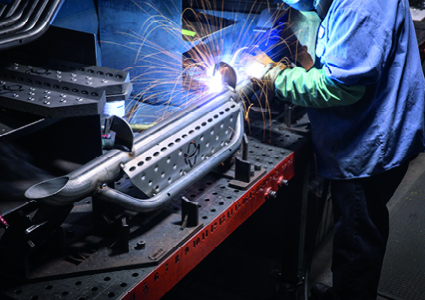
Lippert components are part of systems used daily for travel or work. Mechanical failure directly impacts the end user. “That awareness informs our investment in leadership training alongside manufacturing upgrades.”
Collaboration and accountability guide Lippert’s approach. “Our leaders are expected to deeply understand both the process and the people,” he continues. This perspective shapes team operations and reinforces the link between behavior, output, and consistency across the business.
Philanthropy adds another dimension to Lippert’s environment. Employees are encouraged to engage with their communities, linking internal culture with external impact. “Our core belief is that if a team member is treated well at work, they’ll go home and treat their family, coworkers, friends, and community the same way.”
Growth trajectory
As Lippert celebrates 70 years in business, its growth strategy remains anchored in expanding core competencies and pursuing value-add acquisitions across key markets. “We have massive plans for the company over the next five years. We’ll continue to execute our acquisition strategies and double down on innovation.”
This approach keeps Lippert building on its original framework, expanding through products that connect to its manufacturing base. Work continues in seating, HVAC, and integrated systems, where recent acquisitions are being scaled and applied to new programs. “Our focus isn’t on ‘me-too’ products, but on engineering solutions that genuinely transform the industries we serve,” he adds.
For Braxston, success means staying close to how everything fits together, from plant floor decisions to how components perform in the field. The focus stays on extending what Lippert already does well, bringing its products into more vehicles, more routes, and more environments where people count on them to work flawlessly.
