

Nick Haase says you cannot hire your way out of a maintenance problem

The most expensive machine in your plant is not the one that broke last week. It is the one that has been running four percent slower for nine months and never generated a work order. Nobody calls a meeting about that. It never appears as downtime. It appears as overtime, expedited freight, and a line everyone calls fully utilized when it isn’t.
Call it the paper program. The maintenance strategy that is real in the binder and fictional on the floor. Almost every plant has one, and most carried one for years without paying much of a price. That is changing now, and the reason is simple math.
A tipping point 20 years in the making
For two decades, a paper program was survivable because two cushions absorbed it. The first was slack capacity. When demand was the constraint, a lost shift got made up on Saturday. The second was tenure. The veteran who knew a machine ran hot on humid days never needed the procedure written down. He was the procedure.
Both cushions disappeared at the same time.
Demand has come back faster than capacity can be added, so the asset base runs more hours with fewer windows to work on it. The workforce math is worse. Deloitte and the Manufacturing Institute project US manufacturing could need 3.8 million workers through 2033, with 1.9 million of those roles at risk of going unfilled. Roughly 400,000 sit open today.
That is the tipping point. Not a new technology, not a new trade policy. The two things that covered for weak maintenance execution stopped covering.
Erosion does not announce itself
Neglected maintenance rarely fails loudly. It degrades. A pump gets rebuilt instead of root-caused, four times in 18 months, and each rebuild is logged as completed work. A calibration drifts and the scrap rate moves half a point, which sits inside normal variation until you compare it to two years ago.
None of this shows up in a downtime report. All of it shows up in cost per unit.
In our annual survey of more than 2,200 maintenance and operations leaders, half of all teams still spend less than 40 percent of their time on planned work. Labor shortages and poor knowledge transfer rank among the leading causes of unplanned downtime.
Read that again. The top causes are not mechanical. They are informational.
You cannot hire your way out
This is where most leadership teams reach for the wrong lever, treating a maintenance shortfall as a headcount problem and opening a requisition.
Even if you fill it, and increasingly you won’t, you are hiring into a plant where the knowledge is not written down. A new technician in an undocumented operation is not a solution. He is a second person waiting on the same veteran.
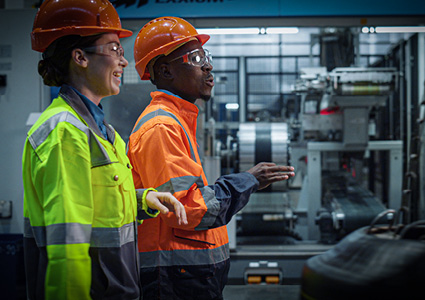
Digitized workflows matter here for a reason that has nothing to do with efficiency. When the procedure, the asset history and the last three fixes live on the device in a technician’s hand, a two-year employee performs closer to a ten-year employee. Automated scheduling means preventive work triggers whether or not a planner remembers it.
That is how output holds when the labor market will not cooperate. Not by finding more people. By making the people you have less dependent on the people you lost.
Adoption is the whole game
Interroll, a global material handling manufacturer with more than 20 plants, had already made digitization a pillar of its lean system. The team adopted a maintenance platform and went paperless. As their lean engineer in North Carolina described it, everything was online and it was still slow to use. Adoption suffered, so the data stayed thin.
When they moved to a system technicians would actually pick up, response time and downtime improved by 15 to 20 percent.
The technology was never the variable. Adoption was. Software that is painful to use gets the bare minimum entered into it, and bare minimum data cannot support anything built on top of it.
Resilience is a shorter recovery
Resilience usually gets discussed as a cushion. More inventory. A second supplier. A spare on the shelf. Expensive, and the wrong instinct in a market where inventories are already thin. Real resilience is not a bigger buffer. It is a shorter recovery.
The manufacturers who win the next three years will not be the ones who avoid failures. Everyone will have failures. They will be the ones who diagnose faster because the asset history is complete, dispatch faster because the procedure is in hand, and return to rate faster because the second-shift technician never has to call a veteran at home.
That advantage compounds. It also cannot be bought on a lead time, which is what makes it worth building.
Start with the asset where an hour of downtime costs the most. Write down what your best technician knows about it. Then do the next one.
The paper program was affordable when you had slack and tenure. You have neither now. Write the plant down. Then run it hard.
Nick Haase
www.getmaintainx.com
Nick Haase is a co-founder of MaintainX, an AI-powered maintenance and asset management platform now part of Autodesk. He has spent the past eight years on plant floors with the maintenance and operations leaders who keep industrial production running.
