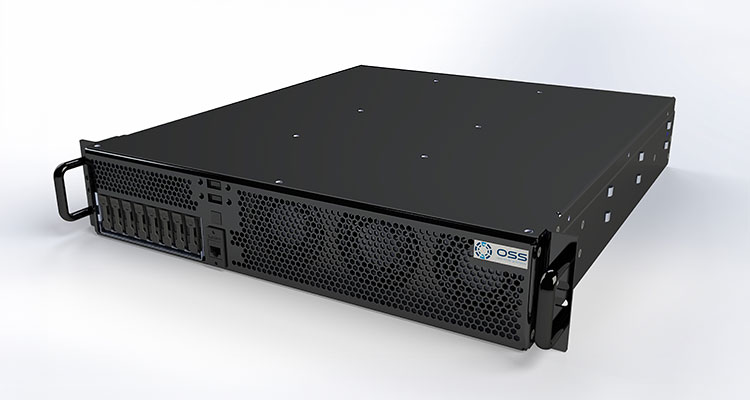
One Stop Systems accelerates edge innovation through advanced computing, cooling, and smarter manufacturing

For 25 years, One Stop Systems (OSS) has specialized in bringing high-performance, low-latency computing to the edge. Its rugged systems run on planes, trains, tanks, ships, submarines, and uncrewed aerial vehicles (UAVs) across defense and commercial markets, powering artificial intelligence (AI), machine learning (ML), sensor processing, sensor fusion, and autonomy. Mike Knowles, President and CEO, explains how the company brings data center performance into the field, and how its manufacturing operation is scaling to match.
Mike joined OSS in 2023. “The company had a differentiated technology and product architecture that I felt was aligned with where the world was going in AI, ML, autonomy, and sensor processing,” he says. “I saw that as an enduring market. Much like the internet, it isn’t going to fade away. The company also had a fantastic culture of innovation and mission accomplishment. The vision was to move markets off the low-compute architectures they had used for decades and design the enterprise-class technology developed for data centers, such as NVIDIA GPUs and Broadcom switch chips, into products that deliver data center-like performance on edge platforms.”
Moving that performance out of the data center brings a new set of constraints. “A data center is a building with a constant temperature and no real ruggedization issues,” Mike continues. “On an edge platform, you have to deal with temperature, shock and vibration, electromagnetic interference, and limited space. The first area where we differentiate ourselves is electrical engineering. We take silicon chips and design them into processing boards and backplane fabric boards that deliver enterprise-class performance with low latency, and we work with chipset vendors to make sure their firmware is aligned to edge environments.
“The second area is ruggedization. If a system is going to operate in the desert, or in mud, rain, salt, and fog, it must withstand those environments and handle different types of power. Because we use the latest high-performance chipsets, heat dissipation has become one of the biggest issues we deal with.”
OSS was an early mover in liquid cooling for the edge, fielding hundreds of ruggedized direct-to-chip systems and developing full-immersion systems, where processing hardware is submerged in a heat-transfer liquid. Packing more computing power into a smaller chassis concentrates heat in that space, and direct-to-chip cooling moves it from the chip into a liquid and out of the chassis quickly.
“Direct-to-chip liquid cooling is the more commonly adopted approach right now because of its usability,” Mike details. “Data centers running the highest-wattage GPUs now need direct-to-chip or immersion cooling just to keep them within operating temperatures. That has created a much wider pool of commercial cooling modules that we can use at better price points. We then work with those vendors, or design our own approaches, to make modules rugged.”
After three years of strong growth, OSS has recently expanded its in-house shock, vibration, and thermal testing, bringing back work it had largely outsourced to local labs. “We found we could reduce our costs, and our customers’ costs, by moving that work in-house,” he explains. “We also have support directly during testing. If a design or manufacturing problem emerges, our quality engineering and engineering teams can deal with it at the time, and we generate and hold that data on our own systems.”
OSS competes with the data center market for many of the same GPUs and chipsets, and Mike is proud of how the company manages that pressure. “We look a year ahead at customers, forecasts, and pipeline, and hold a manageable level of inventory that guarantees delivery times,” he notes. “Then there is our procurement team. I think of them as my day traders. They scan the global market all day, every day. Some people overbuy, and some products come onto the market through brokers, so there are narrow windows where parts are available with short lead times. We have to know when that happens and be ready to act, and we identify customers who can accelerate their schedules or pre-buy for an anticipated order.”
For defense work, a Defense Priorities and Allocations System (DPAS) rating also moves certain orders up vendors’ queues. OSS also runs a formal obsolescence plan, with software that flags long-lead or end-of-life parts early so its engineers can design around them.
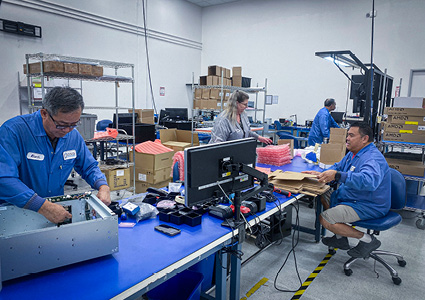
The same data-led approach now runs through the production floor. Around two years ago, OSS appointed a Vice President of Operations with a background in lean manufacturing. “You can now walk onto our floor and see television screens showing live metrics and timing,” Mike highlights. “We use Power BI and other tools to track performance from execution to quality, and we’ve added manufacturing engineering and quality engineering to keep reducing waste. This year, we’ve started pulling all the data from our builds, forecasts, and supply chain into one large dataset and applying AI to it. We can ask it about trends and where we’re heading, and it highlights actions we should take to ensure quality, delivery, and supply.”
The company’s product roadmap spans compute servers, expansion systems, and storage, and moves in step with GPU vendors such as NVIDIA and Qualcomm, which release new revisions every 12-to-18 months. Its manufacturing model is built to grow with that roadmap. “We design all our processing boards in-house, but we don’t need surface-mount lines here,” he adds. “A global network of partners builds our boards, which gives us major scalability. Some defense customers want made-in-USA only, while others want the lowest cost, and we can source either way. Our own manufacturing is build, test, and delivery, which is very scalable, and we have enough space to probably triple our revenue within our existing footprint.”
For Mike, the company’s competitive advantage lies in how quickly it can move. “From a manufacturing standpoint, we’re very agile and quick to respond,” Mike concludes. “We can take what’s on the forefront of AI, ML, sensors, and autonomy and bring it to defense and commercial customers in a way that’s rugged, high quality, and far more efficient in the smaller spaces of edge platforms.”