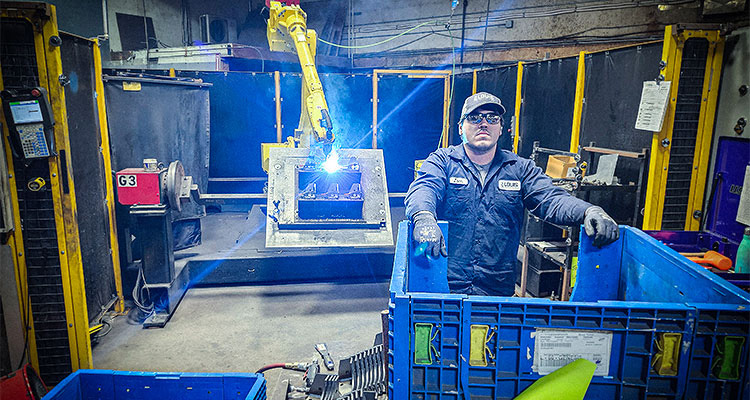
Over the last decade, Louis Industries has been strategically automating its job shop

With a steel processing and manufacturing facility based in Minnesota, Louis Industries is a renowned sheet metal fabricator and distributor. Using state-of-the-art technology like lasers and turrets alongside forming equipment, the company manufactures high-quality parts for various customers. Lance Louis, Chief Executive Officer, introduces us to the business and its rich history.
“Louis Industries was started in 1940 by my grandfather, who was a blacksmith sent to rural America during World War II to help keep farms operational by fixing equipment and building farming gear. From those origins, we have evolved considerably. My grandfather built some of the first turkey processing equipment in the 1960s, though we do not do much in that industry today. In the late 1980s, the skid loader attachment was invented on a farm just outside of Paynesville, Minnesota, and we made the first quick-attach for the gentleman who invented and patented it. That development shifted us from agricultural blacksmithing into job shop manufacturing, which is where we have been for the last 40 years. The next evolution we see for ourselves is automating the job shop by bringing automation to small and medium-volume production runs. We service some large Fortune 500 companies, but we also work with a lot of small and medium-sized OEMs, and we are increasingly capable of automating effectively at those smaller batch sizes,” he begins.
As a long-established family-owned company with over 80 years of history behind it, Louis Industries trades short-term decision-making in favor of what Lance calls the long approach. That sense of long-term thinking is deeply embedded in how the business operates. “What I preach to my staff, customers, and suppliers is that we are planning to be 100 years old. To achieve this age, we do not make decisions today that might benefit us for the next 90 days and hurt us later. Instead, we are asking how we continue to build a company that is sustainable for the long term. That thinking is what led us into automation. We started exploring robotics about ten years ago and invested in more advanced technology around five years ago. But buying the robot is only part of the equation. Building the team around that equipment, including engineers, operators, and salespeople who can sustain it, understand it, develop it, and push its potential, has taken just as long. Now we are at the point where we can scale because the team and the infrastructure are in place. I think that this illustrates what the long approach means to us: create something sustainable, build the right team around it, then scale what you have proven works,” Lance explains.
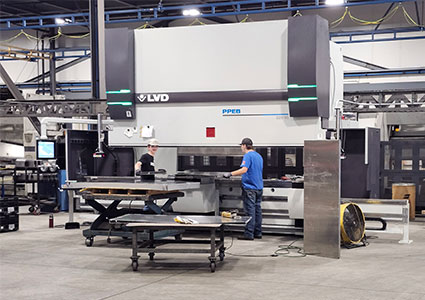
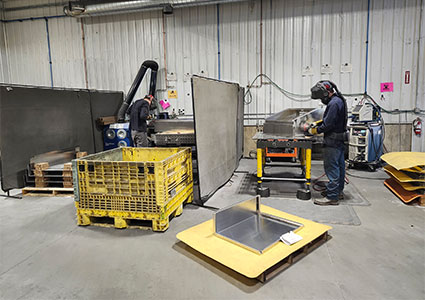
Expanding its facility felt like a natural extension of Louis Industries’ focus on building sustainably. The multi-million-dollar expansion and remodel of its headquarters in Paynesville was a carefully considered decision with clear long-term intent. The existing factory was facing a few obstacles and had run out of available power; a constraint that was limiting the company’s ability to add more robots within its processes. With a lot of land available, the team concluded that a significant expansion carried out now was a far better solution than a series of smaller incremental expansions over time. Taking its preexisting manufacturing infrastructure and utilities, the company added 40,000 square feet of warehouse space, freeing up the existing footprint to accommodate additional robotic press brakes and robotic welders. Expanding the facility was a logical decision for Louis Industries as the team always looks to evolve the business forward while giving the team the right environment to work in. Creating the right working conditions is something the company views as a prerequisite to investing in more advanced equipment.
“Now that the expansion is complete, we are already looking at what comes next. How do we scale the core things we do exceptionally well and just keep getting better at them? We are not looking to move into many new areas. Instead, we want to be an outstanding supplier in the areas where we are already strong and continue to raise the bar in those spaces,” Lance clarifies.
Throughout all these investments and developments, Louis Industries remains a family business at its core, with a set of values that shapes its culture and influences its day-to-day operations. This includes every hiring, commercial, and supplier decision it makes. Innovation and service quality sit at the forefront of that culture, and alignment with those values is a non-negotiable criterion when bringing anyone new into the business. “When we are hiring, when we are evaluating customers or suppliers, they have to fit our long-term objectives as well as the mentality and the culture we are building,” Lance says. “Buying the robots is the easy part; you can walk into any showroom and pick one out. What you cannot buy is a team that knows how to implement the technology, run it, push the thinking around it, and get excited about what it can do. That is the toughest thing to build, but once you have that part of the infrastructure built, everything else becomes much more straightforward.”
That cultural foundation also shapes how Louis Industries thinks about its position in the broader automation landscape. Automation is, in many respects, a race. It is expensive to enter, but transformative once the threshold is crossed and the investment begins to pay back. Louis Industries wants to run that race alongside customers and suppliers who are equally committed to the journey and willing to take a long-term view alongside them. Through this approach, the payoff is not just efficiency, but also stability, quality, and a consistency in process flow that cannot be matched by conventional manufacturing. However, sustaining that requires the supply chain to move in the same direction, at the same pace, which is why Louis Industries is so selective about who it works with.
Technology moves fast, and the question the company always asks of a potential partner is not just whether they can deliver something impressive today, but whether they can sustain it for years to come. In manufacturing, sustainability is the only thing that ultimately determines the longevity of any business. So far, Louis Industries is on the right track as it celebrates its 86th anniversary.