
Peak Design has built a camera accessory empire while championing Fair Trade factory standards

Headquartered in San Francisco, California, Peak Design is an American design and manufacturing company producing gear for adventure, travel and photography. Viewed as a pioneering force in the industry, its products range from camera accessories to lifestyle and travel products. Peter Dering, Founder and CEO, launched the business in 2010, shortly after leaving his previous job, with a clear vision and a small amount of starting capital.
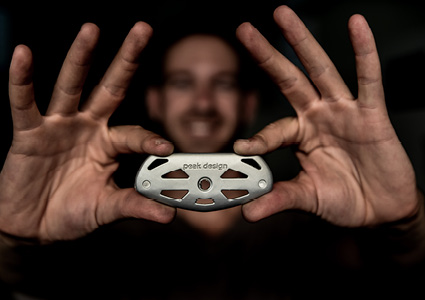
“In 2011, I launched a novel product called the Capture Camera Clip, which is a small metal clip that clamps onto a backpack strap and allows the user to attach a large SLR camera to it securely, keeping their hands free while their camera remains immediately accessible,” Peter begins. “That photography accessory was the beginning of Peak Design. Something that has always been a bit different about our story is that I never pursued outside investors. I used my own capital and a small short-term loan from my parents to fund the prototyping, and then I used Kickstarter as the initial funding mechanism. That pre-order campaign was very successful and even became the second most-funded project on the platform at the time. Practically overnight, I had a profitable company. And in many ways, the story of Peak Design since then has been about applying those same principles and funding techniques again and again. We continued to use Kickstarter for a long time as a cash flow mechanism to fund our next phase of growth. Starting in photography, we expanded into travel, and now broadly cover what I would describe as adventure, with a wide variety of products that sit at the intersection of those three areas.”
Innovation at Peak Design flows from a methodical albeit somewhat unorthodox process, which Peter tells us more about. “There is my personal approach to R&D, and then there is our company approach, and they are probably quite different. Personally, my most productive thinking happens in the in-between moments: while hiking, biking, doing housework or yard maintenance – nothing too complicated. At the company level though, we have become much more structured, writing down design requirements and communicating ideas across the team. Those design requirements have become one of the most important inputs into how we formalize the things we choose to innovate on,” he elaborates.
Two products illustrate what innovation looks like in practice at Peak Design. The first is a single-stage carbon fiber trolley for rolling luggage, a recently launched product that changes how trolley systems work and around which Peak Design holds active patents. “What we have created is simply better than what existed before. What is challenging right now is that our trolley costs us $35 to manufacture, compared to around $8 for an industry-standard equivalent, and that inevitably shows up in the retail price of the finished product. However, I fully expect the luggage industry to work hard to work around those patents and develop their own versions, because that is what innovation does: it moves an entire industry forward,” Peter highlights.
The second example predates Peak Design entirely. In 2008, Peter had the idea for a tripod that closes in on itself to remove all negative space, which fundamentally changed the shape of the product. In that case, Peak Design brought that innovation to market and the rest of the industry followed. “We have our own manufacturer for tripods, one we trained ourselves, but if you walk into other manufacturers today, it smells like Peak Design in there, like they have all gotten the memo. As much as I do not love seeing our ideas replicated, I think it is also a badge of pride and to be expected when you truly innovate,” he adds.
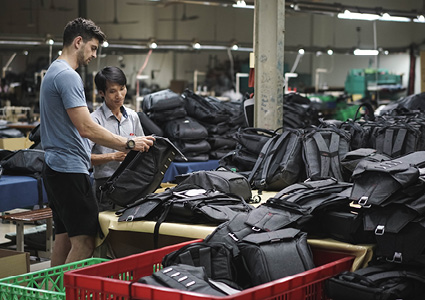
Still, innovation does not come at the expense of ethics at Peak Design, and this is something Peter feels strongly about on a personal as well as a professional level. The company is currently nominating several of its factories for Fair Trade approval, a process that reflects a commitment to ensuring the people making its products are properly looked after. “When I first visited a factory, early in the business, I already had parts on order but had never actually seen an injection molding or die-cast facility in person,” Peter recalls. “But when you go to factories in Asia, you see the reality, and you see families doing repetitive work because of the simple luck, or lack thereof, of where they were born. If you are a business owner and that does not register with you or you do not care about that, I think it shows a real lack of empathy. Fair Trade has emerged as one of the most scalable and credible ways of making working conditions better for factory employees and ensuring they are well cared for, and to me it is a no-brainer. It may cost more and chip away at the bottom line, but it is what our customers expect of us, and more importantly, it is what we expect of ourselves. We would not be comfortable doing it any other way,” he concludes.
Through this approach, Peak Design proves that it is entirely possible to build a profitable business while treating factory workers with the dignity they deserve.