

Photonics innovation enables manufacturing and infrastructure growth as Coherent scales technology, operations, and global capabilities

Manufacturers are adapting as compute demand grows and production systems need greater precision, throughput, and energy efficiency. Data volumes keep rising, and semiconductor processes, display technologies, and energy systems all call for tighter control and repeatability. In today’s environment, photonics has shifted from an enabling function to a core part of the infrastructure. “The rise of AI infrastructure marked an inflection point, moving photonics from a supporting role to a central part of system design,” shares Sanjai Parthasarathi, Chief Marketing Officer at Coherent Corp.
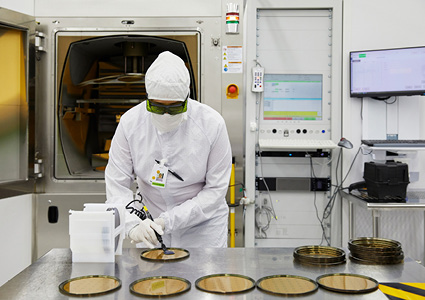
Sanjai brings more than three decades of experience in research, manufacturing, product management, and strategy. He helps the company align market direction with technology development. “We need to identify major market trends early, so what we build aligns with where demand is heading over time,” he notes.
Coherent’s approach connects materials, devices, and systems into a unified portfolio. As Sanjai explains: “We own the key building blocks of photonics, from compound semiconductors and lasers to detectors, silicon photonics, optics, packaging, and systems. That allows us to optimize performance, reliability, and scalability across the value chain while simplifying deployment for customers.”
Founded in 1971 as II‑VI, the company expanded through organic investment and strategic acquisition, including Photop, Oclaro assets, Finisar, and Coherent, Inc., strengthening its capabilities across optical networking and industrial laser technologies. Today, the company operates in more than 20 countries and has over 100 locations.
Integrated innovation
Coherent’s model centers on vertical integration, tying upstream materials to downstream systems. The team develops engineered materials, compound semiconductors, lasers, detectors, and optical modules, then integrates them into platforms for datacenters, communications networks, and manufacturing systems. “That allows us to align performance and system requirements across the value chain,” Sanjai points out.
That alignment matters more as photonics plays a larger role in system architecture, shifting from a supporting function to a central element of system design. Coherent’s portfolio highlights the ongoing transition. In datacenter environments, it develops transceivers, optical circuit switching, and transport technologies to support system scaling. “We see three layers developing: scale-out between racks, scale-up within each rack, and scale-across between datacenters,” Sanjai explains.
The same model extends into customer engagement. Coherent works at both the component and system level, aligning product performance with overall system needs to make deployment simpler for customers. “We can engage at whatever level of integration they require, from components to systems,” he adds.
Manufacturing depth
Coherent holds a strong position in advanced manufacturing, where photonics supports process control and system performance. Its technologies support semiconductor processing, display production, automotive systems, and energy applications. “Photonics is becoming increasingly central to advanced manufacturing. These systems depend on precision, throughput, and energy efficiency,” says Sanjai.
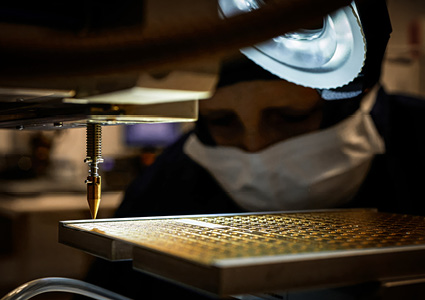
Development aligns with specific application needs. “We focus on higher power for speed and precision, shorter wavelengths for finer features, and shorter pulses to reduce heat while maintaining quality,” Sanjai continues. These directions reflect changes in semiconductor fabrication and display technologies, as smaller geometries and new materials call for tighter process control. “These applications demand extreme precision, high throughput, and reliable, energy-efficient processes,” he adds.
Coherent’s US footprint anchors research, development, and customer collaboration. Sanjai notes that its American presence is critical for advanced R&D, high-value manufacturing, and collaboration with key customers, especially in AI and datacenter ecosystems.
A carefully designed supply chain supports growth. Coherent expanded capacity in key materials such as indium phosphide and maintains multi-site manufacturing with diversified suppliers.
Platforms for growth
Coherent’s trajectory starts with platform technologies that extend across markets. By investing in core materials and device architectures, the company can apply the same building blocks to different applications. “Such an approach allows us to innovate efficiently by investing in core technologies that scale across multiple markets,” Sanjai explains. This platform approach also supports entry into emerging areas. “Over time, areas like fusion and quantum technologies will expand the role of photonics further,” he predicts. “Technologies developed for the industrial market, such as thermal management, are becoming increasingly important in AI datacenters. This ability to translate innovation across verticals is a key differentiator for us,” he adds.
Demand for data infrastructure keeps growing, changing system design in the process. “We already see optical links moving closer to the chip and inside the rack in datacenters,” Sanjai observes. Coherent continues expanding its position to address these demands. “We are growing our role across datacenter and network infrastructure, including co-packaged optics, high-speed transceivers, switching, transport, and thermal solutions,” he adds. The same model extends into manufacturing and energy systems, where expectations for precision and efficiency keep evolving. “This approach allows us to stay closely tuned to each customer segment’s unique needs,” Sanjai explains.
Behind the technology sits an engineering-driven culture. “Cross-disciplinary collaboration spanning physics, materials science, and engineering is central to how we innovate,” Sanjai notes, pointing to continuous learning as a key differentiator.
Across its operations, Coherent’s structure – spanning materials to systems, supported by US capabilities and a global network – remains central to how it sparks innovation and growth in photonics and advanced manufacturing. “Sustaining market leadership takes a combination of long-term strategy, disciplined execution, and the ability to scale manufacturing in line with demand,” Sanjai remarks.
For Sanjai, the bigger picture is clear. “Photonics is becoming foundational to how we live, work, and communicate. Our role is to enable that transition by combining innovation, scale, and a broad technology foundation. Ultimately, it comes down to understanding customer challenges and translating complex technologies into practical solutions that create real impact,” he concludes.
