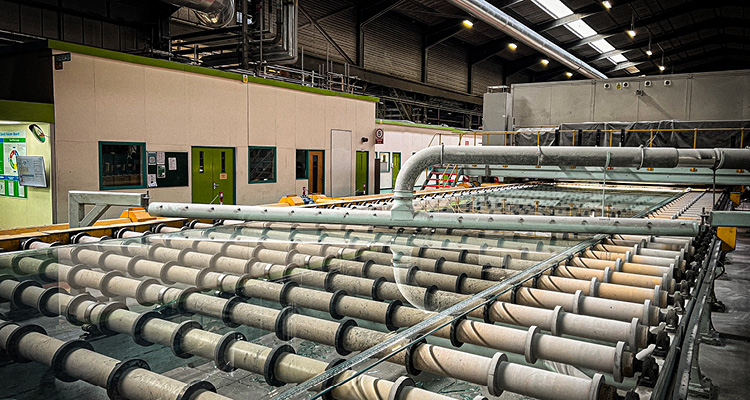
Pilkington United Kingdom Limited, part of the NSG Group, celebrates 200 years while pursuing hydrogen, recycling, and lower-carbon glass manufacturing pathways

Decarbonizing glass production isn’t a straightforward challenge. Furnaces run around the clock, temperatures soar above 1500 degrees Celsius, and the process’s energy demands leave few alternatives as emissions targets get tougher. Yet Pilkington UK has faced moments like this before. Throughout its 200-year history, the company has repeatedly adapted to changes in technology, markets, and customer expectations.
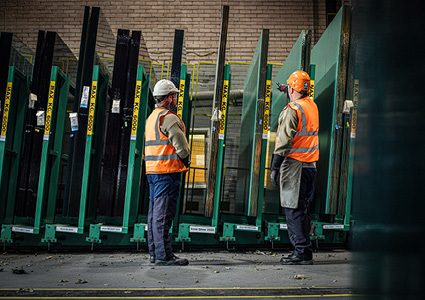
Marking Pilkington UK’s milestone anniversary, it’s once again adapting to market changes. In St Helens, where Pilkington UK developed the float glass process that set the global standard for flat-glass manufacturing, investments in coatings, recycling, hydrogen, and lower-carbon production are shaping the company’s next chapter.
For Neil Syder, Managing Director UK & Ireland, that challenge fits into a broader pattern of change. Neil explains: “Innovation is simply about adapting to change. Nothing stays the same for long. What was profitable ten years ago won’t necessarily be profitable today as markets shift and competition evolves. The key is finding ways to help customers stay ahead, whether through products, services, or knowledge.”
Today, glass is judged not only on cost and appearance, but on performance, embodied carbon, energy efficiency, and recyclability.
Neil’s perspective comes from a career spent inside the business. He joined Pilkington UK straight from school and worked his way up through operational and planning roles. Now, he leads the UK and Ireland business through a new era of investment and industrial change. His role extends across manufacturing, strategy, customer relationships, and the company’s decarbonization agenda, placing him at the center of decisions that will shape Pilkington UK’s future.
Pilkington UK’s history is inseparable from St Helens where the business was founded and many of its defining innovations emerged. “The site was chosen originally because of the raw materials available locally, and over that period it became a real hive of glass manufacturing.”
Pilkington UK’s influence extends far beyond the town. Its most significant contribution transformed how flat glass is made worldwide. “Float glass was successfully developed in St Helens in the 1950s and is now effectively the only way flat glass is produced globally.” That heritage still matters, but history alone doesn’t secure a manufacturer’s future. Pilkington UK is investing heavily in innovation, supported by its parent company NSG Group, and the European Technical Centre in nearby Lathom.
These changes are opening opportunities for new products and applications. Neil notes, “We’re fortunate that a large R&D campus is only ten or 15 miles down the road. Our teams travel globally, bringing back ideas and working hands-on at our sites to make improvements.” The work covers coatings, thermal performance, solar control technologies, and manufacturing processes. “A lot of our new development is heading in that direction. How can we do what we do better for the environment, whether that’s reducing emissions from manufacturing or helping customers reduce carbon through the performance of our products?”
Recent investments show how those ambitions move from concept to reality. One of the biggest is introducing textured-glass production at Greengate Works in the town. Pilkington UK shifted production from its Watson Street operation and integrated it directly into an existing float-glass furnace, an engineering solution few manufacturers would dare to attempt. “We’re probably the only manufacturer to have deliberately cut into the side of a working furnace. With temperatures of 1500 to 1600 degrees Celsius inside, we effectively chain-sawed through the furnace wall to create a new route for the glass.”
This project let Pilkington UK modernize production, cut emissions, and boost efficiency. “In the first year of production, we saved 15,000 metric tons of carbon emissions by moving from the old furnace to the new arrangement.”
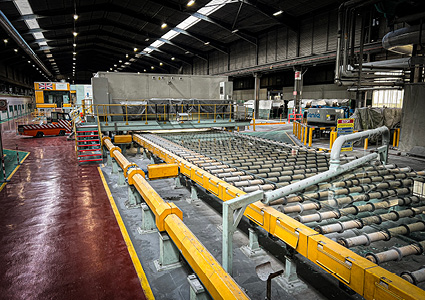
Cowley Hill Works, also in St Helens, is part of a broader strategy to expand coating capabilities. Pilkington UK has produced online coatings at Greengate Works and offline coating at Cowley Hill Works for years, but has recently added a new wet-chemistry process to boost glass performance and help customers meet tougher building standards. “We’re the only manufacturer in the area with both online and offline coating capabilities, and we’re now preparing to add a third coating technology.”
Pilkington UK’s decarbonization efforts go beyond manufacturing to product development. Pilkington Mirai™ grew out of work focused on cutting embodied carbon without sacrificing performance. The result showed what the business can achieve by changing raw materials, energy sources, and production methods. “Pilkington Mirai™ reduces embodied carbon by 52 percent.”
Yet technical achievements must make commercial sense. That realization led to the next product in the range. “Pilkington Mirai Øne™ delivers a 30 percent reduction in embodied carbon at a much more acceptable cost level for the market.”
Alongside lower-carbon products, Pilkington UK is ramping up circular manufacturing by increasing its use of cullet (broken/waste glass). This approach reduces carbon and cuts reliance on virgin raw materials. Still, no initiative has drawn more attention than the company’s work with hydrogen.
Pilkington UK became the first glass manufacturer to run a live float-glass furnace using 100 percent hydrogen fuel, a milestone that opened a new pathway toward lower-carbon glass production. Bringing this technology online wasn’t easy. “Hydrogen is a different fuel with different combustion characteristics. The challenge is ensuring the heat goes where it’s needed, into the glass, without increasing stress on the furnace itself.” Adapting the process meant changes throughout the company’s operations.
“We needed dedicated hydrogen supply lines and new burner arrangements to create the right flame pattern and ensure the furnace operated correctly.” The trial revealed differences the operators hadn’t seen before. “As we increased the hydrogen ratio, you could see less and less flame. By the time we reached 100 percent hydrogen, you couldn’t see the flame at all.”
He adds, “We’re confident in our technology and furnace design to operate on 100 percent hydrogen for long periods.”
For Neil, the success of those trials puts infrastructure availability at the top of the agenda. That’s why Pilkington UK stays closely involved with HyNet in North West England. Glass production limits how quickly manufacturers can move away from traditional fuels. “You can’t produce glass at scale using electricity alone. Electricity can support the process, but large-scale glass manufacturing still depends on an alternative fuel source.”
Hydrogen now sits at the center of Pilkington UK’s future plans. “Hydrogen really suits the North West and our operation.” The location offers advantages that reach beyond Pilkington UK’s own facilities. “It’s well placed because hydrogen storage, carbon capture, and major manufacturing sites are all located along the same corridor. It helps the whole region, not just Pilkington UK.” That regional thinking reflects a broader shift: innovation isn’t just a growth strategy for UK manufacturers anymore – it’s becoming a requirement.
Global competition is fierce, and producers must balance investment with cost pressures. “It’s cheaper to manufacture glass outside the UK, especially when compared to countries like China.” Instead of competing only on price, Pilkington UK focuses on technology, product development, and manufacturing expertise. “We may not always be able to compete in commodity markets, and that’s where innovation becomes essential.”
Focusing on adaptation connects Pilkington UK’s heritage with its future. The float-glass process changed the industry decades ago. Today, investments in coatings, recycling, lower-carbon products, and hydrogen aim to create new advantages for customers.
After more than three decades with the business, Neil sees reinvention as fundamental to Pilkington UK’s future. “We’ve made significant investments in textured glass and our additional offline wet-chemistry process. We need to use those advantages to create new products, new services, and new opportunities for customers.”
Over the next five years, Pilkington UK will focus on extracting value from these investments while advancing manufacturing and product development. “We’re on the right trajectory. We’ve got to keep moving forward with innovation.”
The long-term opportunity goes beyond glass itself and into the role the material can play in a lower-carbon economy. “I’d love to see a future where solar panels are made in the UK, and Pilkington UK supplies the glass from St Helens using hydrogen and recycled cullet. That wouldn’t just create a low-carbon product – it would help generate low-carbon energy. That would be quite an achievement,” Neil concludes.