
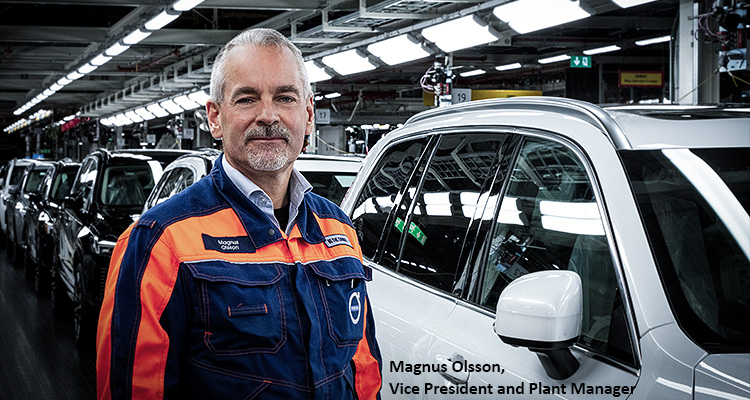
Plant manager Magnus Olsson discusses the transformation of Volvo Cars’ Torslanda plant

When Swedish King Gustaf VI Adolf inaugurated Volvo’s Torslanda plant in 1964, it represented the biggest industrial investment in Swedish history. Sixty years later, the facility remains Volvo’s largest plant, producing 300,000 cars annually with 6500 employees across three shifts. Now it’s undergoing an even more dramatic transformation: a SEK 10 billion investment to become the company’s primary electric vehicle production hub. Starting this spring, Torslanda will anchor Volvo Cars’ fully electric future, as the foundation for manufacturing the next generation of EVs built on the company’s new Scalable Product Architecture 3 (SPA3) platform.
The scale of this investment and project is impressive. “We had four years to prepare and implement a plan of how to continue to manufacture 6000 cars per week in parallel to rebuilding the complete plant,” begins Magnus Olsson, Vice President and Plant Manager at Volvo Car Torslanda. “We started by creating an open space and in that we rebuilt one fourth of the assembly plant – new lines, renovated floor, upgraded roof and so on, and then moved onto the next empty space.”
The transformation introduces new and more sustainable technologies and manufacturing processes into the plant, including the mega casting of aluminum body parts, a new battery assembly plant and fully refurbished paint and final assembly shops.
Mega casting
In fact, Volvo Cars is one of the early adopters of mega casting, and the technology promises to deliver several benefits in terms of sustainability, cost and car performance during the car’s lifetime. The facility uses an 8400-ton Bühler die-casting machine to create a single-piece rear underbody that replaces over 100 parts, accelerates production to a 120-second cycle time and reduces weight. This in turn improves the energy efficiency and thereby the electric range of the car.
Magnus highlights more drivers behind the mega casting investment. “There are considerable landed cost savings with this technology compared to the traditional process. It reduces complexity in the manufacturing process, creates savings in terms of material use and logistics, and reduces the overall environmental footprint across the manufacturing and supply chain networks. It also offers improvements to the product and more design flexibility.”
The new casting process has led to investment in the body shop, as new joining and adhesion methodologies were needed to ensure aluminum parts are properly joined to steel. “We’ve increased our riveting, our laser welding and our friction drilling capabilities, and augmented our laser and plasma treatments,” explains Magnus.
Battery assembly
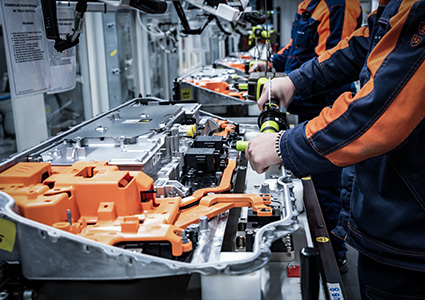
Alongside mega casting, a vital element of the project is a new battery assembly plant. This gigafactory is designed for a potential annual production capacity of 50 gigawatt-hours (GWh), aimed at supplying batteries for approximately half a million electric vehicles per year. “The decision to create our own battery assembly plant was driven from a product perspective,” says Magnus. “To really optimize EV architecture, you must maximize the use of the battery. By manufacturing our own batteries, we’ve been able to integrate the battery cells and modules in the floor structure of the car, so the battery is part of the body. This delivered a lot of product related improvements – the integrated battery improves structural rigidity, we can integrate our crush structure, and we can reduce weight. It also helps optimize the interior space within the car.
“From my perspective as a plant manager, In-sourcing such as this, gaining more control over the battery and battery assembly and being able to pick the best chemistry in the cells and integrate that into the car will be a competitive edge.”
Torslanda’s search for continuous improvement has also involved the adoption of some AI tools. “The two areas that look most promising are in maintenance and quality control. For the former, we are using AI to monitor frequencies and vibrations, so we can predict and foresee equipment breakdowns. We can also use AI to assist our maintenance technicians and engineers. We have set up an AI chat bot system that has access to maintenance manuals, both from suppliers and open source, and our engineers can work with the AI on recommending solutions to problems.”
For quality, Torslanda is using AI to ensure that some critical parts have been mounted correctly in the car. “That is something we’re actively working on,” adds Magnus.
Sustainability
Volvo Car Torslanda already stands as a cornerstone in Volvo’s sustainability efforts – it has been powered by climate-neutral electricity since 2008 and has climate-neutral heating. It became Volvo Cars’ first fully climate-neutral car manufacturing facility in 2021. Given this pedigree, Magnus and his team had to consider the sustainability ramifications of the transformation, ensuring the new paint shop minimized emissions for example, and studying the power requirements for intensive processes such as mega casting. “We are continuously learning about these areas,” he says. “We are looking at the possibility of reusing the heat generated in mega casting or battery assembly, for instance. These are relatively new technologies for us so this is a journey that will take several years.”
People and culture
All Volvo Car Torslanda’s improvements have been designed around a comprehensive vision, created from the ground up to ensure its EV portfolio sets new standards for excellence. However, machines and equipment solutions are only as effective as the people operating them, and Volvo understands to maximize productivity, it must ensure the right internal processes and the right people systems are in place, too.
“We can make all the investments and do all the preparation but without the people, none of it will happen,” Magnus emphasizes. “When we started this journey, we decided to embed some Kaizen principles around continuous improvement. But we recognized that for this to succeed, everyone must work to standard instructions, and this requires a new training plan. We had three shifts in place, and each shift almost had its own culture. A unified culture was needed, so we took staff from each shift, and trained them in the standard principles of Kaizen for four weeks. They then train their own team members.”
Volvo quickly saw positive results. “It’s seldom that I can see improvements in delivery, safety and quality of up to 30 percent – if we reach that number, we call it a ‘breakthrough’. The Kaizen training has resulted in breakthroughs every week, with improvements in all those segments.
“We accept that the true knowledge of the process is with the operators, so we are enabling them to be part of the pilot plant build, making sure that they are driving the efficiency improvements we need.”
Further positives include the breakdown of some of the traditional barriers between desk- and deskless workers with design engineers visiting the production line and seeing their parts produced. It has also helped with the costs of additional staffing for the new facilities – the savings created by the continuous improvements means total spend on staff remains about the same. Recognizing that getting the team involved at all stages results in improvements in production; Volvo Cars encourages all staff to be curious, ask questions, and develop their knowledge. “The best of our people are in the new factories, so we gain from their skills and retain their knowledge for the future as well,” adds Magnus.
Thanks to the approaches adopted at Volvo Car Torslanda, company culture has emerged as a defining factor. People are keen to work at the plant, enabling Volvo to recruit the best candidates and maintain a status of prestige as a prospective employer. “We are breaking down the traditional views of manufacturing, as a male-centric, harsh environment. More than one third of our staff are women and we are keen to build a diverse workforce. If people are open to learning, we will give them every opportunity to develop and it’s fantastic to see the energy in the people who are achieving great things.”
Volvo Car Torslanda’s transformation extends beyond its own operations. As a ‘mother plant’ – Volvo’s term for facilities that pioneer new platforms – it will guide sister plants worldwide through the electric transition. “Our new plant in Slovakia will use SPA3 and benefit from the lessons we’ve learned,” says Magnus. “We send leaders and senior operators to share knowledge, and others come to help us.”
With Torslanda now running both its existing and new platforms, Magnus notes that this offers flexibility around customer demand. “This is great for the plant because we can mix PHEV, mild hybrids and EVs. However, it does come at a cost – from my perspective I would prefer to have one platform, and over time, that is our end target. But at the moment it is great to have this flexibility, and we can adjust depending on how quickly the EU decides to push for EVs.”
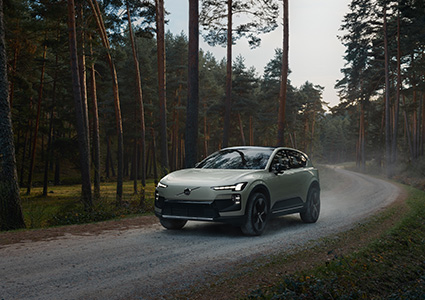
After the years of hard work invested in Volvo Car Torslanda’s upgrades, Magnus and his team celebrated the official launch of the all-electric Volvo EX60 on Jan 21st, 2026. The first car built on SPA3, the Volvo EX60 is a key step in Volvo’s transformation to full electrification. As a ‘born electric’ model, it features exceptionally fast charging capabilities and thanks to the mega casting and battery integration technologies, achieves a class-leading range of up to 810km.
The car features many new innovations, including a world-first and award-winning safety improvement: Volvo Car’s multi-adaptive safety belt. Volvo Cars believes this vehicle, its first entry into the mid-size fully electric segment, ‘turns range anxiety into range comfort and demonstrates that going electric is no longer a compromise’. Håkan Samuelsson, CEO of Volvo Cars, states the EX60 represents ‘a new beginning for Volvo Cars and our customers’.
“The remainder of this year will be dedicated to ramping up activity towards full production and we expect half of the production to be EX60 by the end of 2026,” says Magnus. It’s a fitting milestone for a plant that has spent 60 years at the forefront of automotive manufacturing. The SEK 10 billion transformation hasn’t just modernized Volvo Car Torslanda – it has positioned the facility to lead Volvo’s electric future while preserving the manufacturing excellence that has defined it since 1964. As the automotive industry accelerates toward electrification, Torslanda’s combination of advanced technology and deeply skilled workforce ensures it will remain vital for decades to come.
