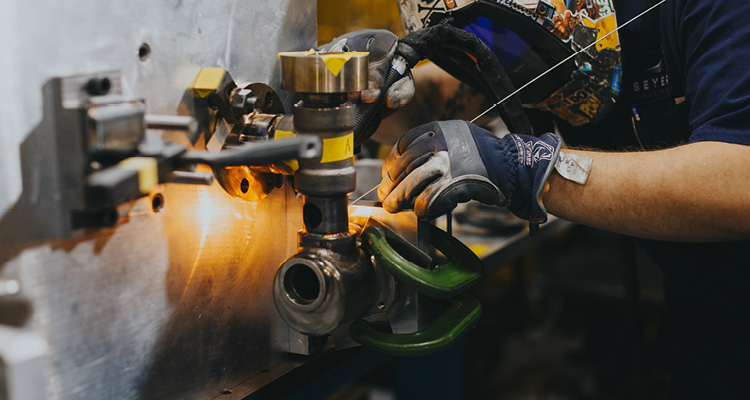
Seyer Industries’ latest investments have enhanced its capabilities and enabled growth in its target markets

Now in its third generation of family ownership, Seyer Industries (Seyer) is an aerospace and defense manufacturer specializing in the production of parts to customer-supplied designs. The company works closely with clients to assess their engineering requirements, price and schedule the work, and manufacture each component to specification. Seyer has extensive in-house CNC machining, welding, assembly and chemical processing capabilities, supporting customers across both the military and commercial sectors. When we last spoke in 2024, Seyer had recently acquired a business in Cuba, Missouri. CEO, Chris Seyer, reflects on how the acquisition has progressed and the opportunities it has created.
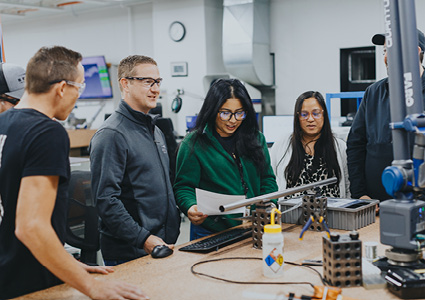
Our main facility is in St. Charles, Missouri, just outside St. Louis, while the company we acquired is in rural Missouri, about an hour and a half away. The acquisition was intended to add capacity quickly. It was a relatively small deal with around 25 people and 20 machines, but the machines were similar to those we already operate, which was part of the attraction, along with the different geographic location. The transition has been smooth, as we retained the vast majority of employees, assuring the new team was aligned with our culture and ultimately migrating them onto our ERP system. All in all, it has been a successful and much needed addition to the business,” he opens.
Understanding that employees are the company’s most valuable resource, every team member at Seyer is trained to the high standard that the aerospace industry demands. Institutional knowledge about aerospace machining is passed down internally from veteran machinists to newer hires. Seyer manages to carry out this process while retaining consistent production. The key is not to introduce too many new employees at once, because experienced machinists can only train so many people at the same time. As a low-volume, high-mix supplier producing development parts that will support future production rates between dozens and hundreds annually of any given part, Seyer’s team may not work on a particular component again for a year or more after making it. That means it can take two or three years for a new employee to encounter the full breadth of what the company produces and to be trained perfectly on every product. Seyer addresses this through a rigorous process with standardized approaches to machine setup, programing, and production that reduce dependence on individual skillset. But at the end of the day, documentation only goes so far. Understanding a product from cradle to grave, which is complicated due to the sheer number of parts and how infrequent the orders may be, takes time and repetition.
As Seyer approaches 70 years in business, preserving its family culture and passing on its knowledge remains central to maintaining the company’s legacy. However, the business has evolved significantly over that time, with one of its most important strategic shifts coming around 2010, when it decided to diversify beyond its original product line.
“Prior to 2010, we were exclusively focused on support equipment, but that segment came with huge annual fluctuations, with revenue swings of 30-to-40 percent from year to year, driven by the lumpy way customers order that type of work. It was always challenging to manage the ups and downs in terms of staffing and capacity,” Chris elaborates. “We recognized that we had all the right capabilities to move into aircraft structures, which is a much larger and more stable segment of the market. Therefore, we decided to enter into long-term production agreements with our customers in that space. The margin is lower, but production is more predictable, which is what we were after. With a stable base of aircraft structure work in place, we could let the support equipment business continue alongside it without its fluctuations defining the whole organization. Support equipment remains a growing part of Seyer, but we needed something in addition to this legacy piece of the business,” he reveals.
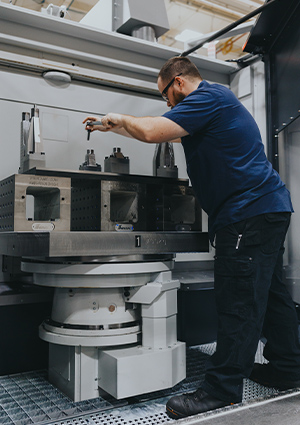
In the year following our last conversation, Seyer has invested over $12 million in manufacturing expansion, including eight new CNC machining centers alongside a combination of facilities and equipment upgrades. Almost everything Seyer purchases in terms of equipment has to include some level of automation, whether that means multi-pallet systems, lights-out machining capability or other features that allow the machines to run with little human attendance. The company is also investing in collaborative robots, or cobots, designed to work side by side with people on repetitive tasks. Together with its apprenticeship program, this approach allows Seyer to grow its workforce and keep up with demand, which is particularly crucial given the current industry-wide workforce challenges.
“Our most significant individual investment has been in a series of large CNC machines from Starrag, a high-end Swiss machine manufacturer, which we use for hard metal machining. We do a lot of work in titanium, Inconel, stainless steel and exotic metals, and these machines allow us to machine parts up to 12 feet long with extreme precision. The accuracy of these machines is outstanding, and in our world, it is difficult to find suppliers who can do large, high-precision hard metal parts at that level. The total investment is over $5 million per machine once you factor in the infrastructure around them. This capital investment is on top of the additional machines we have bought for capacity growth more broadly,” Chris adds.
That investment was well-timed, given that about a year ago, Seyer began working with SpaceX. “It is a new and significant relationship for us,” Chris states. “SpaceX has a high demand for large hard metal parts, which is exactly what the new Starrag machines enable us to produce. They have a very aggressive production ramp-up forecast over the next five years, and we are in the process of working out how to best support this project, which represents a new market for us,” he concludes.
Seyer’s impressive seven-decade legacy is marked by a dedication to making complex, precision parts for the most demanding customers in aerospace and defense to an exacting standard. The decision to diversify into aircraft structures in 2010 gave the business the stability to invest confidently, and those investments are now opening doors to exciting contracts. Starting work with SpaceX while simultaneously expanding capacity and capability shows the company has no intention of slowing down.